
Storm Damage Roof Inspection NJ: The First 48 Hours (2026 Playbook)
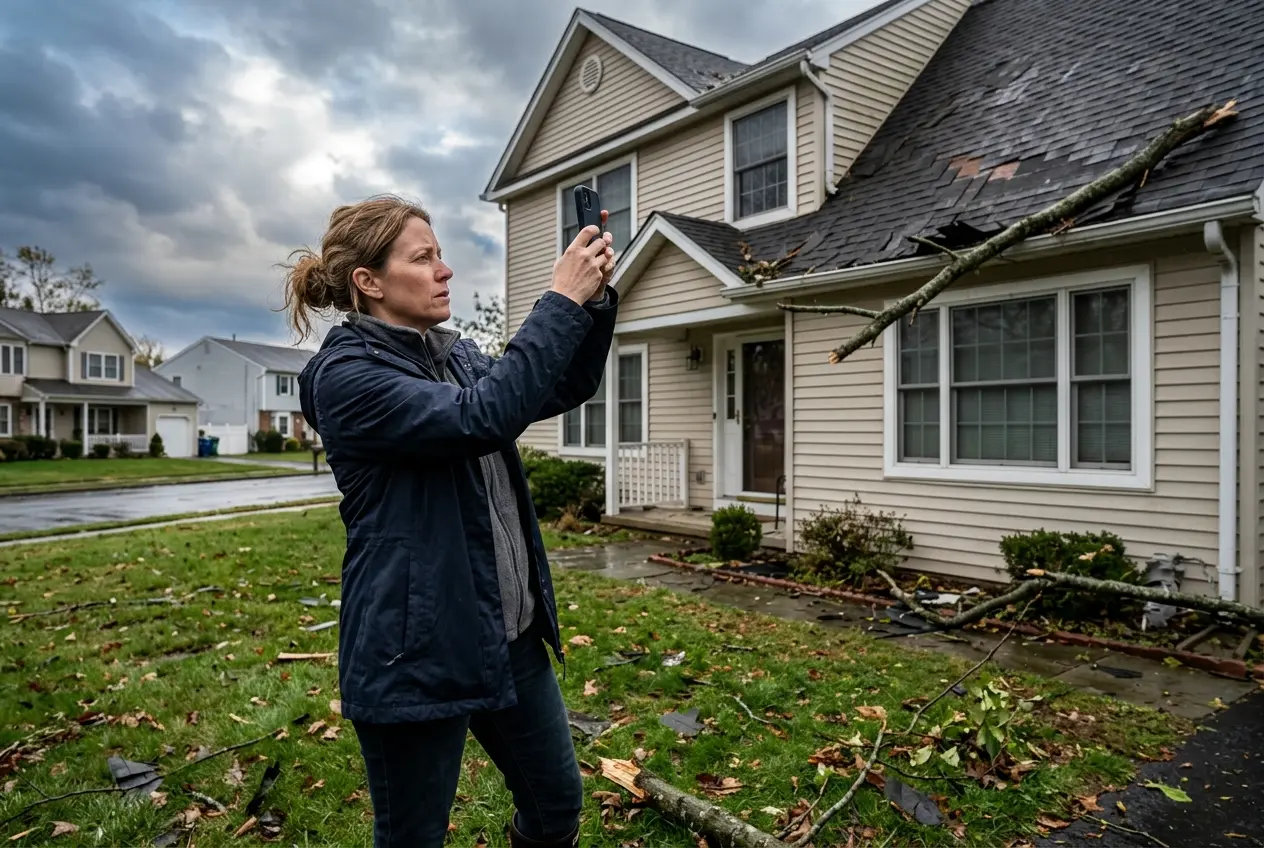
After a major storm, a storm damage roof inspection NJ follows one order: stay off the roof, document visible damage with date-stamped ground photos within 24 hours, check the attic for fresh water stains or daylight, call a licensed NJ contractor for a written inspection, file your insurance claim inside the policy notice window (commonly 30 to 60 days), and authorize emergency tarping if there is active exposure. The playbook below walks through each step.
It is 6:30 in the morning. Last night’s storm knocked out power for three hours, rattled every window in the house, and left branches across your driveway. You are standing in your kitchen with coffee, looking at the ceiling. No stain. No drip. But you heard something hit the roof around 11 PM, and the wind was loud enough that you still do not know what it was.
That uncertainty (not the obvious ceiling collapse, but the quiet “did something happen up there?”) is the situation most NJ homeowners face after a significant storm. And it is the situation where the next 48 hours matter most.
Here is what to do.
What Makes NJ Storm Damage Different
New Jersey produces three distinct storm patterns, each with its own damage profile and each affecting different parts of the three-county service area.
Nor’easters generate sustained winds of 50 to 70 mph for 12 to 36 hours. They do not just peak and quit. Prolonged exposure at that wind speed fatigues shingle adhesive, lifts tab edges, and works flashing loose at ridges and valleys. Nor’easters also carry driven rain that finds any compromised seam. Coastal towns (Long Branch, Point Pleasant, Asbury Park) take the worst of it.
Summer thunderstorms develop fast and produce hail (commonly 0.75 to 1.25 inch, sometimes larger) along with short-duration wind gusts of 60 to 80 mph. A 20-minute summer storm can strip granules across an entire roof slope without blowing a single shingle off. The damage is real; it just is not always visible. Research from the Insurance Institute for Business & Home Safety shows hail can fracture the shingle mat below the surface even when the roof looks intact from the street. The central NJ summer hail corridor crosses Freehold, western Howell, and parts of Marlboro.
Late-season storms (October to November) are the most damaging because they combine both: nor’easter wind duration with hail and rain. They hit roofs already stressed by a summer of UV exposure and thermal cycling.
Sandy-era special case. Hurricane Sandy made landfall in October 2012. Emergency repairs done 2012 to 2014 on coastal Ocean County and Monmouth County homes are now 12 to 14 years old. Any post-storm inspection on a Sandy-era home should specifically check whether the prior emergency work was done correctly, whether deck damage from Sandy was fully replaced or just covered over, and whether ice and water shield was properly lapped at all penetrations.
Knowing which type hit your neighborhood matters. A pure nor’easter calls for an inspection focused on lifted flashing and ridge cap displacement. A summer hail event means granule loss and impact bruising across the field of the roof, damage that often looks fine from the ground. You can look up the wind and hail reports for your area through the National Weather Service office that covers New Jersey.
Damage You Can See vs Damage You Cannot
Most storm damage is not obvious from the street. This table separates what you can assess yourself from what requires a professional on the roof.
| Visible from the ground | Requires professional inspection |
|---|---|
| Shingles on the ground or in the yard | Granule loss across the roof field (not visible without close inspection) |
| Displaced or missing ridge cap shingles | Hail impact bruising on individual shingles |
| Lifted or buckled shingle sections | Cracked or fractured shingle tabs |
| Visible damage to gutters, downspouts, fascia | Flashing separation at chimneys, walls, and skylights |
| Dents on metal surfaces (AC unit, gutters) | Underlayment exposure at compromised seams |
| Fallen branches or debris on the roof surface | Deck damage or soft spots under the sheathing |
| A gutter full of granules after a hail event | Pipe boot and penetration seal failures |
| Active interior water staining or drips | Attic water infiltration at the rafter or insulation level |
Visible damage is the starting point. It almost always signals that hidden damage is also present, and the hidden damage is what drives long-term leaks.
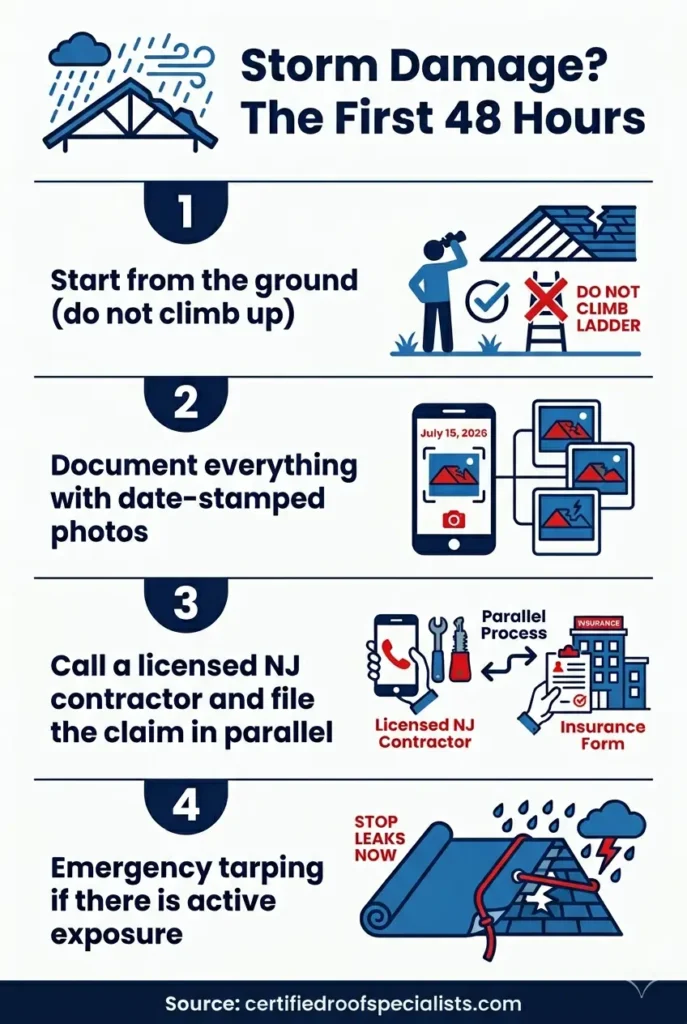
Step 1: Start From the Ground. Do Not Go Up.
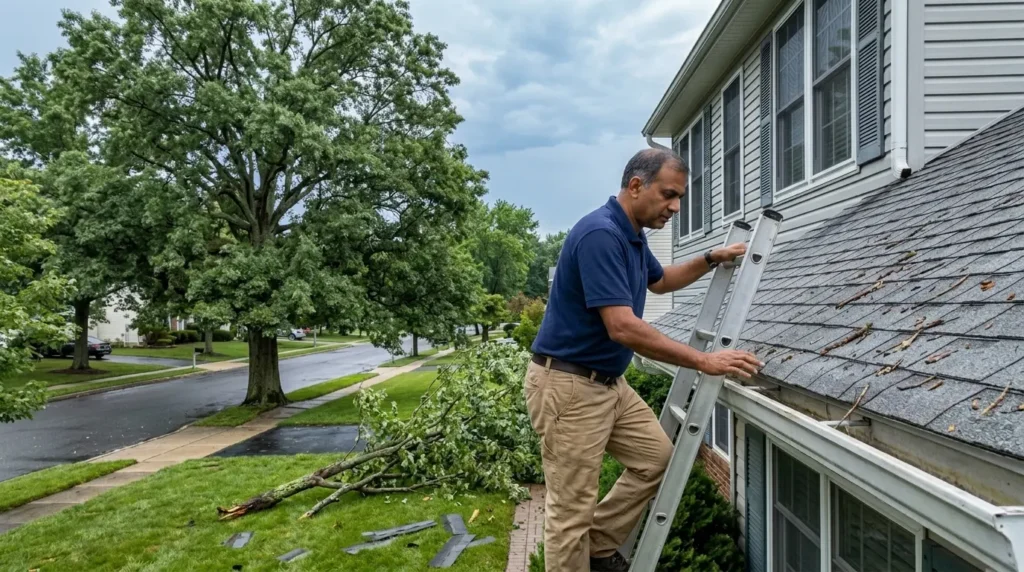
Do not go on your roof immediately after a storm. Wet shingles are slippery. Storm damage can leave structural soft spots that are not visible until weight is applied. Leave the roof-level assessment to a professional.
From the ground or from a ladder at the eave line, work through the visible column of the table above. You are building a picture, not performing an inspection.
Check your attic within 24 hours. Bring a flashlight. Look for fresh water stains on rafters and sheathing (darker, possibly still damp), daylight visible through roof boards, compressed or discolored insulation, and any active dripping. A wet attic after a storm means water is already inside. Document it with photos before anything dries.
Step 2: Document Everything Before Anyone Touches the Roof
If you think a claim is possible, photograph the damage before any repairs or cleanup happen. Capture:
- Date-stamped photos from the ground at multiple angles, with the full roof visible
- Close-ups of any visible damage: missing shingles, gutters, fascia
- Attic photos showing any infiltration
- Metal-surface dents on gutters, downspouts, and the AC unit casing
- The date and time on your phone in at least one photo from each area
- The address visible in one or two frames (mailbox, house number)
Send the photos to yourself by email or text immediately. This creates a timestamp that is independent of your phone’s metadata. These images are the foundation of your claim.
Step 3: Call a Licensed NJ Contractor and File the Claim in Parallel
This is the step most NJ homeowners get backwards. The right move is to do both on the same day.
File the claim with your insurer to start the policy notice clock. Most NJ homeowners policies require timely notice of a loss (commonly within 30 to 60 days). Filing late gives the insurer grounds to deny on a notice violation.
Call a licensed NJ contractor for a written inspection so you have an independent, professional scope of damage before the adjuster arrives. That report documents every finding with photos, specific damage descriptions, and a scope of necessary work. You present it to the adjuster as a reference. Any discrepancy between what the adjuster finds and what your contractor documented becomes a discussion, one you are equipped to have.
Certified Roofing Specialists Inc. does not file, negotiate, or settle insurance claims on your behalf. That stays the homeowner’s role. What CRS provides is the documentation: a thorough written inspection your insurer can work from.
What a qualified post-storm inspection produces:
- A condition assessment across all roof sections, not just the visible damage
- Documented evidence of hail impact or wind damage with photos
- Flashing and penetration inspection results
- Attic findings, if accessible
- A written report with itemized findings you provide to your insurer
Your insurer’s adjuster works for your insurer. A licensed contractor works for you. If you want to understand your rights as a policyholder, the NJ Department of Banking and Insurance publishes consumer guidance on homeowners claims.
Step 4: Temporary Protection If Needed
If there is active exposure (missing shingles, a section of lifted or damaged decking), a licensed contractor can apply emergency tarping or sealing while you wait for the full repair or replacement to be scheduled.
This matters for two reasons. First, it limits additional water damage from the next rain event. Second, most homeowner policies require you to take reasonable steps to prevent further damage after a covered event. Emergency mitigation demonstrates you did that. Keep all receipts; most policies reimburse emergency mitigation costs.
CRS carries roofing tarps and offers same-day emergency tarp service for qualifying situations across Monmouth, Ocean, Middlesex, Somerset, and Union Counties. Tarp service is quoted separately from the repair or replacement; the free inspection covers the diagnosis. See our roof repair and emergency services.
Town-Specific Post-Storm Patterns
CRS sees consistent storm-damage patterns by area. Use this as a self-diagnosis aid before the inspection.
- Coastal Atlantic (Long Branch, Asbury Park, Point Pleasant, Sea Girt): nor’easter wind uplift on shingles at the eaves and rakes, copper-flashing corrosion exposed by lifted ridge caps, and salt-driven rain finding any unsealed step flashing.
- Barrier-island and bayfront Ocean County (Toms River Silverton lagoons, Brick Shore Acres, Cherry Quay): wind uplift plus salt-spray accelerated flashing failure. Sandy-era patch repairs often fail at this stage.
- Central NJ hail corridor (Freehold, western Howell, parts of Marlboro): hail bruising across south and west-facing slopes, with granule accumulation in gutters and downspouts. Often invisible from the ground but documented during a professional inspection.
- Suburban inland (Edison, Woodbridge, Old Bridge, inland Hazlet): tree-strike damage and debris loading, branch impact on ridge caps and skylight curbs, and pipe boots cracked by impact debris.
- High-value complex rooflines (Holmdel, Colts Neck, Rumson): multiple-valley flashing displacement, copper-flashing solder joint stress, and cricket flashings at chimneys lifted by sustained wind.
What Not to Do in the First 48 Hours
- Do not go on the roof yourself. Storm-damaged roofs are dangerous. You are not equipped to assess what you would find, and the risk of injury is not worth it.
- Do not wait. Water damage compounds fast. A compromised section that takes an inch of rain on Monday is worse by Friday. Most policies also have prompt-reporting requirements in the fine print.
- Do not make permanent repairs before the adjuster documents the damage. Emergency tarping is fine and appropriate. Permanent shingle replacement before the adjuster visits removes evidence of what the storm actually caused.
- Do not assume no visible damage means nothing happened. Hail damage, granule loss, and flashing failures rarely show up from street level. A professional inspection after any significant storm is the only way to know what you are dealing with.
- Do not assume visible damage means a full replacement. A professional assessment tells you what actually occurred and what it will cost to address. The right answer may be a targeted repair, not a full roof.
- Do not hire storm chasers. After major events, unfamiliar out-of-state contractors knock doors offering quick replacements, then leave the state when the work is done, taking the warranty with them. Verifying NJ HIC registration at njconsumeraffairs.gov takes 30 seconds.
- Do not accept a deductible waiver. It is illegal under New Jersey law for a contractor to absorb, rebate, or “eat” your insurance deductible. A contractor offering this is operating outside the rules and can expose you to an insurance-fraud problem.
Storm hit your roof?
A licensed CRS roofer inspects every section, documents each finding with photos, and delivers a written report you can hand to your insurer.
How CRS Handles Storm Damage Roof Inspection NJ Calls
Certified Roofing Specialists Inc. responds to storm damage calls across Monmouth, Ocean, and Middlesex Counties. A licensed roofer gets on the roof, documents every finding, and delivers a written report the same day or next day. If the damage supports an insurance claim, the report gives your insurer a professional scope to work from. If it does not, you will know exactly what you are dealing with and what it costs to fix.
After repairs, a CRS Protection Plan keeps your roof monitored with annual inspections and priority scheduling after future storms, so the next nor’easter does not start a 48-hour scramble.
Roof repair and emergency service · 8 signs you need a new roof · Repair vs replacement · How long a roof lasts in NJ · Choosing a contractor · Toms River · Freehold · Edison
Last updated July 1, 2026. Written by the Certified Roofing Specialists Inc. team, licensed New Jersey roofing contractors serving Middletown, Toms River, Edison, Freehold, Marlboro, Long Branch, Old Bridge, and every other town across Monmouth, Ocean, Middlesex, Somerset, and Union Counties.
Frequently asked questions
Should I call my insurer or a roofer first after storm damage?
Do both in parallel on the same day. File the claim with your insurer to start the policy notice clock, and call a licensed NJ contractor for a written inspection so you have an independent scope of damage before the adjuster arrives. Your contractor’s written report is the documentation that supports a supplemental claim if the adjuster’s scope misses damage.
What types of NJ storms cause the most roof damage?
Nor’easters (50 to 70 mph wind for 12 to 36 hours) lift flashing and ridge caps, mostly along coastal Ocean and Monmouth Counties. Summer thunderstorms bring hail (commonly 0.75 to 1.25 inch, larger stones breaking the granule bond) and 60 to 80 mph gusts across the central NJ hail corridor through Freehold, western Howell, and Marlboro. Late-season storms combine both.
How long do I have to file a storm damage roof insurance claim in NJ?
Most NJ homeowners policies require prompt notice of a loss, commonly within 30 to 60 days, but the exact window is written into your policy. File as soon as you have documented the damage. Filing late gives the insurer grounds to deny the claim on a notice violation, so do not wait for repairs to start the claim.
-

How NJ HOAs and Condos Budget a Roof Replacement: The 2026 Reserve Study Guide
How NJ HOAs budget for roof replacement comes down to the reserve study: it estimates each roof’s remaining…
-
How to Prepare for a Roof Replacement in NJ: The 2026 Pre-Construction Checklist
Knowing how to prepare for a roof replacement NJ homeowners can act on comes down to a short…
-
How to Choose a NJ Roofing Contractor: 7 Intelligent Questions to Ask in 2026
How to choose a NJ roofing contractor with confidence: verify the contractor’s New Jersey Home Improvement Contractor (HIC)…