How Long Does a Roof Last in NJ? 2026 Material-by-Material Lifespan Guide
How long does a roof last NJ? It depends almost entirely on the material. Architectural asphalt shingles, the New Jersey residential default, last 22 to 28 years. 3-tab shingles last 12 to 18 years. Impact-resistant Class 4 shingles last 25 to 35 years. Metal roofing lasts 40 to 60 years. Slate lasts 75 to 150 years. New Jersey’s freeze-thaw, humidity, hail, and salt air all shorten the upper end of every range versus drier climates.
A roof installed in New Jersey will not last as long as the same roof installed in Arizona. That is not a sales pitch. It is climate.
New Jersey gets roughly 47 inches of rain per year, 8 to 12 freeze-thaw cycles every winter, regular summer hail, nor’easters with 60-plus mph gusts, and summer humidity that promotes algae growth and stresses asphalt. Each of those forces removes years from a roof’s serviceable life. Understanding them is how you plan and budget realistically instead of being surprised by a leak.
How Long Does a Roof Last NJ by Material (2026 Field Data)
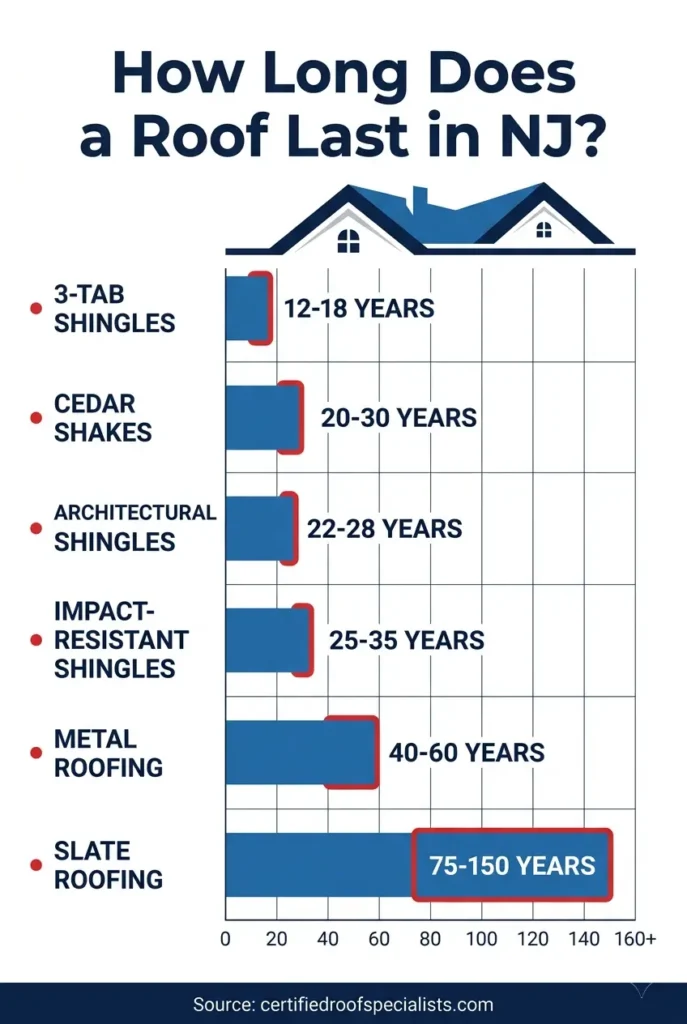
| Material | Expected lifespan (NJ) | Notes |
|---|---|---|
| 3-tab asphalt shingles | 12 to 18 years | Thin, single-layer; poor wind and impact performance. Phasing out of the NJ market. |
| Architectural shingles | 22 to 28 years | Laminated, better wind resistance; the NJ residential standard. |
| Impact-resistant shingles | 25 to 35 years | Class 4 UL 2218 rating; best for coastal Ocean County and central NJ hail-corridor towns. |
| Metal (standing seam) | 40 to 60 years | Excellent NJ performance; significantly higher upfront cost. Common on Holmdel and Rumson custom homes. |
| Cedar shake | 20 to 30 years (with maintenance) | Requires regular treatment; high-humidity NJ areas shorten the range. Common on older Red Bank and Long Branch West End homes. |
| Slate | 75 to 150 years | Exceptional longevity; expensive and requires an experienced installer. Original slate still serves Keyport and Red Bank historic-district Victorians. |
| Modified bitumen (flat) | 15 to 20 years | The standard for low-slope sections in 55-plus communities such as Crestwood Village and Greenbriar I and II. |
| TPO (heat-welded, flat) | 20 to 30 years | Better long-term value than mod-bit on newer construction; cold-adhesive TPO fails fast in NJ freeze-thaw. |
Most NJ homes have architectural shingles. That 22-to-28-year range assumes proper installation, adequate attic ventilation, and prompt repair of flashing failures. Poor ventilation or neglected minor repairs can cut it to 15 to 18 years. If you are choosing a new roof now, our guide to the best roofing shingles for NJ weather walks through how each product holds up in this climate.
What Shortens a Roof’s Life in NJ
Freeze-thaw cycles
Water expands when it freezes. Any crack in a shingle, separation at a flashing joint, or gap around a pipe boot collects water. That water freezes in winter, expands the gap, thaws in spring, and lets in more water. After several cycles, what was a minor issue becomes a structural one. New Jersey averages 8 to 12 freeze-thaw cycles per winter, with more in the northern counties. The National Weather Service office serving New Jersey tracks the freeze and thaw swings that drive this damage.
Hail impact
Parts of NJ see multiple hail events in an active summer, with stones commonly in the 0.75 to 1.25 inch range. Hail around an inch causes cosmetic damage; larger hail breaks granule bond and reduces shingle life by years. Hail does not always punch through shingles visibly. More often it knocks granules loose, leaving exposed asphalt that degrades under UV light. A roof that took a significant hail hit at year 10 may behave like a 15-year-old roof by year 12. Damage of this kind requires professional assessment to identify. The central NJ summer hail corridor crosses Freehold, western Howell, and parts of Marlboro; inland Middlesex County sees less hail, and barrier-island Ocean County sees less hail but more wind.
Inadequate attic ventilation
A poorly ventilated attic traps heat in summer. Surface temperatures on a dark asphalt shingle roof can exceed 150 degrees Fahrenheit on a hot NJ day. That sustained heat accelerates the breakdown of the asphalt binder, so shingles crack and lose adhesion faster. In winter, warm attic air hits the underside of cold roof decking and creates condensation, leading to mold, rot, and compromised insulation. Attic ventilation, with intake at the soffits and exhaust at the ridge, is not optional for roof longevity; it is structural maintenance. The code minimum is 1 sq ft of net free area per 150 sq ft of attic floor (or 1:300 with balanced intake and exhaust). Energy Star’s attic sealing and ventilation guidance explains why balanced airflow matters.
Salt air
Within two miles of the Atlantic, salt accelerates granule degradation and corrodes galvanized flashing significantly faster than inland. A coastal Long Branch or Point Pleasant roof installed in 2003 may behave like a 27-year-old inland roof by year 22. Copper flashing is the CRS default within two miles of the ocean; G-90 galvanized is the inland minimum, because G-60 is insufficient here.
Installation quality
The best shingles installed incorrectly will not reach their rated lifespan. Common errors that shorten roof life include improper nailing (too high, too few, or overdriven nails), inadequate ice and water shield at eaves, valleys, and penetrations, and improper flashing at chimneys, skylights, and wall intersections. A proper NJ installation includes synthetic underlayment, full ice and water shield at vulnerable areas, drip edge at eaves and rakes, and correctly flashed and counter-flashed penetrations. Those are not upgrades. They are the minimum for a roof that will last its rated lifespan in this climate.
Post-Sandy emergency repairs (coastal Ocean County)
Hurricane Sandy emergency repairs from 2012 to 2014 were not full replacements. They were emergency patches done under insurance and weather deadlines, often with under-spec fasteners, single-layer underlayment where doubled was needed, and decking that was never fully inspected. Those repairs are now 12 to 14 years old and well past their intended life. If your coastal Ocean County home has not had a full assessment since Sandy, that assessment is overdue regardless of how the roof looks from the street.
Not sure where your roof sits in its lifespan?
A free CRS inspection gives you a written condition report with ratings, specific findings, and an honest estimate of your remaining roof life, so you can plan instead of guess.
What Extends a Roof’s Life in NJ
How Long Does a Roof Last NJ With Good Maintenance?
Short answer: with the five habits below, an architectural shingle roof reliably reaches the top of its 22-to-28-year range, and a qualifying roof can be pushed a little past it with restoration. Neglect does the opposite, knocking years off a roof that was otherwise installed correctly.
Annual inspections. Most roofing problems start small. Catching a failing pipe boot seal or lifting chimney flashing before it allows sustained water infiltration is the difference between a $400 repair and a $4,000 decking replacement. Inspect every one to two years, and after any significant storm.
Prompt flashing repairs. Flashing at chimneys, skylights, dormers, and wall intersections fails before the shingles do. Most NJ roof leaks start at flashing, not the shingle field. Addressing it when it fails, before the ceiling stains, keeps a repair from becoming a structural problem.
Gutter maintenance. Clogged gutters force water back under the shingles at the eaves. Keep gutters clear and make sure downspouts discharge well away from the foundation.
Restoration coating on qualifying roofs. Bio-based oil treatments (the Roof Maxx category) restore asphalt flexibility on roofs that qualify: 10 to 18 years old, 70-plus percent granule coverage, sound deck, and no active leaks. They add roughly 5 years per application and can be applied up to three times, at roughly $1,500 to $4,000 versus $9,000 to $32,000 for replacement. Honest candidate framing matters: not every roof qualifies, and CRS will tell you when yours does not. Learn about roof restoration.
A protection plan. Annual inspections, minor repair credits, and written condition reports catch issues before they escalate. For a roof that is 10 to 15 years into its life, systematic maintenance is the most effective way to reach the upper end of its expected lifespan. See CRS Protection Plans.
When to Start Planning for Replacement
The right time to think about replacement is before you need it urgently. A 15-year-old architectural shingle roof in NJ has used roughly 60 to 70 percent of its expected life. That is the moment to get a professional assessment and understand your remaining timeline, so you can budget, plan, and schedule on your terms rather than after a storm forces the decision. Knowing the signs you need a new roof helps you read your own roof between inspections.
An emergency replacement after a major storm costs more and can mean substandard materials or rushed work during peak demand. NJ contractor availability typically runs four to six weeks in October and four to eight weeks in spring; emergency replacements compress both that window and your material choices.
Signs you need a new roof in NJ · Best NJ roofing shingles for 2026 · CRS Protection Plans · Roof restoration · Find your CRS town
National Weather Service (NJ region) · Energy Star: attic sealing and ventilation · GAF shingle products · Insurance Institute for Business and Home Safety
Last updated June 24, 2026. Written by the Certified Roofing Specialists Inc. team, licensed New Jersey roofing contractors serving Monmouth, Ocean, Middlesex, Somerset, and Union Counties. Lifespan ranges reflect NJ field conditions and assume professional installation; your roof’s remaining life depends on material, ventilation, and maintenance history.
Frequently asked questions
What shortens a roof's life in NJ?
8 to 12 freeze-thaw cycles per winter that expand every micro-crack, summer hail that breaks granule bond, inadequate attic ventilation that bakes shingles at 150 degrees F or higher, salt air within two miles of the Atlantic that corrodes flashing significantly faster than inland, and installation defects such as improper nailing, missed ice and water shield, and failed flashing.
How do I extend the life of my NJ roof?
Annual inspections, prompt flashing repairs (most NJ leaks start at flashing, not the shingle field), keep gutters clear, and verify attic ventilation meets the 1-to-150 net-free-area ratio. A CRS Protection Plan packages all of this with member discounts and priority storm response. Restoration coating can add roughly 5 years per application on qualifying roofs.
How long does an architectural shingle roof last in NJ?
Architectural shingles last 22 to 28 years in NJ with proper installation and adequate attic ventilation. Coastal homes within two miles of the Atlantic run toward the lower end of the range, 22 to 25 years, because of salt-air acceleration. Inland homes with good ventilation and prompt repair routinely reach 28 years.
Is a 20-year-old roof in NJ at the end of its life?
A 20-year-old architectural shingle roof in NJ has consumed 70 to 90 percent of its expected life. Plan for an inspection now and a likely replacement within 2 to 8 years. A 20-year-old 3-tab roof is past its useful life, and replacement should be on the immediate schedule.
Can I make my NJ roof last 30+ years?
Architectural shingles can reach 28 to 30 years with annual inspections, prompt flashing repair, adequate attic ventilation, and timely restoration coating on qualifying roofs. Impact-resistant Class 4 shingles routinely reach 30 to 35 years. Metal and slate exceed 40 years easily.
-

How NJ HOAs and Condos Budget a Roof Replacement: The 2026 Reserve Study Guide
How NJ HOAs budget for roof replacement comes down to the reserve study: it estimates each roof’s remaining…
-
How to Prepare for a Roof Replacement in NJ: The 2026 Pre-Construction Checklist
Knowing how to prepare for a roof replacement NJ homeowners can act on comes down to a short…
-
Storm Damage Roof Inspection NJ: The First 48 Hours (2026 Playbook)
After a major storm, a storm damage roof inspection NJ follows one order: stay off the roof, document…