Best Roofing Shingles for NJ Weather: 2026 Comparison
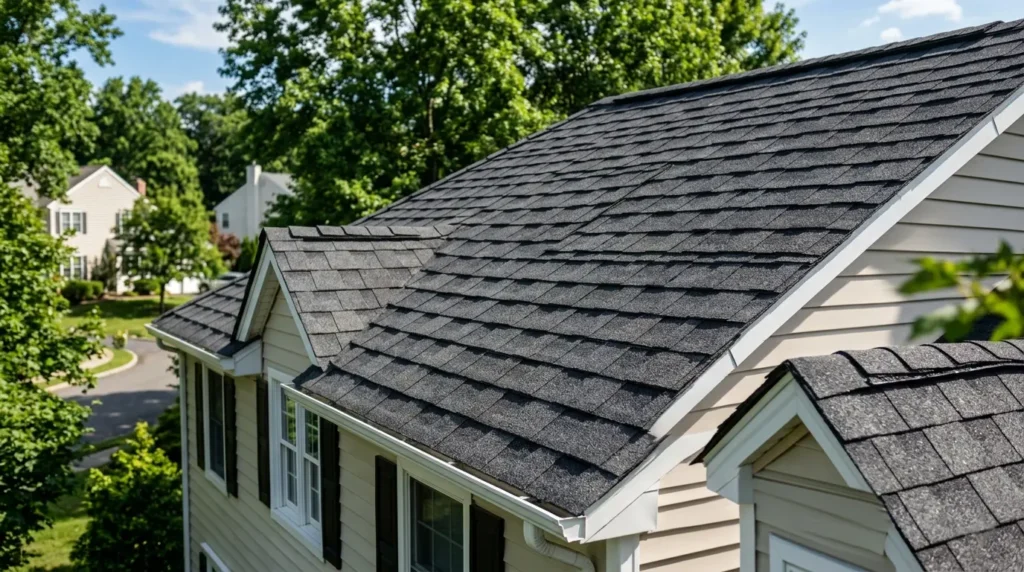
The best roofing shingles NJ homeowners can install in 2026 are architectural asphalt shingles. GAF Timberline HDZ (130 mph wind rating, StainGuard Plus algae resistance) and CertainTeed Landmark (110 mph standard, transferable SureStart Plus warranty) are the two most-specified lines. For coastal Ocean County and shore-adjacent Monmouth homes, prioritize the 130 mph wind rating and salt-rated systems.
This guide focuses on product recommendations by weather exposure. The three shingle categories (3-tab, architectural, and impact-rated) are compared in the sections below.
What NJ Weather Actually Does to Shingles
New Jersey does not give roofs an easy life. Before picking a product, it helps to understand what is working against your roof:
- 47-plus inches of rain per year. One of the wettest states on the East Coast. Shingles need to shed water cleanly for decades without cracking or lifting.
- 8 to 12 freeze-thaw cycles per winter. Water expands when it freezes. Any crack, lifted seam, or damaged flashing becomes a larger problem with every cycle.
- several significant hail events a year. One-inch hail causes cosmetic damage; larger hail breaks granule bond and reduces shingle life by years. The central NJ hail corridor crosses Freehold and western Howell.
- High humidity and heat. Summer heat softens asphalt, and shingles near valleys and penetrations expand and shift. Algae growth is common in humid, shaded areas (Edison, Robertsville, Marlboro tree-canopy sections).
- Nor’easter wind. Nor’easters regularly hit 50 to 70 mph gusts on coastal Ocean and Monmouth Counties. High wind ratings hold at the edges and tabs where standard shingles fail first.
- Salt air. Within two miles of the Atlantic, salt accelerates granule degradation and corrodes galvanized flashing significantly faster than inland. Long Branch, Point Pleasant, and Asbury Park homes need salt-rated systems.
The Three Shingle Types You Will Encounter
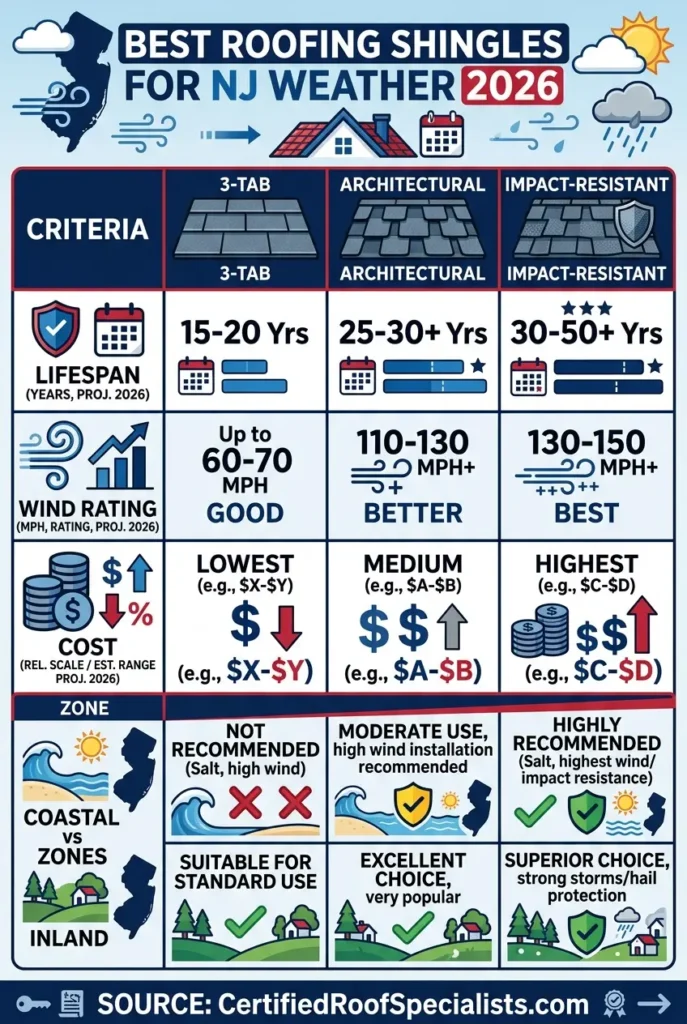
3-tab shingles
The standard flat shingle. Three uniform cutouts along the bottom edge give each shingle its shape.
- Lifespan: 15 to 20 years in NJ conditions
- Wind resistance: typically 60 to 70 mph, marginal for coastal NJ
- Cost: lowest upfront cost
Honest assessment: three-tab is the budget option, and for most NJ homeowners replacing a roof today it is the wrong choice. The lifespan is short for the investment, wind resistance is inadequate for our weather, and warranty coverage is limited. The only reasonable case is a homeowner selling within a few years who needs the minimum functional roof at the lowest cost.
Architectural shingles (dimensional)
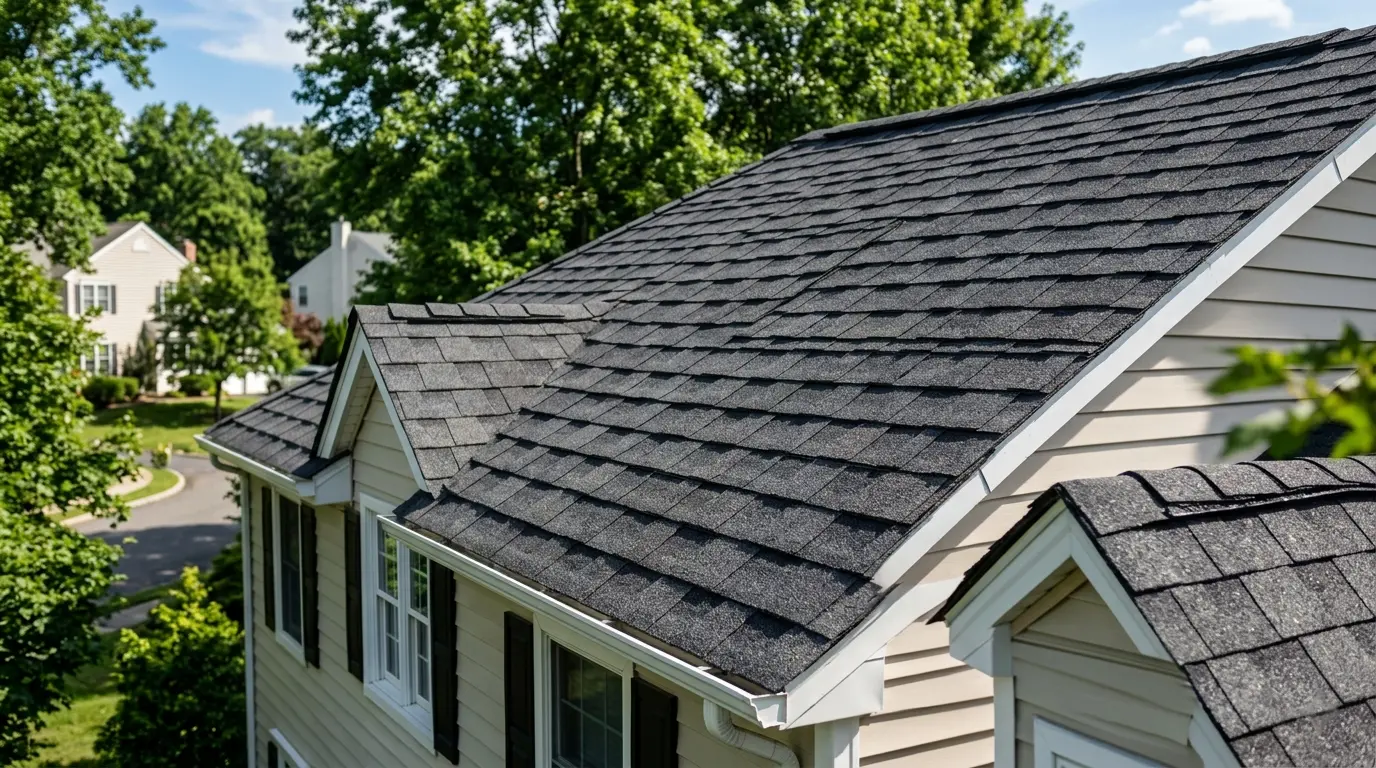
The current standard for residential roofing in New Jersey. Architectural shingles are laminated (two bonded layers), which gives them more mass, better weather resistance, and a dimensional look that reads like wood shake or slate from the street.
- Lifespan: 25 to 30 years in NJ conditions
- Wind resistance: 110 to 130 mph on premium lines
- Cost: $1.50 to $2.50 per square foot more than three-tab, and a much better value over the life of the roof
GAF, CertainTeed, and Owens Corning all make quality architectural shingles, and the differences between their flagship products are small. What matters more is which line you choose within the category.
| Product | Wind rating | Algae resistance | Warranty notes |
|---|---|---|---|
| GAF Timberline HDZ | 130 mph | StainGuard Plus (deep treatment) | System Plus available with a certified contractor; Golden Pledge with the top tier |
| CertainTeed Landmark | 110 mph (130 with upgraded fastening) | StreakFighter | SureStart Plus transferable warranty; extended workmanship coverage with a credentialed contractor |
| Owens Corning Duration | 130 mph with SureNail | Algae-resistant granules | TruDefinition Duration warranty; SureNail strip notable for high-wind performance |
Manufacturer documentation confirms these ratings: GAF Timberline HDZ specifications and CertainTeed Landmark specifications. For most Ocean County and coastal Monmouth homes, lean toward 130 mph lines. For sheltered inland Middlesex neighborhoods, the standard 110 mph lines perform fine.
Impact-resistant shingles
A specialized category with a Class 4 impact rating, the highest available from Underwriters Laboratories (UL 2218).
- Lifespan: 30-plus years
- Wind resistance: 130-plus mph
- Cost: 20 to 40 percent premium over standard architectural
- Insurance benefit: some NJ carriers offer a discount for Class 4 roofs. Check with your insurer before deciding.
Impact-resistant shingles are worth considering for Ocean County barrier-island communities (Ortley Beach, Lavallette), coastal Monmouth areas with frequent hail, central-NJ hail-corridor towns (western Howell, central Freehold), or any home with a history of storm shingle damage. Independent testing by the Insurance Institute for Business & Home Safety (IBHS) backs up the impact and wind claims manufacturers make.
How to Choose by Scenario
“I want the most cost-effective roof that lasts 25-plus years.” GAF Timberline HDZ or CertainTeed Landmark (standard architectural). Both perform well in NJ; choose on color availability and warranty preference.
“I live near the shore or in a storm-exposed area.” Prioritize the 130 mph wind rating (GAF Timberline HDZ or Owens Corning Duration), ask about impact-resistant and salt-rated systems, and expect copper flashing as the CRS default within two miles of the Atlantic.
“I want maximum protection and the longest lifespan.” Impact-resistant architectural shingles with the upgraded GAF system warranty. Higher upfront cost, better long-term performance, and transferability adds resale value.
“I’m planning to sell in the next few years.” Standard architectural shingles with a transferable warranty. Both GAF and CertainTeed offer transferable coverage, which buyers and inspectors notice.
“I live in a hail-corridor town (Freehold, western Howell, parts of Marlboro).” Class 4 impact-resistant shingles. The premium pays back the first time a a larger hailstone comes through your zip code.
Best Roofing Shingles NJ by Zone: Coastal vs Inland
The right shingle system depends meaningfully on where you live. CRS specifies materials by coastal and hail exposure, not by a one-size-fits-all template.
| Zone | Towns | Default specification |
|---|---|---|
| Direct coastal (within 1 mile of Atlantic) | Long Branch, Point Pleasant, Asbury Park, Sea Girt | 130 mph architectural + salt-rated system + copper flashing + six-nail fastening |
| Coastal-adjacent (1 to 2 miles inland) | West End Long Branch, eastern Brick, Manasquan | 130 mph architectural + copper flashing + six-nail fastening |
| Bayfront and lagoon | Toms River bayfront, Brick Shore Acres, Cliffwood Beach | 130 mph architectural + stainless flashing + six-nail fastening |
| Hail corridor inland | Western Howell, central Freehold, parts of Marlboro | Class 4 impact-resistant architectural recommended |
| High-value complex roofline | Holmdel, Colts Neck, Rumson | 130 mph architectural, cedar shake, or slate + copper flashing + cricket transitions |
| Standard inland suburban | Edison, Woodbridge, Old Bridge, Middletown, Manalapan | 110 to 130 mph architectural + G-90 galvanized flashing |
The Shingle Is Only Part of the System
Why the best roofing shingles NJ homeowners buy still need quality flashing
The shingle is only one piece of the system. Ice-and-water shield at the eaves and valleys, synthetic underlayment, properly installed drip edge, and quality flashing all affect how the roof performs in NJ weather. A premium shingle installed over a cut-corner underlayment system will underperform a standard shingle installed correctly.
Most NJ roof leaks start at flashing points, not the shingle field, so the flashing material matters more than most homeowners realize. CRS does not install aluminum flashing on full replacements (incompatible with copper, inadequate for NJ rain and freeze-thaw): G-90 galvanized minimum inland, copper coastal. When you review estimates, look at the full materials list, not just the shingle line. (Still weighing whether to replace at all? See our roof repair service.)
Get a shingle recommendation matched to your home
We factor in your coastal and hail exposure and give you a written spec with wind rating, warranty tier, and flashing, so every estimate compares on the same terms.
Roof replacement service · Roof repair service · More roofing guides · Monmouth County cost guide · Toms River roofing · Long Branch coastal roofing · Holmdel complex roofing
Last updated June 15, 2026. Written by the Certified Roofing Specialists Inc. team, New Jersey roofing contractors serving Monmouth, Ocean, Middlesex, Somerset, and Union Counties.
Frequently asked questions
What are the best roofing shingles for NJ weather in 2026?
Architectural asphalt shingles are the practical default for NJ in 2026. GAF Timberline HDZ (130 mph wind rating, StainGuard Plus algae resistance) and CertainTeed Landmark (110 mph standard, transferable SureStart Plus warranty) are the two most-specified lines. For coastal Ocean County and shore-adjacent Monmouth homes, prioritize the 130 mph wind rating and salt-rated systems.
Are impact-resistant shingles worth it in NJ?
Yes for coastal hail-corridor counties (Monmouth, Ocean). Class 4 impact-rated shingles cost 20 to 40 percent more upfront but reduce hail-claim risk and may qualify for an insurance discount. NJ sees several significant hail events in a typical year, with larger hail breaking standard-shingle granule bond.
Should I use copper or galvanized flashing on a NJ roof?
Copper for any roof within two miles of the Atlantic. Galvanized fails significantly faster in salt air than inland. CRS installs copper flashing as the default on Long Branch, Point Pleasant, and other coastal replacements. Inland Monmouth and Middlesex roofs use G-90 galvanized minimum; G-60 is insufficient for NJ conditions.
-

How NJ HOAs and Condos Budget a Roof Replacement: The 2026 Reserve Study Guide
How NJ HOAs budget for roof replacement comes down to the reserve study: it estimates each roof’s remaining…
-
How to Prepare for a Roof Replacement in NJ: The 2026 Pre-Construction Checklist
Knowing how to prepare for a roof replacement NJ homeowners can act on comes down to a short…
-
Storm Damage Roof Inspection NJ: The First 48 Hours (2026 Playbook)
After a major storm, a storm damage roof inspection NJ follows one order: stay off the roof, document…