
How NJ HOAs and Condos Budget a Roof Replacement: The 2026 Reserve Study Guide

How NJ HOAs budget for roof replacement comes down to the reserve study: it estimates each roof’s remaining useful life and roof replacement cost, then sets a monthly reserve contribution so the money is there when the roof needs replacing. When the reserve falls short, boards close the gap with a special assessment, a bank loan, or a phased roof replacement sequenced against reserve cycles.
For most NJ community associations, the roof is the single largest capital expense the board will ever manage. A community-wide roof replacement can run into the hundreds of thousands of dollars, and unlike a single homeowner who can put off a roof for a season, a board answers to dozens of owners, a reserve study, an insurance carrier, and now a state law that sets the rules for how the money has to be set aside.
This guide explains how roofing fits into an NJ reserve study, what the 2024 reserve-funding law requires, and the realistic options when the reserve does not cover the full cost. It is written for board members and property managers who need to understand the budgeting mechanics before they sit down with a reserve specialist and a contractor. Certified Roofing Specialists Inc. provides the roofing condition data that feeds this process; we are not financial advisors or reserve study preparers, and nothing here is legal or financial advice. For the broader project-management picture, pair this with the NJ community association roofing guide.
What a Reserve Study Is, and Where Roofing Fits
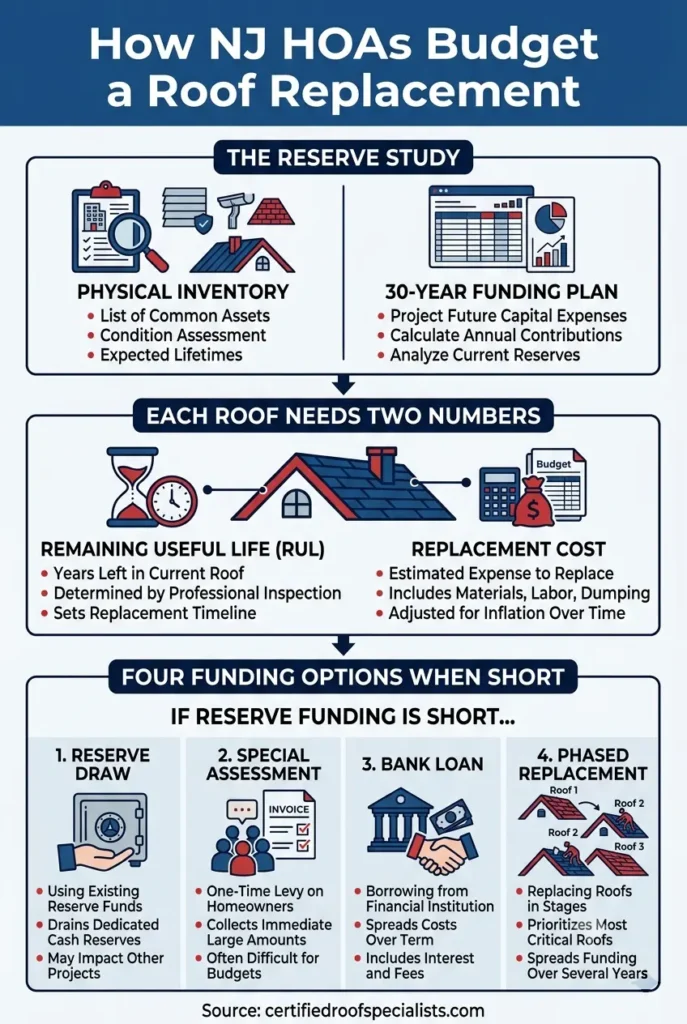
A reserve study is the financial plan for an association’s major repair and roof replacement obligations. It has two halves:
The physical analysis (component inventory). A list of every major common-element component the association is responsible for: roofs, siding, paving, decks, mechanicals, and more. For each, the study records its condition, its estimated remaining useful life, and the cost to replace it.
The financial analysis (funding plan). Using those roof replacement costs and timelines, the study calculates how much the association should hold in reserves now and contribute each month so the money is there when each component reaches the end of its life.
Roofing dominates the physical side. On most townhome and condo communities, the roofs represent the biggest single line item in the entire inventory, and roof timing often drives the shape of the whole funding plan. That is why an accurate, current roof condition assessment matters so much: if the reserve study assumes the roofs have ten years left and they actually have four, the funding plan is wrong by years and hundreds of thousands of dollars.
What New Jersey Law Now Requires
New Jersey changed the rules in 2024. The law commonly cited as S2760 (paired with Assembly bill A4384), effective January 8, 2024, and since amended (notably by S3992), established statewide reserve study and reserve funding requirements for community associations. Boards should confirm the current specifics with their association attorney, but the core obligations are:
- Who must comply. All New Jersey condominiums and cooperatives must have a reserve study. Planned real estate developments (the HOA category) with at least $25,000 in common-area capital assets must also have one.
- Who prepares it. The study must be prepared by a qualified professional: someone holding a reserve-study credential (the Reserve Specialist (RS) or Professional Reserve Analyst (PRA) designation) or a New Jersey-licensed engineer or architect, working to National Reserve Study Standards.
- The deadline. Existing associations had to commission an initial study within two years of the January 8, 2024 effective date (as extended by the S3992 amendment), a window that has now closed; newly formed associations must complete one within their first year.
- Updates. The reserve study must be updated at least every five years.
- The funding standard. The study must include a 30-year funding plan, and the plan must be designed so the reserve balance never falls below zero at any point over those 30 years.
The practical effect for roofing: boards can no longer treat the roofs as a problem to deal with “when they leak.” The law pushes associations toward funding the roof replacement on a schedule, which means knowing the real remaining life of every roof in the community. This is the data a roofing condition assessment provides.
How a Roof Enters the Funding Plan: Two Numbers
For each roof in the community, the reserve study needs two roofing inputs, and both come from a condition assessment, not a guess off a depreciation table.
1. Remaining useful life (RUL). How many years until this roof needs replacing. A generic table might assign a 25-year asphalt shingle a flat 25-year life. NJ reality is different: coastal salt air, freeze-thaw cycling through the winter, and summer hail shorten real-world life, and a roof that took a hail event five years ago may have far less life left than its age suggests. A per-building assessment corrects the table with what is actually on the roof.
2. Replacement cost. What it will cost to replace this roof in today’s dollars, escalated forward to the roof replacement year. This must reflect NJ multi-unit realities: tear-off and disposal, ice and water shield to code, copper flashing within two miles of the coast, and the flat or low-slope sections (modified bitumen or TPO) that 55-plus attached units carry alongside the pitched asphalt.
The reserve specialist takes those two numbers per building and builds the funding plan. Feed them bad numbers and the plan is wrong; feed them a current assessment and the plan is defensible.
When the Reserve Falls Short: The Four Options
Even a well-funded community can find the roofs aging faster than the plan assumed, especially older communities catching up after years of baseline funding. When the reserve will not cover the roof replacement, boards have four levers.
| Option | How it works | Best for | The trade-off |
|---|---|---|---|
| Reserve draw | Pay from the existing reserve fund as planned | Communities whose funding plan is on track | Requires the reserve to actually hold the money; no help if underfunded |
| Special assessment | A one-time charge split among all unit owners | Closing a moderate gap quickly | Unpopular; hits owners with a large lump sum; can strain fixed-income residents in 55-plus communities |
| Bank loan | The association borrows and repays over years through dues | Large gaps where owners cannot absorb a lump sum | Interest cost; the community pays more over time; lender documentation requirements |
| Phased roof replacement | Replace the worst buildings now, sequence the rest against future reserve cycles | Most NJ communities that cannot fund everything at once | Deferred buildings keep aging; costs escalate 3 to 5 percent per year on later phases |
In practice, boards often combine these: a reserve draw plus a modest special assessment to fund Phase 1, with later phases timed to rebuilt reserves. Phased roof replacement is the most common NJ approach, and it only works when the condition assessment tells you which buildings genuinely must go first.
How NJ HOAs Budget for Roof Replacement: A Worked Example
Consider an illustrative NJ townhome community: 12 buildings, 8 units each, pitched architectural-shingle roofs with small flat sections over shared entries. Numbers are examples to show the mechanics, not a quote; real costs depend on roof size, pitch, complexity, town, and deck condition.
Per-building cost. Each building carries roughly 38 to 42 roofing squares. At an illustrative $600 to $750 per square installed for architectural shingles, plus tear-off, code-required ice and water shield, flashing, and the flat-section work, a single building lands around $28,000 to $36,000. Call it $32,000 average.
Community-wide cost, today. 12 buildings times $32,000 is roughly $384,000 in current dollars. Add a contingency for deck repair discovered at tear-off and the working number is closer to $400,000 to $420,000.
The reserve gap. Say the reserve study shows the roofs at 3 to 7 years of remaining life, and the roofing line of the reserve currently holds $230,000. The community is roughly $170,000 to $190,000 short of a community-wide roof replacement.
A phased plan. Rather than a single $190,000 special assessment, the board phases over four years: the four worst buildings (active leaks, failed flashing) in Year 1 from the existing reserve, three buildings each in Years 2 through 4, funded by rebuilt reserve contributions plus a smaller special assessment. The plan builds in 4 percent annual escalation, so the Year 4 buildings are budgeted higher than the Year 1 buildings. The condition assessment sets the sequence; the funding plan sets the pace.
This is the conversation that should happen between the board, the reserve specialist, and the contractor before anyone signs anything.
Common Budgeting Mistakes NJ Boards Make
- Trusting the depreciation table over the actual roofs. Generic useful-life tables understate NJ climate wear. A current per-building assessment is the fix.
- Treating all buildings as identical. Roofs in the same community age differently based on exposure, slope orientation, and past storm hits. A single community-wide roof replacement date hides the buildings that need to go first.
- Underfunding to keep dues low. Baseline funding keeps monthly dues down but leaves the reserve thin, which sets up the special assessment nobody wants. The 2024 law pushes against this by requiring a funding plan that never hits zero.
- Forgetting the flat sections. The low-slope sections on attached units need modified bitumen or TPO, priced separately from the pitched asphalt. Leaving them out of the budget guarantees a shortfall.
- Forgetting escalation. A four-year phased plan priced entirely in today’s dollars is under-budgeted by 12 to 20 percent by the final phase. Build in 3 to 5 percent annual escalation.
- Skipping the documentation trail. Each completed phase should produce updated condition reports, warranty certificates, and permit records that feed back into the next reserve study update. This is also what lenders and future buyers’ attorneys ask for.
What CRS Provides to the Process
Certified Roofing Specialists Inc. supports NJ community associations and property managers across Manchester, Brick, Toms River, and the rest of Monmouth, Ocean, Middlesex, Somerset, and Union Counties with the roofing inputs a reserve study and a board decision require:
- Written per-building condition assessments with ratings, photographed deficiencies, and estimated remaining useful life
- Replacement cost projections in a format your reserve specialist can use
- Mixed-system scope (pitched asphalt plus flat modified bitumen or TPO) under one agreement
- Line-item, board-ready proposals broken down by building and phase
- Phased project sequencing matched to reserve fund cycles, with escalation built in
- Complete permit, inspection, and warranty documentation for each completed building (multi-unit roofing requires permits and inspections under the NJ Uniform Construction Code, administered by the NJ Department of Community Affairs)
What we do not do is prepare the reserve study or give financial advice. The reserve specialist builds the funding plan; we give them accurate roofing numbers to build it on. CRS is a registered NJ Home Improvement Contractor, and every proposal carries the registration and insurance certificates your board’s documentation trail needs.
To understand the steps that follow the budget decision, walk the pre-replacement checklist before work begins.
Start with accurate roofing numbers
A reserve study is only as good as the roof data behind it. CRS provides a per-building condition assessment with the remaining-life and replacement-cost numbers a defensible funding plan requires.
Community association roofing services · Roof roof replacement service · NJ community association roofing guide · Pre-replacement checklist · Roof roof replacement cost in NJ · Find your CRS town
This content is educational. Certified Roofing Specialists Inc. is a licensed NJ roofing contractor, not a reserve study preparer, financial advisor, or attorney. For reserve study and funding requirements, consult a credentialed reserve specialist and your association attorney.
Last updated July 8, 2026. Written by the Certified Roofing Specialists Inc. team, licensed New Jersey roofing contractors. Active community association roofing in Crestwood Village (Manchester), Holiday City (Toms River), Greenbriar (Brick), and Heritage Bay (Barnegat).
Frequently asked questions
What if our HOA reserve fund can't cover the roof replacement?
Boards have four levers: draw from the existing reserve, levy a special assessment, take an association bank loan repaid through dues, or phase the replacement so the worst buildings go first. Most NJ communities combine a reserve draw with a modest special assessment or a phased plan. A per-building condition assessment tells the board which buildings must be replaced first.
Does New Jersey require condo associations to have a reserve study?
Yes. New Jersey’s 2024 reserve law (S2760, amended by S3992) requires condominiums, cooperatives, and planned developments with $25,000-plus in common assets to maintain a reserve study. A credentialed reserve specialist or NJ-licensed engineer prepares it, updates it at least every five years, and backs it with a 30-year funding plan. Confirm specifics with your association attorney.
Can a roofing contractor's assessment be used in a reserve study?
Yes, as input. A written per-building condition assessment documenting current condition, deficiencies, estimated remaining useful life, and replacement cost is exactly the roofing data a reserve specialist needs. The reserve specialist still prepares the formal study and funding plan. CRS provides the condition assessment; it does not prepare reserve studies or give financial advice.
-

How to Prepare for a Roof Replacement in NJ: The 2026 Pre-Construction Checklist
Knowing how to prepare for a roof replacement NJ homeowners can act on comes down to a short…
-
Storm Damage Roof Inspection NJ: The First 48 Hours (2026 Playbook)
After a major storm, a storm damage roof inspection NJ follows one order: stay off the roof, document…
-
How to Choose a NJ Roofing Contractor: 7 Intelligent Questions to Ask in 2026
How to choose a NJ roofing contractor with confidence: verify the contractor’s New Jersey Home Improvement Contractor (HIC)…