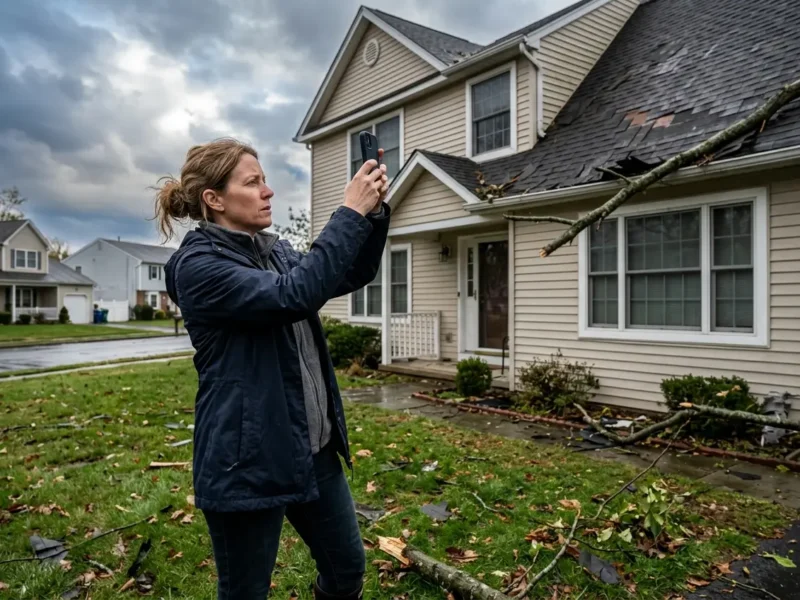

How to Choose a NJ Roofing Contractor: 7 Intelligent Questions to Ask in 2026
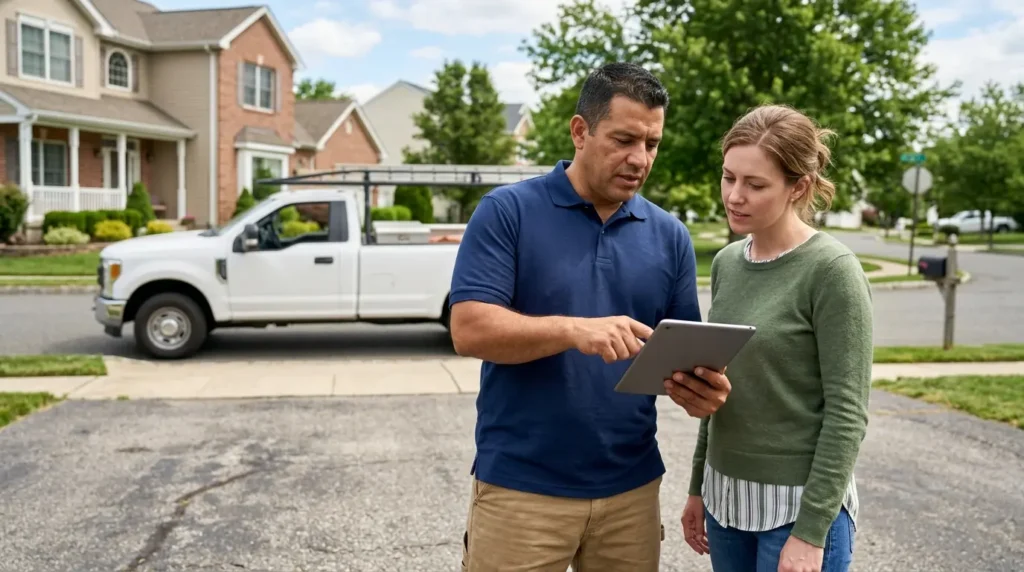
How to choose a NJ roofing contractor with confidence: verify the contractor’s New Jersey Home Improvement Contractor (HIC) registration on the Division of Consumer Affairs website, confirm general liability and workers’ compensation insurance, require a written inspection report before any estimate, ask exactly how they protect your property and clean up, get the workmanship guarantee in writing, and call two or three recent local references. Walk away from anyone who offers to waive your insurance deductible, which is treated as fraud in New Jersey. The seven questions below separate a contractor who will stand behind the work from one who will not.
Most NJ homeowners hire a roofing contractor once or twice in their life. They have no reference point for what a good one looks like, and the industry has enough bad actors that the wrong choice gets expensive in ways that do not show up for years.
These seven questions cut through the noise. Ask every contractor you interview. The answers, and how readily they come, tell you what you need to know.
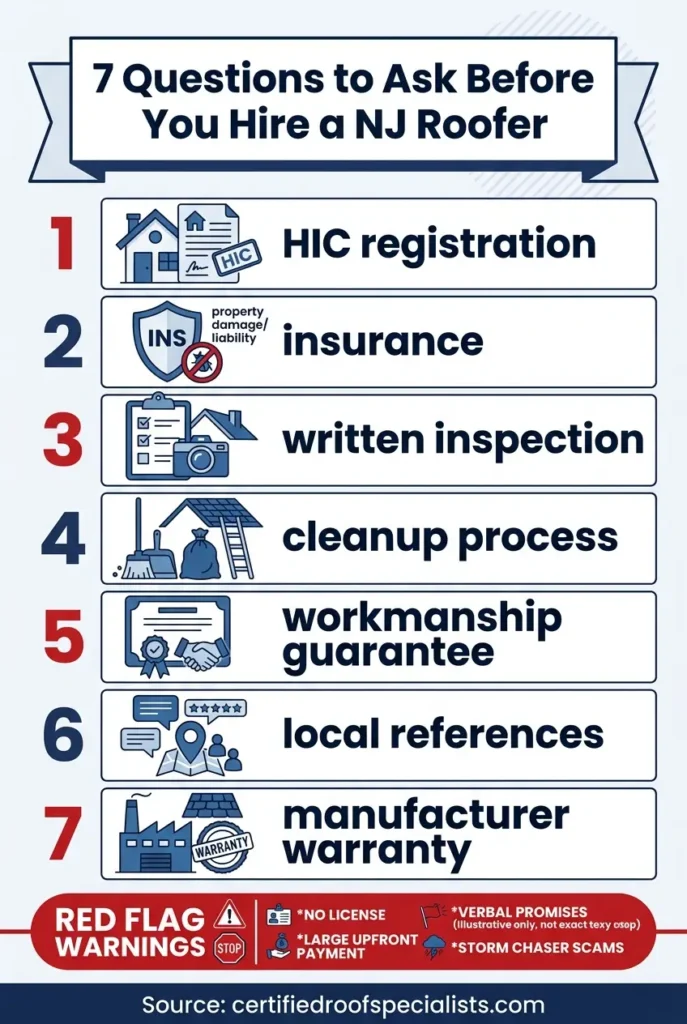
- Is the contractor NJ-registered?
- Are they insured (liability + workers’ comp)?
- Written inspection before the estimate?
- What does cleanup actually look like?
- Workmanship guarantee in writing?
- Local references you can call?
- What manufacturer-backed warranty can they register?
- NJ-specific red flags
- What good estimates look like
How to Choose a NJ Roofing Contractor: The 7 Questions to Ask
Use these as an interview script. A contractor who answers all seven clearly, and puts the important ones in writing, is the kind you want on your roof.
1. Are You Registered as a New Jersey Home Improvement Contractor?
This one is not optional. New Jersey law requires any contractor performing home improvement work over $500 to register with the Division of Consumer Affairs and to put that registration number on the contract. An unregistered contractor has no standing to provide enforceable warranties and is a red flag on its own.
Ask for the HIC registration number, then look it up. It takes 30 seconds at the NJ Division of Consumer Affairs.
2. Are You Insured, and Can I See the Certificates?
Two policies matter. General liability covers damage to your home during the job. Workers’ compensation covers an injured worker on your property. If a roofer is uninsured and someone is hurt on your roof, or your house is damaged during tear-off, you can end up holding the bill.
Ask for current certificates of insurance for both, and do not accept “we’re covered, don’t worry about it” as an answer. An established contractor produces the certificates without hesitation.
3. Do I Get a Written Inspection Report Before Any Estimate?
A qualified contractor gets on your roof before quoting anything. They measure, assess the condition of shingles, flashing, decking, and ventilation, and give you documented findings.
If a contractor quotes a replacement after a ten-minute look from the driveway, you do not have real information. You have a number, and you cannot confidently compare it against other quotes. Ask for a written inspection report with photos, condition ratings, and specific findings.
CRS provides a written inspection report on every free residential inspection. That is the standard to require from anyone you interview.
4. What Does Your Cleanup Process Look Like?
Old asphalt shingles shed hundreds of roofing nails into your grass, flower beds, driveway, and gutters. A vague answer (“we’ll clean everything up”) is not a process. Ask specifically:
- Do you run magnetic nail sweeps at the end of every work day?
- How do you protect landscaping during tear-off (tarps, plywood walking paths)?
- Do you do a final walkthrough of the property before you leave?
- Where do the old shingles go? (NJ regulates construction-debris disposal.)
A contractor who can describe the cleanup in detail has done it consistently. One who gives a vague reassurance has not.
5. What Workmanship Warranty Do You Carry, and Can I See It in Writing?
Shingle manufacturers warrant the materials. Your contractor is separately responsible for the quality of the installation. A flashing failure, an improperly sealed penetration, or an ice-and-water-shield deficiency is an installation problem, not something the shingle warranty covers.
Ask for the workmanship warranty terms in writing before you sign anything: the duration, what it covers, and how to make a claim. Contractor workmanship warranties in NJ commonly run 5 to 10 years, and the strongest manufacturer-backed options run longer (see question 7). A contractor unwilling to put this in writing is telling you how confident they are in the work.
6. Can You Provide References From Completed Jobs in My Area?
A contractor who works consistently in Monmouth, Ocean, or Middlesex County will have references in the same county, ideally from the past 6 to 12 months. Ask for two or three and call them. When you call, ask:
- Did the crew arrive when scheduled?
- Was the cleanup thorough?
- Were there surprises in the final cost versus the estimate?
- How did they handle deck damage discovered at tear-off?
- Would you hire them again?
The answers matter, and so does the fact that the contractor was willing to hand over the references. A good bonus question: “How many jobs have you done in my town in the past year?” A roofer working your town every week has the township’s housing-stock quirks and inspector relationships dialed in. CRS publishes a full town-by-town service area for that reason.
7. What Manufacturer-Backed Warranty Can You Register?
Beyond a contractor’s own workmanship guarantee, shingle manufacturers offer enhanced system warranties that can cover the full roof system, stay in force for decades, and are usually transferable to a buyer if you sell. The catch: the strongest tiers require the manufacturer to certify the installing contractor, and require the complete system (underlayment, ventilation, and accessories), not just the shingles.
GAF’s warranties and CertainTeed’s SureStart family work this way. Ask which manufacturer warranty the contractor can actually register on your roof, what it covers, how long it lasts, and whether it transfers at sale. Then verify any manufacturer credential a contractor claims, directly on the manufacturer’s own site, because terms like “factory certified” get used loosely.
Want a contractor who answers all seven in writing?
Across New Jersey, every free CRS inspection comes with a written report and photos, a line-item scope, proof of insurance, and a workmanship guarantee in writing.
NJ-Specific Red Flags to Watch For
“We’ll waive your insurance deductible.” Offering to waive or absorb your insurance deductible is treated as insurance fraud in New Jersey. A contractor who leads with it is operating outside the rules and is creating exposure for you, not doing you a favor. You can read NJ’s consumer guidance through the NJ Department of Banking and Insurance.
“We’re fully covered, don’t worry about it.” Then ask for the certificates. A contractor who cannot produce current general liability and workers’ compensation certificates is a financial risk to you, not just to themselves.
Storm chasers from out of state. After major hail or wind events, unfamiliar out-of-state contractors knock doors offering quick replacements, then leave the state when the work is done and take the warranty with them. Avoid.
Full payment up front. A reasonable deposit at contract signing is standard. Full payment before any work is a fraud risk. The NJ norm is a deposit at signing with the balance due after the final walkthrough.
Refuses to provide an HIC number. Walk away. NJ law requires the registration number on the contract. Refusing it signals an unregistered operator.
What Good Estimates Look Like
Once you have vetted contractors on the questions above, compare their estimates on the same basis:
- Materials: specific shingle line, weight, and warranty tier
- Tear-off and disposal: listed as a separate line item
- Ice and water shield: at eaves, valleys, and penetrations (NJ code requirement)
- Underlayment: synthetic preferred, specified by type
- Drip edge and flashing: detailed scope and material (copper on coastal homes; G-90 galvanized minimum inland)
- Proof of insurance: liability and workers’ compensation certificates attached or referenced
- Deck repair allowance: a per-sheet rate and how unknowns are handled
- Workmanship guarantee: duration and scope, in writing
- A point of contact: who you call if a question comes up after the install
Any estimate that is a single number with no line-item detail does not give you enough to compare. Still weighing whether you even need a full replacement? Our repair vs replacement guide walks through the math, and the roofing shingles guide covers what to line up once you have chosen a contractor.
About CRS · Roof replacement service · Repair vs replacement · Monmouth County · Ocean County · Middlesex County · Full FAQs
NJ Consumer Affairs: verify an HIC registration · NJ Department of Banking and Insurance · GAF warranties · CertainTeed
Last updated June 29, 2026. Written by the Certified Roofing Specialists Inc. team, licensed New Jersey roofing contractors serving Monmouth, Ocean, Middlesex, Somerset, and Union Counties. Consumer-protection points reflect New Jersey law as of June 2026; verify any contractor’s registration and insurance yourself before signing.
Frequently asked questions
How do I choose a roofing contractor in NJ?
Verify the contractor’s NJ Home Improvement Contractor (HIC) registration on the Division of Consumer Affairs site, confirm liability and workers’ compensation insurance, require a written inspection report before any estimate, get the workmanship guarantee in writing, and call two or three recent local references. Walk away from anyone who offers to waive your insurance deductible, which is fraud in NJ.
What are NJ-specific red flags when hiring a roofer?
A contractor who offers to waive or absorb your insurance deductible (insurance fraud in NJ), refuses to give an HIC registration number, cannot produce liability and workers’ compensation certificates, or quotes from the driveway without getting on the roof, demands full payment up front. Out-of-state storm chasers after major storms are also high-risk.
What warranty should a NJ roofer give me in writing?
Two separate things. The manufacturer warrants the shingles; the contractor separately warrants the installation. Most leaks come from installation details (flashing, penetrations, ice-and-water shield), which fall under the workmanship guarantee, not the shingle warranty, so get the workmanship terms in writing. Manufacturers offer enhanced system warranties; ask which one the contractor can register and whether it transfers when you sell.
-

How NJ HOAs and Condos Budget a Roof Replacement: The 2026 Reserve Study Guide
How NJ HOAs budget for roof replacement comes down to the reserve study: it estimates each roof’s remaining…
-
How to Prepare for a Roof Replacement in NJ: The 2026 Pre-Construction Checklist
Knowing how to prepare for a roof replacement NJ homeowners can act on comes down to a short…
-
Storm Damage Roof Inspection NJ: The First 48 Hours (2026 Playbook)
After a major storm, a storm damage roof inspection NJ follows one order: stay off the roof, document…