Roofing for NJ Community Associations: The Essential 2026 Property Manager and HOA Board Guide
Community association roofing NJ projects differ from standard residential work in four ways: scope (15 to 80+ units across multiple buildings), approval process (board authorization required), resident communication during active work, and documentation depth (reserve study professional, lender, and insurance carrier all want records). 55-plus communities also need flat-roof systems (modified bitumen or TPO) on attached units that most residential roofers do not handle.
HOA board members and property managers in New Jersey carry a specific kind of accountability when a roofing project comes up. The decision is not yours alone. You need board approval, documentation that satisfies the reserve study professional, insurance and lender requirements, and a contractor who understands all of it while residents watch every move and ask questions at the next meeting.
Most roofing contractors are set up for single-family residential work, and a few handle commercial flat roofs. Community association work (multi-building, phased, fully documented, with a group decision-making process) is a narrower category. Hiring the wrong contractor costs more than money.
How NJ Community Associations Are Governed (and Why It Affects Your Roofing Project)
NJ community associations are governed under the New Jersey Planned Real Estate Development Full Disclosure Act (N.J.S.A. 45:22A-21 et seq.), administered through the New Jersey Department of Community Affairs. That framework requires associations to maintain reserves for major capital items, and roofing is consistently the largest single line item in most community reserve budgets.
Board members have a fiduciary duty to maintain the property and fund reserves adequately. A deferred roofing project is not just a maintenance issue; it is a governance liability. FHA and VA lending guidelines require evidence of adequate reserves and no deferred major maintenance. When a unit owner tries to sell and the buyer’s lender finds an underfunded roofing reserve or an aging, unaddressed roof, the sale can fall apart, and the board becomes the problem.
Why Community Association Roofing Projects in NJ Are Different from Residential
The physical work is the same. Everything around it is not.
Scope. A community roofing project might cover 15 buildings or 80+ units. Each section needs individual condition assessment and documentation. Some buildings may need replacement now; others may have eight years of life left. An effective plan distinguishes between the two. A single-scope bid that treats all buildings identically is a red flag.
Approval process. Most NJ community associations require board authorization (sometimes a formal vote) before any major capital expenditure. Depending on governing documents and dollar amount, you may also need a written contractor comparison, a reserve study update, or owner notification before a contract is signed.
Resident impact. Staging materials, crew schedules, noise, and temporary parking restrictions all affect residents directly. A contractor who does not communicate proactively will generate calls to the management office throughout the project.
Documentation. Insurance carriers, lenders, reserve study professionals, and future purchasers will all want records of what was done and when. A contractor who hands you a receipt and walks away has failed the job.
Mixed roofing systems. 55-plus communities with attached units routinely have both pitched asphalt-shingle roofs on the main living areas and flat low-slope sections on additions, sunrooms, and shared walkways. The flat sections require modified bitumen or TPO, not asphalt, and many residential-only roofers do not handle flat work. CRS does, on the same scope, under one written agreement.
Flat-Roof Systems for NJ 55-Plus Communities
The dominant 55-plus communities in our service area (Crestwood Village I through VII in Manchester, Holiday City at Silverton and Silver Ridge Park in Toms River, Greenbriar I and II in Brick, Heritage Bay and Four Seasons at Mirage in Barnegat) all have attached-home stock with flat or low-slope roof sections. The wrong material here is a budget item that fails inside three years.
Flat-roof material choices for community association roofing NJ projects
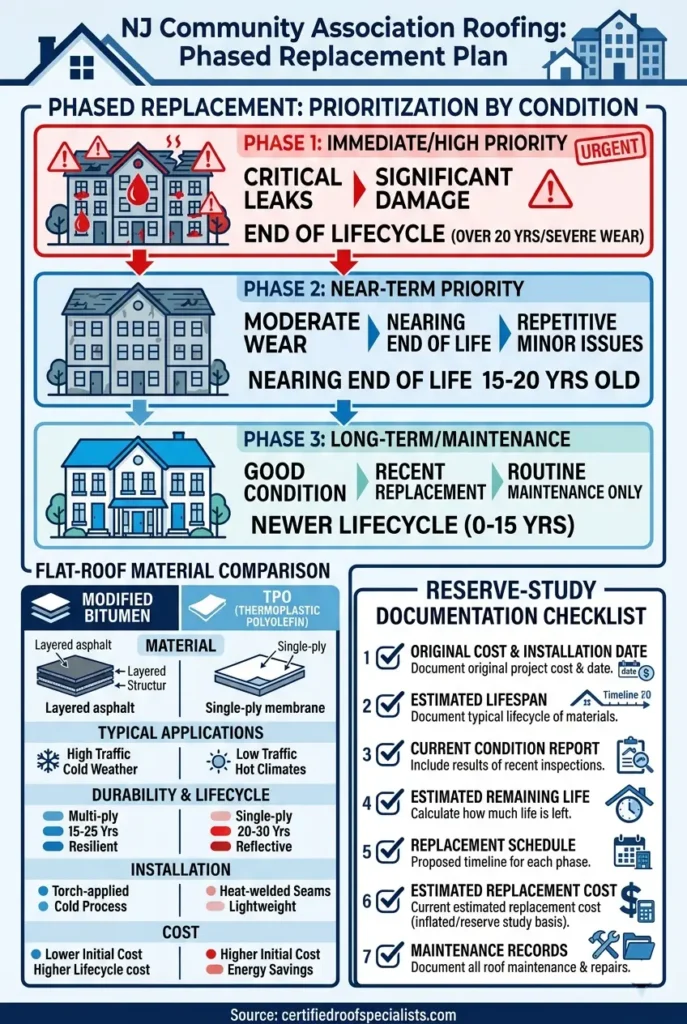
| System | Lifespan | Cost per sq ft | NJ freeze-thaw performance |
|---|---|---|---|
| Modified bitumen (SBS or APP) | 15 to 20 years | $4 to $8 | Excellent cold-weather flexibility; resists NJ freeze-thaw cycling; repair-friendly |
| TPO (heat-welded seams) | 20 to 30 years | $5 to $10 | Heat-welded seams outperform cold-adhesive in freeze-thaw; reflective surface cuts summer cooling load |
| Cold-adhesive TPO (cheap install) | Often fails inside 10 years | Lower install cost | Fails fast in NJ’s 8 to 12 freeze-thaw cycles per winter. Avoid. |
The hidden risk: ponding water. Modified bitumen tolerates light ponding better than TPO, and TPO requires proper slope (minimum 1/4 in 12) or tapered insulation. Any flat-roof inspection on a NJ 55-plus community should include a ponding-water check 48 hours after rain. Water standing longer than that is an active warranty issue.
Common NJ failure point: flat sections on cape cods and colonial additions (dormers, garage rooflines). These get inherited by buyers without anyone realizing they need a different maintenance schedule than the main roof.
What NJ Property Managers Need from a Roofing Contractor
| Requirement | What it looks like in practice |
|---|---|
| Written condition assessment | Per-building condition ratings, deficiency documentation, and photos. Suitable for reserve study input. |
| Insurance limits | General liability $2M+ per occurrence; workers’ comp current; association named as additional insured. |
| Phased project planning | Sequenced by condition priority, matched to reserve fund balance and annual funding capacity. |
| Change-order process | Written change orders required before any additional work begins. No verbal authorizations. |
| HOA references | Verifiable references from property managers or board members, not just homeowners. |
| Permit documentation | Permits pulled per building. Copies of all permits and inspections provided at project close. |
| Board-ready proposal format | Scope broken down by building, materials specified by manufacturer and product line, phased timeline. |
| Mixed-system competence | Pitched asphalt and flat modified-bitumen or TPO under one scope when the buildings need both. |
How to Structure the Bid Process
Before issuing a bid request, commission a professional roof condition assessment that produces a written report with per-building condition ratings, specific deficiency documentation, verified measurements, and a prioritization recommendation. Provide this identical assessment to all bidders. If each contractor bids a different scope, you cannot compare the proposals.
A qualified bid for a community association project includes:
- Materials specified by manufacturer, product line, and warranty tier (not just “architectural shingles”)
- Scope broken down by building or section
- Tear-off, disposal, and deck repair as separate line items
- Ice-and-water shield and underlayment specs (verify they meet NJ code minimum; they are not optional)
- Flat-section material spec where applicable (modified-bitumen weight class, TPO mil thickness, seam method)
- Permit fees listed separately, not bundled
- Phase sequencing with a calendar
- Workmanship warranty terms in writing
- Current NJ Home Improvement Contractor (HIC) registration and insurance certificates
A bid that presents a single lump-sum number without line-item detail should not advance.
Phased Replacement Planning: The Standard Approach
Most NJ community associations cannot fund a community-wide replacement in one budget cycle. Phased replacement done correctly is the right approach; done incorrectly, it leaves the worst buildings waiting too long. An effective phased plan does four things:
Prioritizes by actual condition. Buildings with active leaks, failed flashing, or compromised decking go in Phase 1. Buildings with 7 to 10 years of remaining life go in Phase 2 or 3. The assessment drives the sequence, not convenience.
Maps to reserve fund capacity. Work with your reserve study professional to align phase timing with projected reserve balances. A contractor who understands this context can adjust phase boundaries to match your funding timeline.
Documents each completed phase. Every completed building produces inspection photos, material records, warranty certificates, and an updated condition report, which feeds directly into reserve study updates and satisfies lender and insurer requirements.
Accounts for cost escalation. A multi-year plan should assume 3 to 5 percent annual cost escalation on deferred phases. Build that into reserve fund projections from the start.
Reserve Study Documentation: What Licensed NJ Contractors Can Provide
Reserve study professionals use condition assessments and remaining-useful-life estimates to calculate required funding levels. Written condition assessments from a licensed NJ roofing contractor (documenting current condition, observed deficiencies, and estimated remaining life per building) are usable as reserve study input. For the full budgeting picture, including NJ’s reserve-funding requirements and the special-assessment-versus-phased-replacement decision, work closely with your association’s reserve study professional and attorney.
After each completed phase, the association’s reserve study professional should receive updated condition reports, material and product-line records, warranty certificates with effective dates, permit and inspection documentation, and flat-roof system records (mod-bit weight class, TPO mil, seam method) for the attached-home sections. This keeps reserve fund projections accurate and gives the board defensible documentation of its capital decisions.
What to Ask a Contractor Before Signing
Ask these before awarding any community association contract:
- How many multi-building NJ community association projects have you managed? What was the largest?
- Can you provide references from an HOA property manager or board member we can call?
- What does your documentation package include at project completion?
- How do you handle resident communication during active work phases?
- Do you assign a dedicated project manager for multi-building work?
- What are your insurance limits, and will you name the association as additionally insured?
- Are you a registered NJ Home Improvement Contractor?
- Do you handle flat-roof systems (modified bitumen and TPO) under the same scope as the pitched asphalt work?
A contractor who gives general answers to specific questions has not done this work at scale.
Give your board a roofing decision it can document
A CRS pre-bid condition assessment gives you per-building ratings, photos, and a prioritization you can hand to your reserve study professional and present at the next meeting.
Community association roofing · Roof replacement service · More roofing guides · Roofing FAQs · Service area · Manchester · Brick · Toms River
NJ Department of Community Affairs · Community Associations Institute (reserve study standards) · NJ Home Improvement Contractor registration
Last updated June 17, 2026. Written by the Certified Roofing Specialists Inc. team, New Jersey roofing contractors. Active community association roofing in Ocean County, Monmouth County, Middlesex County, Somerset County, and Union County NJ.
Frequently asked questions
What makes community association roofing different from residential in NJ?
Scope (15 to 80+ units across multiple buildings), approval process (board authorization required), resident communication during work, and documentation depth (reserve study, lender, and insurance carrier all want records). 55-plus communities also need flat-roof systems (modified bitumen or TPO) on attached units that most residential roofers do not handle.
What flat-roof system is right for NJ 55-plus communities?
Modified bitumen (15 to 20 year lifespan, excellent cold-weather flexibility, $4 to $8 per sq ft) for the attached units in Crestwood Village, Greenbriar I and II, and similar 1960s to 1980s 55-plus communities. TPO (heat-welded seams, 20 to 30 year lifespan, $5 to $10 per sq ft) for newer attached construction where proper slope is built in.
How do NJ HOA boards fund a community-wide roofing project?
Phased replacement sequenced against reserve fund cycles is the standard NJ approach. Buildings with active leaks or failed flashing go in Phase 1. Buildings with 7 to 10 years of remaining life go in Phase 2 or 3. A multi-year plan should assume 3 to 5 percent annual cost escalation on deferred phases, built into reserve fund projections.
-

How NJ HOAs and Condos Budget a Roof Replacement: The 2026 Reserve Study Guide
How NJ HOAs budget for roof replacement comes down to the reserve study: it estimates each roof’s remaining…
-
How to Prepare for a Roof Replacement in NJ: The 2026 Pre-Construction Checklist
Knowing how to prepare for a roof replacement NJ homeowners can act on comes down to a short…
-
Storm Damage Roof Inspection NJ: The First 48 Hours (2026 Playbook)
After a major storm, a storm damage roof inspection NJ follows one order: stay off the roof, document…