8 Signs You Need a New Roof in NJ (Before It’s an Emergency)
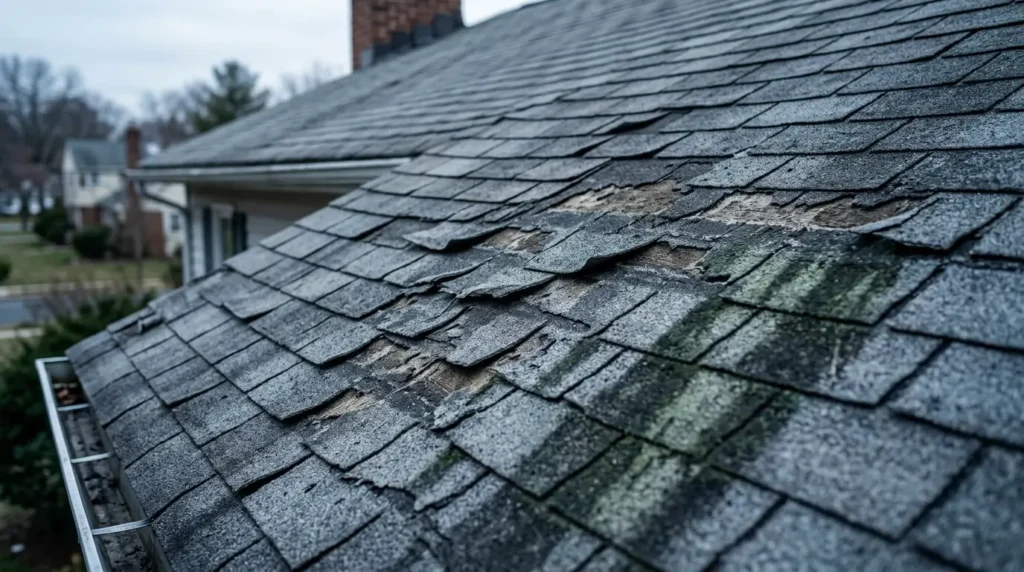
The most common signs you need a new roof NJ homeowners should watch for are: roof age over 20 years, curling or buckling shingles, heavy granule loss in the gutters, dark algae streaking, sagging deck sections, daylight visible in the attic, rising energy bills, and two or more repairs in 24 months. Any three of these on the same roof move replacement from “maybe in a few years” to “inspect now.”
Most NJ homeowners discover their roof is failing through water damage inside their home. By that point, the warning signs had been on the roof for 12 to 36 months. You can avoid that outcome. Eight signals tell you a roof is failing before the damage reaches your living space, and most of them are visible from the ground or the attic.
NJ’s climate accelerates every one of these warning signs. The state averages roughly 47 inches of rain per year and 8 to 12 freeze-thaw cycles per winter. A roof that would survive 30 years in a dry climate may last 22 to 28 years here. The signs below progress faster than they would in the Southwest or the Pacific Northwest. Know what to look for.
Signs You Need a New Roof NJ: Self-Check vs Professional Inspection
Six of the eight signs below you can check yourself from the ground or the attic. Two require a professional with close-up access. Here is the split.
| Sign | Can You Check It? | How |
|---|---|---|
| Roof age | Yes | Ask the previous owner or check your home-purchase inspection report |
| Granule loss in gutters | Yes | Look in gutters after a heavy rain |
| Dark streaking and algae | Yes | Visible from the ground or driveway |
| Curling or buckling shingles | Yes (partial) | Binoculars from ground level; edges are visible |
| Sagging deck sections | Yes (partial) | Visible along the roofline from ground |
| Daylight in the attic | Yes | Attic inspection with lights off |
| Flashing failures | Professional | Requires close-up access at penetrations |
| Moisture in decking or mold | Professional | Hidden under shingles; needs direct inspection |
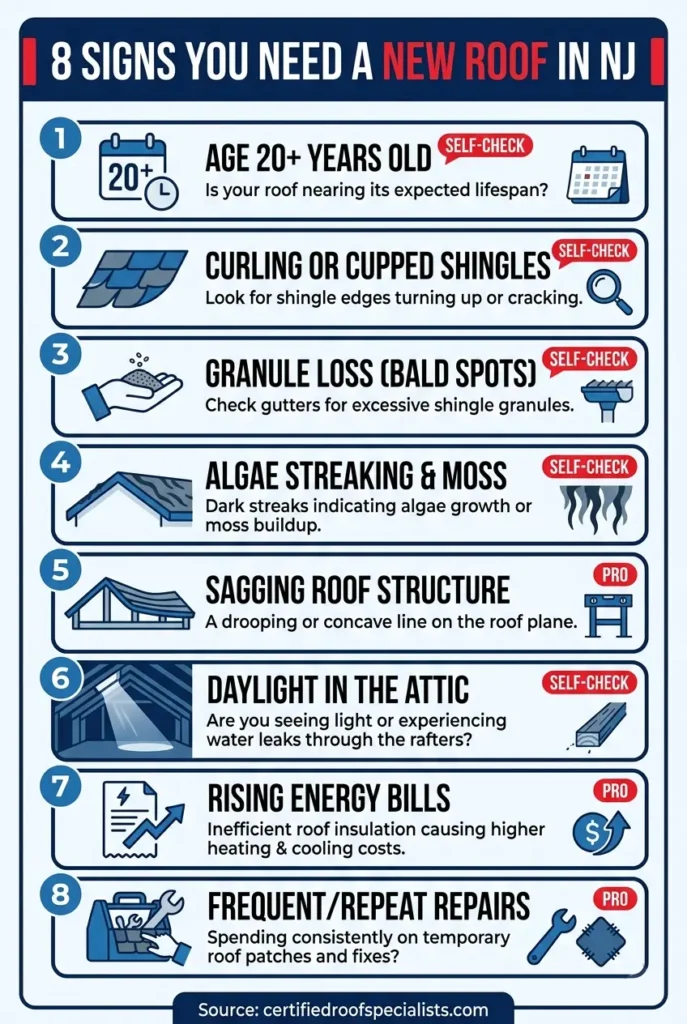
The 8 Signs You Need a New Roof NJ
1. Your Roof Is Over 20 Years Old
A 20-year-old NJ roof has consumed most of its serviceable life. Architectural shingles are rated for 25 to 30 years under ideal conditions. NJ’s climate (roughly 47 inches of annual rain, 8 to 12 freeze-thaw cycles, occasional hail, and nor’easters) shortens that window. A roof installed in 2003 in New Jersey is not the same as a 2003 roof in Nevada.
Age alone does not mean replace immediately. It means inspect now. Get a professional condition report before a storm forces the decision on a timeline that works for the contractor’s emergency schedule, not your budget.
If you do not know the roof’s age, a few records usually pin it down: the seller’s disclosure or your home-purchase inspection report, a dated installation receipt or manufacturer warranty registration from the prior owner, or a shingle wrapper left in the attic. If none of those exist, a roofer can estimate the age within a few years from granule wear, shingle profile, and flashing condition.
2. Curling or Buckling Shingles
Curling shingles signal end-stage asphalt deterioration. The binder has dried out and the shingle can no longer lay flat. Replacement is the only solution. Curling shingles are a structural liability in a nor’easter, where sustained 60-plus mph gusts can lift them off the deck in sections.
Two types: cupping (edges turning upward) and clawing (middle rising while edges stay flat). Both indicate the asphalt layer has lost flexibility. No sealant or repair stops the process once it begins across the shingle field.
Look along the edges of your roof from ground level with binoculars. Curling is often visible without getting on the roof. Any visible curling on a roof older than 15 years warrants a professional inspection.
3. Granule Loss in Your Gutters
Granule loss signals late-stage shingle deterioration. Granules block UV degradation and protect the asphalt underneath. Once they shed at scale, the shingles age rapidly, sometimes taking years off the remaining lifespan in a single season.
After a heavy rain, look in your gutters. A thin layer of black or gray grit is normal throughout a roof’s life. A thick deposit (enough to fill your palm) on a roof older than 15 years means the protective coating is failing. Check the downspout discharge area too. Granules pool where water exits.
Some granule shedding in the first year of a new roof is normal as excess granules settle. On an aging roof, it is a warning flag.
4. Dark Streaking Across the Shingles
Dark streaks running down the roof surface are Gloeocapsa magma algae, which feeds on the limestone filler in asphalt shingles. NJ’s humidity (particularly in summer) makes this common across Monmouth, Ocean, and Middlesex Counties. North-facing slopes and shaded sections develop streaking first.
Town-specific note: Edison, Woodbridge, and Old Bridge homes within a mile of the Route 1 or Route 9 corridor often show heavier streaking because diesel and brake-dust particulate gives the algae more to bond with. A soft wash often clears the surface staining itself, and if the shingles still have real life left, a restoration treatment can delay replacement.
Streaking alone does not require immediate replacement. It signals the shingles have reached the stage where organic growth takes hold. On a 20-year-old roof, streaking combined with any other sign on this list moves up the inspection timeline.
5. Sagging Sections
Sagging anywhere on the roof deck is a structural failure. The decking below the shingles has absorbed sustained moisture and softened or rotted. This is not a surface problem. The structural integrity of the roof assembly is compromised.
Walk your property and look along the roofline. Dips, waves, or sections that look lower than the surrounding plane are visible signs. A spongy feel underfoot during a professional inspection confirms moisture damage in the decking. Sagging requires immediate professional assessment. Do not delay.
This sign is the most dangerous to ignore. Decking failure can become a collapse risk in severe weather.
6. Daylight Visible in the Attic
Any pinpoint of daylight visible in your attic on a sunny day means water can enter through the same path. Go into your attic, turn off all lights, and let your eyes adjust. Light penetration that does not come from a vent is a problem.
While you are in the attic, examine the rafters and sheathing for water stains, mold, or discoloration. Check the insulation. Damp or matted insulation along the eaves or at a specific roof plane indicates ongoing water infiltration even if no active leak is visible at ceiling level.
This is the one sign every homeowner can check without any equipment. Do it annually.
7. Rising Energy Bills Without Another Explanation
A failing roof degrades attic thermal performance. Poor ventilation (often caused by a compromised roof assembly) traps heat in summer and accelerates heat loss in winter. If heating and cooling costs have climbed without a change in equipment, occupancy, or utility rates, add the roof to the diagnostic checklist.
Surface temperatures on dark asphalt shingle roofs exceed 150 degrees Fahrenheit on a hot NJ summer day. A properly ventilated attic exhausts that heat. A poorly ventilated one transfers it directly into the living space. The energy penalty is real and measurable.
8. Multiple Repairs in the Last Two Years
One repair is maintenance. Two or three repairs on different sections of the same roof within 24 months means the deterioration is widespread. You are patching individual failures while the system continues to fail underneath. At a certain point, cumulative repair costs approach replacement cost without the benefit of a warranty or meaningful remaining lifespan.
A professional assessment defines where you are on that curve. Some roofs genuinely have 5 to 8 years of serviceable life after repairs. Others are spending money to delay an inevitable and more costly emergency replacement. Know the difference before you authorize another repair. Our roof repair service page explains when a targeted repair still makes sense.
How Many Signs You Need a New Roof NJ Add Up to Replacement?
One sign on its own is rarely a verdict. The rule of thumb: any three of the eight signs on the same roof move it from “watch it” to “inspect now,” and any structural sign (sagging, attic daylight, widespread moisture) warrants an immediate professional look regardless of the others.
NJ Climate Context: Why Signs Progress Faster Here
The same deterioration patterns that take five years to develop in a dry climate can develop in two to three years in New Jersey. Freeze-thaw cycles expand every micro-crack. Hail knocks granules loose that UV then attacks. Summer humidity feeds algae. Nor’easters stress every lifted shingle edge.
Town-specific accelerators to know:
- Post-Sandy bayfront homes in Ocean County (Toms River Silverton, Brick Shore Acres, Point Pleasant): 2012 to 2014 emergency repairs are now 12 to 14 years past their intended life. Sagging, decking issues, and underlayment failures are common in this cohort.
- Central NJ hail corridor (Freehold, western Howell, parts of Marlboro): summer convective storms produce hail bruising that breaks granule bond and accelerates loss over the following two to three years.
- Direct coastal Atlantic (Long Branch, Asbury Park, Point Pleasant): salt air corrodes galvanized flashing significantly faster than inland, with rust streaks on shingle faces as a leading sign.
- Inland mature tree canopy (Robertsville in Marlboro, parts of Holmdel): debris loading on north-facing slopes accelerates moss growth and lifts shingle tabs.
If you are on the fence about whether a sign is “serious enough,” lean toward inspection. In NJ, minor signs often have less runway than they appear to.
If the signs point to replacement, our 2026 Monmouth County cost guide shows what to budget, and our roof replacement service page walks through the process.
Get a written verdict on your roof in under an hour
A free 45 to 60 minute CRS inspection ends with a written report, photos, condition ratings per section, and honest guidance on remaining lifespan.
Roof replacement service · Roof repair service · Best roofing shingles NJ · 2026 Monmouth County cost guide · Find your CRS town
National Weather Service (NJ climate) · GAF on roof algae streaking · Energy Star attic ventilation
Last updated June 22, 2026. Written by the Certified Roofing Specialists Inc. team, New Jersey roofing contractors serving Middletown, Howell, Marlboro, Freehold, Toms River, Edison, Old Bridge, and every other town in Monmouth, Ocean, Middlesex, Somerset, and Union Counties.
Frequently asked questions
What are the most common signs you need a new roof in NJ?
Roof age over 20 years, curling or buckling shingles, heavy granule loss in the gutters, dark algae streaking, sagging deck sections, daylight visible in the attic, rising energy bills, and two or more repairs in 24 months. Any three of these on the same roof move replacement from “maybe in a few years” to “inspect now.”
How can I tell if my NJ roof needs replacement without going on it?
From the ground with binoculars: look for curling shingle edges, dark algae streaking, sagging rooflines, missing shingles, and granule accumulation in gutters. From inside the attic on a sunny day: look for pinpoint daylight, water staining on rafters, mold, or damp insulation. Six of the eight major warning signs are visible without climbing the roof.
Why do NJ roofs fail faster than roofs in other states?
NJ averages roughly 47 inches of rain per year, 8 to 12 freeze-thaw cycles per winter, occasional summer hail, regular nor’easter wind, summer humidity, and salt air within two miles of the Atlantic. The combination accelerates every deterioration pattern. A roof that would survive 30 years in a dry climate often lasts 22 to 28 years in coastal NJ.
-

How NJ HOAs and Condos Budget a Roof Replacement: The 2026 Reserve Study Guide
How NJ HOAs budget for roof replacement comes down to the reserve study: it estimates each roof’s remaining…
-
How to Prepare for a Roof Replacement in NJ: The 2026 Pre-Construction Checklist
Knowing how to prepare for a roof replacement NJ homeowners can act on comes down to a short…
-
Storm Damage Roof Inspection NJ: The First 48 Hours (2026 Playbook)
After a major storm, a storm damage roof inspection NJ follows one order: stay off the roof, document…