Roof Valley Leak in NJ: Why the Channel Fails First
A roof valley leak NJ homeowners find in winter is a channel failure, not a joint failure. The valley is the trough where two roof planes meet, and it carries the water off both of them. When debris, ice or a nail interrupts that channel, the water backs up and goes sideways under the shingles.
Every roof has a few places where the water volume is many times higher than anywhere else, and the valley is the worst of them. Two full slopes drain into a strip about a foot wide. That is why a valley detail that is slightly wrong leaks, while the same mistake in the middle of a shingle field would never show.
Be clear about what this is not. It is not a joint where the roof meets a vertical surface, which is the subject of our post on a chimney flashing leak in NJ. It is not a pipe or vent penetration. And if you do not yet know where the water is entering at all, start with the broader roof leak repair guide for NJ and come back once the valley is the suspect.
What Causes a Roof Valley Leak NJ Homes Get in the First Place?
Roof valley leaks come from three constructions: open metal valleys that rust through or were nailed inside the channel, closed-cut valleys where the cut line drifts into the channel, and woven valleys where shingles bridge the trough and crack with age. With no membrane under any of them, water reaches the deck.
| Valley type | What you see from the ground | How it fails | Winter behavior |
|---|---|---|---|
| Open metal valley | A visible metal strip running down the trough between two slopes | Rusts through at the low end, or the shingles beside it were nailed into the channel | Sheds ice and debris best of the three |
| Closed-cut valley | Shingles from one slope run through, the other slope is cut in a straight line | The cut line drifts into the channel, or the cut shingles were never sealed back | Holds debris and snow longer, so meltwater sits |
| Woven valley | Shingles from both slopes interlaced through the trough | Shingles bridge instead of lying flat, and the high spots crack with age | Worst at holding ice, common on older NJ roofs |
| Any type, no membrane | Nothing. This one is invisible until the deck is opened. | Felt alone under the valley tears and the water reaches the sheathing | The failure that turns a leak into rotten decking |
The nail is the one worth naming twice. A fastener driven inside the water channel, rather than back from it, puts a hole in the exact strip of roof carrying the most water. It passes every visual inspection. It leaks for twenty years quietly, and the decking underneath is what pays for it.
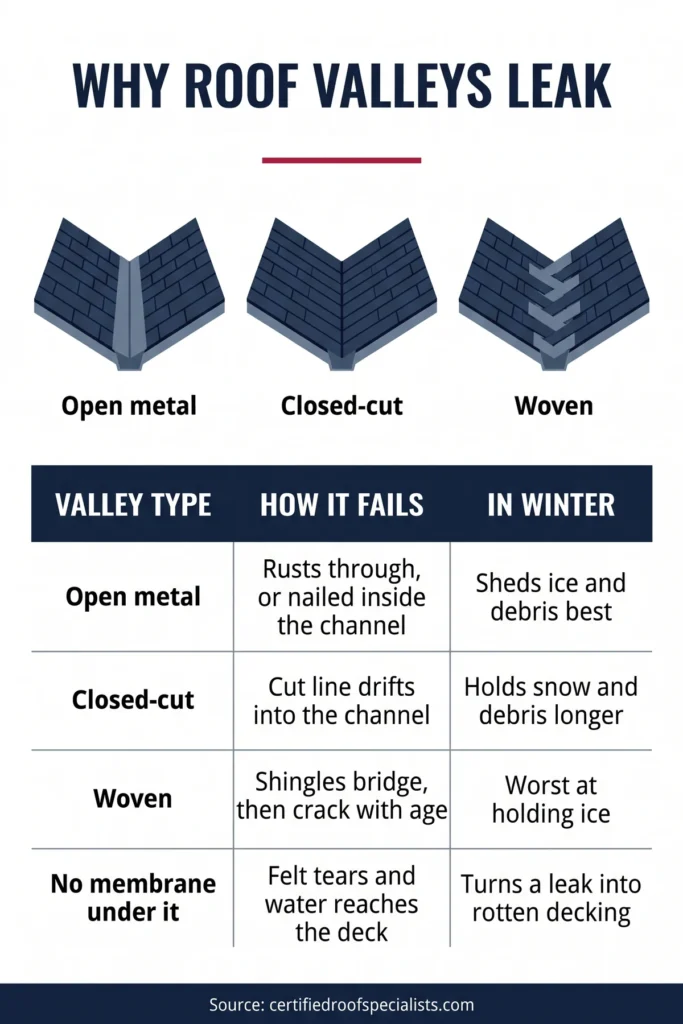
Embed this infographic on your site
Copy the code below to share this infographic with a link back to this guide.
<p><a href="https://certifiedroofspecialists.com/roof-valley-leak-nj/"><img src="https://certifiedroofspecialists.com/wp-content/uploads/2026/10/roof-valley-leak-nj-infographic.webp" alt="roof valley leak NJ: open metal, closed-cut and woven valleys compared by how they fail and how they hold up in winter" style="max-width:100%;"></a></p>
<p>Source: <a href="https://certifiedroofspecialists.com">Certified Roofing Specialists</a></p>
What Are the Signs of a Roof Valley Leak NJ Homeowners Can Actually See?
Six signs point to a valley leak: three you can see from the ground or a second-floor window, and three inside. Outside, look for a rust streak running out of the valley, packed debris in the channel, and shingle edges lifting along the cut line. Inside, a ceiling stain running in a line, not a circle, is clearest.
- A rust streak running out of the valley onto the shingles below it. Metal that is rusting on top is thinner than it looks from forty feet away.
- Packed debris sitting in the channel. Under oaks and maples this happens every November, and a packed valley is a dam.
- Shingle edges lifting or curling along the cut line. On a closed-cut valley that means the cut course is no longer lying down over the one beneath it.
- A ceiling stain that runs in a line rather than a circle. Valley water arrives along a rafter, so the stain often follows a straight edge in the drywall.
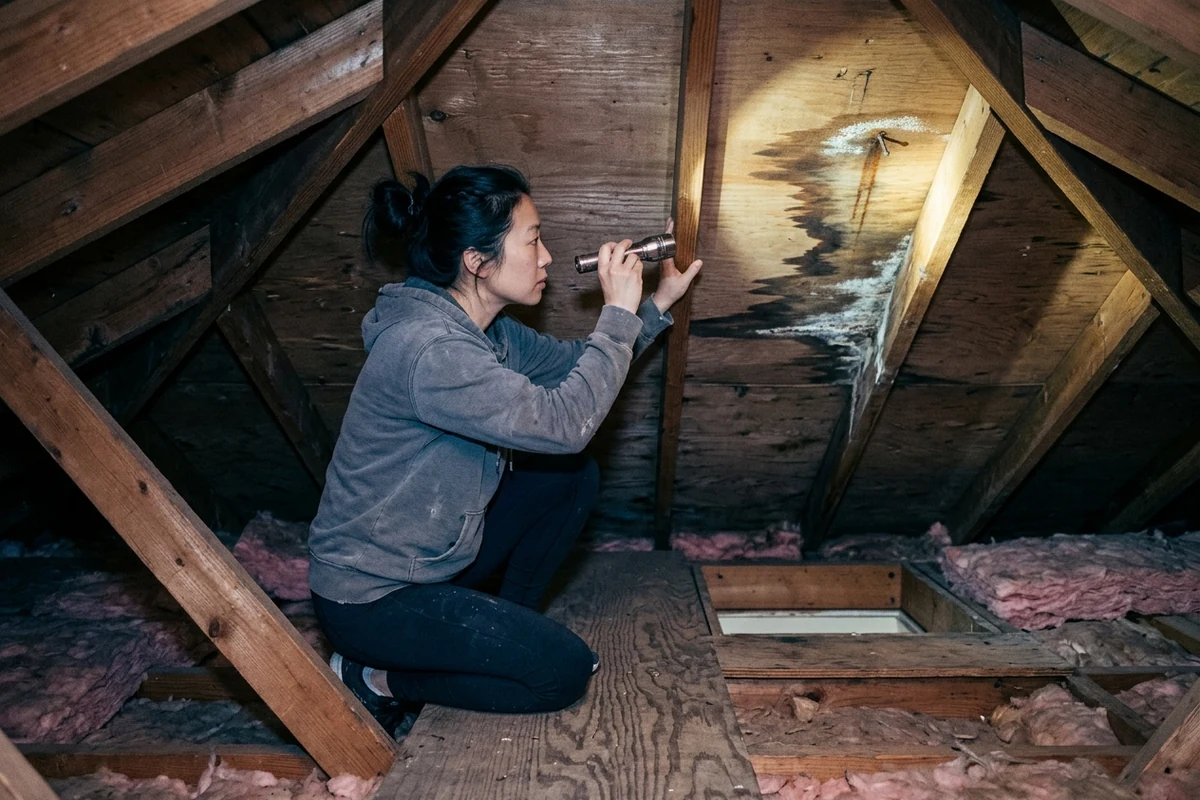
- A dark strip on the attic sheathing that traces the line of the valley above it, sometimes with white mineral deposits where water dried repeatedly.
- A stain that only appears after snow, not after rain. That is the ice tell, and it is covered next.
A proper inspection should cover every valley on the roof rather than the one under the stain, which is part of what a NJ roof inspection includes. The installation standards behind these details come from the NRCA.
Why roof valley leak NJ calls spike after the first hard freeze
Water moving fast down a valley does not have time to find a marginal lap. Water sitting still in a valley does. Once snow falls into a trough that is already holding wet leaves, it stays there through the melt and refreeze cycle, and the standing water works uphill under the shingle edges by capillary action.
That is the case for a self-adhered ice-and-water membrane under the valley rather than felt alone. It is a rubberized sheet that seals around fasteners and does not care about standing water. Whether your town requires an ice barrier, and where, is a local code question: confirm it with your construction office or the NJ Division of Codes and Standards before you accept a bid that leaves it out. For the weather side of the same question, the National Weather Service office in Mount Holly tracks the freeze and thaw pattern across our counties.
Debris is the other half. If a limb came down anywhere upslope of the valley, the twigs and leaves it left behind end up in the channel, which we cover in roof damage from falling branches in NJ. Clearing the valleys belongs on the autumn list in our NJ fall roof prep guide.
Get the valley looked at before the first hard freeze
A CRS inspector walks every valley on your roof, clears and photographs what is in the channel, and tells you in writing whether the membrane underneath is still doing its job or the valley has to be rebuilt.
What Does a Real Valley Repair Include, and What Does It Cost?
A valley cannot be repaired from the surface. The shingles on both sides have to come back far enough to expose the channel, which is why sealing along a valley from above is not a repair and never lasts a season. A proper repair opens the valley, and what comes next depends on what is found.
- Shingles stripped back on both slopes to sound material.
- The old metal and old underlayment removed, not covered.
- Any soft sheathing cut out and replaced. In a valley this is usually a strip, not a square.
- Self-adhered membrane run up the center of the valley and out under both slopes.
- New valley metal or a new cut line, with every fastener kept out of the water channel.
- Shingles woven back in so the courses line up with the roof either side.
Four things move the price: the length of the valley, whether decking has to come out, the pitch and access, and whether the surrounding shingles are still available and still flexible enough to lift without breaking. That last one is the honest limit on repairing an old roof. Shingles past about fifteen years often crack when a roofer tries to lift them, and at that point the repair grows.
If the roof is aging generally, price the repair against the alternative using our guide to roof repair against replacement. And know this before you accept a cheaper bid: a second layer installed over the old roof generally leaves the existing valley where it is, which is one of the trade-offs in a roof-over against a full tear-off.
On permits, valley repair on a one- or two-family New Jersey home is ordinary maintenance and needs no building permit. Replacing sheathing under the valley is structural work and does, and condominium, multi-family and attached-community buildings require one either way. Confirm the current requirement with your local construction office. No permit never means no code, and the repair still has to meet it.
Certified Roofing Specialists handles valley work as targeted repair, and will tell you plainly when a valley is the only problem on an otherwise sound roof. That answer sends less work our way, and it is the one we would want.
Roof leak repair in NJ · Chimney flashing leaks · What a roof inspection includes · Fall roof prep checklist · Roof repair services
Last updated November 16, 2026. Written by the Certified Roofing Specialists team, registered New Jersey home improvement contractors, NJ HIC registration #13VH14243900, serving Monmouth, Ocean, Middlesex, Somerset, and Union Counties. Call (201) 841-3858.
Common questions
Frequently Asked Questions
Should I clean the leaves out of my roof valley myself?
Not from the roof. A valley is the steepest, slickest path on any roof and it is wet whenever debris is sitting in it. If a valley is packed from the ground you can see it, and that is enough information to book the work. Nobody should be walking a valley.
Which valley type is best for a New Jersey roof?
There is no single answer, but an open metal valley sheds debris and ice better than a shingled one, which matters under oaks and maples. A closed-cut valley looks cleaner and costs less. The install quality matters more than the type on almost every roof we see.
Can a valley leak damage the roof deck?
Yes, and faster than most leaks, because a valley concentrates the water from two slopes into one narrow path. Sheathing under a leaking valley often goes soft along a strip rather than in one spot, so the repair is measured in feet of decking rather than a single sheet.
My valley has a rust line but no leak yet. How long do I have?
Rust means the metal is thinning and the coating is gone, and it will not reverse. There is no reliable countdown. Have it inspected before winter, because a valley that holds ice through a New Jersey January can go from a rust line to an open path in one season.
-

Roof Vent Boot Leak in NJ: The Small Part That Fails First
A roof vent boot leak NJ winters expose starts at the rubber collar on a pipe, not the…
-
Chimney Flashing Leak in NJ: Where the Water Really Gets In
A chimney flashing leak NJ winters expose starts at the joint, not the brick. See the five failure…
-
Emergency Roofing in NJ: Storm Damage Response
Emergency roofing NJ: what to do after storm damage, how fast to get a tarp on, what it…