
Chimney Flashing Leak in NJ: Where the Water Really Gets In
A chimney flashing leak NJ homeowners find in November starts at the joint where the masonry meets the roof plane, not in the brick above it. Five components seal that joint: the apron, the step flashing, the counter flashing, the cricket, and the mortar reglet. One of them has failed.
Chimney flashing leaks are easy to misdiagnose. The chimney gets blamed as a whole object. It is not one thing. It is a masonry stack passing through a waterproof surface, and every failure has a specific address.
Be clear about what this post is not covering. It is not the chimney crown, the cap, or the brick and mortar above the roofline, which are masonry work. It is not a valley, which is a channel carrying water down a roof rather than a joint at a vertical wall. It is not a pipe penetration. And it is not a general leak hunt: if you do not yet know where the water is entering, start with our guide to roof leak repair in NJ and come back here once the chimney is the suspect.
Where Does a Chimney Flashing Leak NJ Homes Get Actually Start?
A chimney leaks at one of five places: the apron flashing on the downhill face, the step flashing along the side walls, the counter flashing cut into the mortar, a missing cricket on the uphill face of a wide chimney, or the crown, cap, and mortar. The first four are roofing work. The last is masonry.
| Failure point | Where it sits | The tell | Trade |
|---|---|---|---|
| Apron flashing | The downhill face of the chimney | Stain directly below the chimney, worst in wind-driven rain | Roofer |
| Step flashing | Both side walls, one bent piece per shingle course | Stain that runs down one side of the chase, often behind a wall | Roofer |
| Counter flashing | Cut into a mortar joint, lapping over the step flashing | Metal lifted or curled away from the brick, often with old caulk behind it | Roofer |
| Missing cricket | The uphill face of a wide chimney | Packed wet leaves and a rust line above the chimney, leak after every storm | Roofer |
| Crown, cap or mortar not a flashing leak | Above the roofline, on top of the stack | Damp brick inside the attic well above the roof deck, white staining on the stack | Mason |
The counter flashing row is where most of the bad work in New Jersey lives. Counter flashing is supposed to be cut into a mortar joint with a grinder, bent, and set so it sheds water back over the step flashing. Surface-caulking it to the face of the brick instead takes twenty minutes and looks identical from the ground for about two winters.
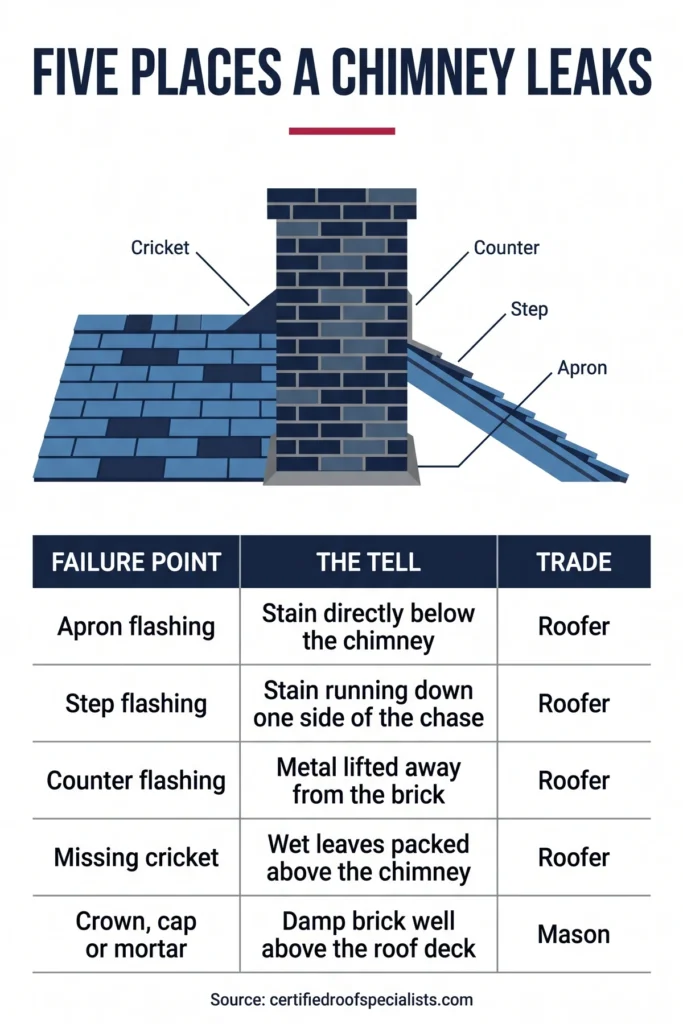
Embed this infographic on your site
Copy the code below to share this infographic with a link back to this guide.
<p><a href="https://certifiedroofspecialists.com/chimney-flashing-leak-nj/"><img src="https://certifiedroofspecialists.com/wp-content/uploads/2026/10/chimney-flashing-leak-nj-infographic.webp" alt="chimney flashing leak NJ: five chimney leak points, where each one sits, and whether a roofer or a mason fixes it" style="max-width:100%;"></a></p>
<p>Source: <a href="https://certifiedroofspecialists.com">Certified Roofing Specialists</a></p>
How Do You Tell Flashing From Masonry Without Going Up There?
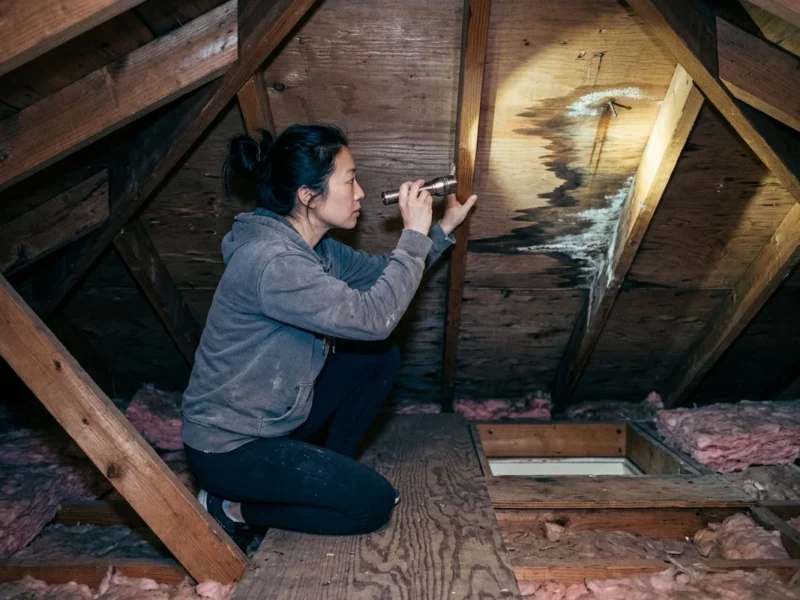
Check the height of the stain from the attic. Follow the chimney with a flashlight: staining that begins at or just below the roof deck points at flashing, while staining that runs down the brick from well above the deck points at the crown, the cap, or open mortar joints, which is masonry work.
- Find the height of the wet. In the attic, follow the chimney with a flashlight. Water staining that begins at or just below the roof deck points at flashing. Staining that runs down the brick from well above the deck points at the crown, the cap, or open mortar joints, and that is masonry work.
- Watch the weather that triggers it. A leak that only appears in wind-driven rain from one direction is almost always a lap or an edge on that side. A leak that appears in any steady rain is usually an open path rather than a marginal one.
- Check what happens after a freeze. Water sitting in a bad joint expands when it freezes and widens the gap, so a New Jersey chimney leak that was intermittent in November is often continuous by February.
A proper inspection settles it. The visit should cover every transition and penetration rather than the one spot you pointed at, which is part of what a NJ roof inspection includes. The NRCA publishes the installation standards these details are drawn from.
What makes a chimney flashing leak NJ winters produce different from a summer one
Two things change in the cold. Snow sits on the uphill face of the chimney instead of running off it, so a joint that only ever handled fast-moving rain now sits in standing meltwater for days. And the freeze and thaw cycle works the metal: a counter flashing that was merely loose in October gets levered further out of the mortar every night the temperature crosses freezing.
That is why the November call and the February call about the same chimney are different jobs. It is also why a limb that came down on the chimney side of the roof deserves a look at the flashing, not just the shingles, as we cover in roof damage from falling branches in NJ.
Can the Flashing Be Repaired, or Does It All Come Out?
Flashing gets repaired when the metal is sound and the problem is one fastener, one lap, or one loose section. It comes out and gets rebuilt when the metal is rusted through, was installed as a single bent strip where step pieces belong, or was surface-caulked instead of cut into the mortar. Ask for a photograph of what was found.
Ask for a photograph of what was found and ask which of those two it is. Four things drive the price: access, whether a reglet has to be ground into the masonry, whether the sheathing under the joint is soft, and the metal specified. Aluminum, galvanized steel and copper are three prices with three service lives, and salt air along the Monmouth and Ocean shore is hard on the cheap end of that list.
One warning worth the paragraph: a roof replacement that reuses the old chimney flashing is a common way a low bid gets low. New shingles, old joints, and a leak in year three at the exact spot where the workmanship argument gets murky. Read the line items, and read what your coverage says, because reused flashing sits close to the list of things that void a roof warranty in NJ.
Find out which chimney joint is letting the water in
A CRS inspector goes up, photographs the apron, the steps, the counter flashing and the cricket separately, and tells you in writing which one failed and whether it is roofing work or masonry work.
Roofer or Mason: Who Fixes a Chimney Flashing Leak NJ Winters Expose?
Draw the line at the roof surface. Everything that seals the joint between the chimney and the roof, meaning the apron, the step flashing, the counter flashing and the cricket, is roofing work. Everything above the roofline, meaning the crown, the brickwork, the liner and the cap, is masonry.
Plenty of leaks blamed on flashing are crown problems, and plenty of leaks blamed on the chimney are flashing. A roofer who tells you the water is coming from above the roofline and sends the job to a mason is giving you the correct answer even though it costs them the work. That is the answer you want.
- Ask which of the five components failed, by name.
- Ask whether the counter flashing will be cut into the mortar or surface-sealed, and get the answer in writing.
- Ask what happens if the sheathing under the joint is soft, and what that adds.
- Verify the New Jersey Home Improvement Contractor registration before work starts at the NJ Division of Consumer Affairs.
Carriers generally treat worn or badly installed flashing as maintenance rather than sudden accidental damage, so a slow chimney leak is usually not a claim. Storm damage that tears flashing loose is a different case. Certified Roofing Specialists documents roof condition with photographs, measurements and a written report, and does not file, negotiate, or settle insurance claims on your behalf.
On permits: flashing repair on a one- or two-family New Jersey home is ordinary maintenance and needs no building permit. Replacing sheathing is structural work and does, and condominium, multi-family and attached-community buildings require one either way. Confirm the current requirement with your local construction office or the NJ Division of Codes and Standards. No permit never means no code.
If the roof around the chimney is also near the end of its life, price the repair against the alternative before committing, using our guide to roof repair against replacement. And put the chimney on the autumn walkaround list in our NJ fall roof prep guide, because a joint checked in October is a repair and the same joint found in February is a repair plus a ceiling.
Roof leak repair in NJ · What a roof inspection includes · Roof damage from falling branches · What voids a roof warranty · Roof repair services
Last updated November 9, 2026. Written by the Certified Roofing Specialists team, registered New Jersey home improvement contractors, NJ HIC registration #13VH14243900, serving Monmouth, Ocean, Middlesex, Somerset, and Union Counties. Call (201) 841-3858.
Common questions
Frequently Asked Questions
Why does my chimney only leak in heavy rain?
Because flashing works by overlap and gravity. A short lap or a lifted edge sheds a light rain fine and fails once wind drives water sideways and uphill. That is why a chimney can stay dry for months and then stain a ceiling during one November nor’easter.
Is roof cement around a chimney a real repair?
No. It buys months. Roof cement hardens, cracks, and then holds water against the metal and the mortar underneath, so the damage continues out of sight. The next contractor has to chip it all off before doing the actual repair, which adds labor to the eventual bill.
Do I need a chimney cricket on my roof?
If the chimney is wider than about thirty inches across the slope, yes. A cricket is a small peaked structure built behind the chimney that splits water around it. Without one, water and leaves pond against the uphill face until they find a way through the flashing.
Can the chimney be the leak if the stain is nowhere near it?
Often, yes. Water entering at the flashing runs along the top of the sheathing, drops onto a rafter, and travels down that rafter until something stops it. The ceiling stain forms at the low point, which can be several feet away and even on a different wall.
-

Roof Vent Boot Leak in NJ: The Small Part That Fails First
A roof vent boot leak NJ winters expose starts at the rubber collar on a pipe, not the…
-
Roof Valley Leak in NJ: Why the Channel Fails First
A roof valley leak NJ winters expose is a channel failure, not a joint. Compare open, closed-cut and…
-
Emergency Roofing in NJ: Storm Damage Response
Emergency roofing NJ: what to do after storm damage, how fast to get a tarp on, what it…