
Fall Roof Prep in NJ: What to Do Before Winter
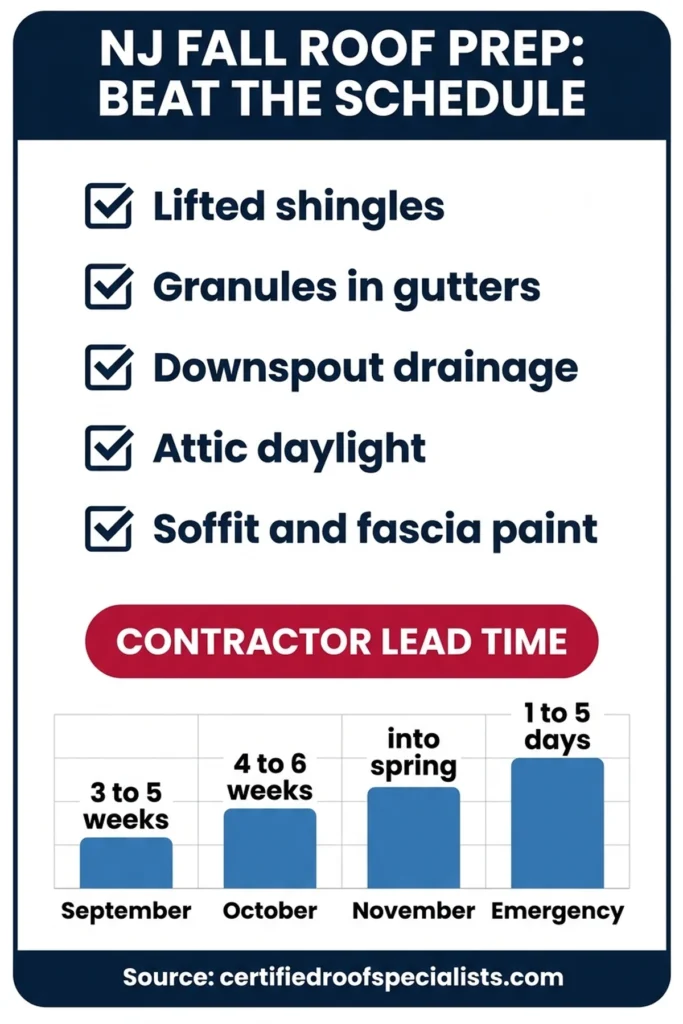
Fall roof prep NJ starts in September, before the first hard freeze. Fall roof prep in NJ comes down to timing. Check your roof from the ground and the attic now, prioritize flashing and any active leaks first, and book any work in September or early October. NJ contractor lead times run about 3 to 5 weeks in September and 4 to 6 weeks in October, and asphalt shingles install best before daily temperatures fall below 40 degrees in mid-to-late November. Wait too long and the choice becomes an emergency repair or a winter with a roof you already know is failing.
Here is the trap. It is mid-October, a nor’easter is tracked for Thursday, and you finally call about the two lifted shingles you noticed in August. The earliest appointment is six weeks out, past Thanksgiving. The storm arrives on schedule. That sequence is common for NJ homeowners who wait, and it is entirely avoidable.
This guide covers what you can check yourself, what a professional inspection adds, how to rank repairs by urgency, and how to time a replacement so your current roof does not have to survive another NJ winter. If a summer storm already hit, start with our summer storm roof prep guide.
Fall Roof Prep NJ: Why September Is the Window
NJ roofing schedules follow a predictable seasonal curve. Summer storm repairs and spring-assessment jobs fill the calendar from July on, so by late September most contractors are booking into November, and by October new replacements push toward spring. The schedule fills from the top: the slot you want in October is being claimed by the homeowner who calls in September.
| When you call | Typical lead time | Likely install window |
|---|---|---|
| September | 3 to 5 weeks | October, the ideal asphalt window |
| October | 4 to 6 weeks | November, weather permitting |
| November | Into spring for replacement | Spring, with the old roof carrying the winter |
| Emergency (any month) | 1 to 5 days | Tarping now, permanent repair when scheduled |
A September call typically lands an October installation, after the summer heat and before hard freezes set in. That is the best installation window for asphalt shingles in NJ. A late-October call usually means spring, which means your current roof has to make it through the winter.
What to Check Yourself, From the Ground Only
Do not go on your roof. A single missed step on a worn shingle is a serious fall, and you can gather most of what you need from the ground or the attic. Walk the perimeter and look for:
- Missing or lifted shingles. Stand at the corners and scan each slope. Lifted tabs at the perimeter or ridge are visible from the ground; missing shingles leave dark patches of exposed underlayment.
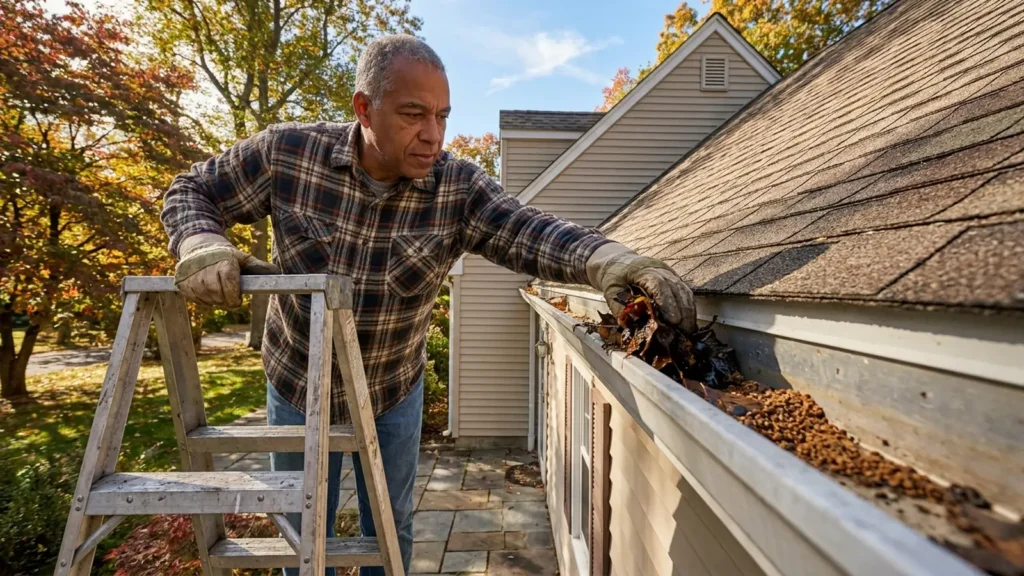
- Granules in the gutters. A light dusting is normal wear. A heavy, consistent pile along the gutter seam signals late-stage shingle wear, often only a few years of life left.
- Downspout drainage. Confirm downspouts run freely and extend at least four feet from the foundation. Clogged downspouts back water up to the drip edge, where it reaches the fascia and soffit.
- Daylight in the attic. On a sunny day, let your eyes adjust and look for pinpoints or streaks of light through the deck. Any gap is a water path.
- Soffit and fascia paint. Peeling paint is a moisture signal, meaning water is reaching the wood from a failed gutter, shingle overhang, or attic ventilation problem.
What a Professional Fall Inspection Covers
A CRS fall inspection takes 30 to 60 minutes and reaches what a ground walkthrough cannot:
- Every shingle slope, including north faces where moss and algae colonize first.
- Flashing at every penetration: chimneys, pipe boots, skylights, and roof-to-wall transitions, the most common source of interior leaks in NJ.
- Ridge cap fasteners, which loosen under multidirectional wind and pull free in a nor’easter.
- Attic moisture and ventilation balance between soffit intake and ridge or box exhaust, per Energy Star ventilation guidance.
- Deck condition, probing for soft spots where moisture cycling has weakened the sheathing.
The inspection produces a written report with photos and a condition rating for each component. For the full scope, see what a NJ roof inspection includes.
Which Repairs to Prioritize Before Winter
| Priority | Finding | Why it ranks here |
|---|---|---|
| 1. Now | Active leak or attic daylight | Water in the structure compounds daily; tarp and repair cannot wait |
| 2. Within 30 days | Flashing failure at chimney or pipe boot | A $250 to $600 fix prevents $4,000 to $15,000 in interior damage |
| 3. Before first storm | Missing or cracked ridge caps | The ridge is where nor’easter wind drives rain in |
| 4. Before hard freeze | Lifted shingles at seams and edges | Still re-securable now; a full lift becomes an emergency |
| 5. Monitor and plan | Granule loss and surface cracking, no active failure | Aging, not failing; plan a replacement on your terms |
Get ahead of the fall schedule crunch
A free CRS inspection takes 30 to 60 minutes and gives you a written report with photos, so you know what your roof needs before the calendar closes the fall install window.
Timing a Replacement Before the Cold
Asphalt shingles install down to about 40 degrees. Below that, the self-sealing strips do not activate, since they bond by softening in warmth. Below 40 degrees, shingles need hand-sealing with roofing cement, which adds labor and a quality variable, and most NJ contractors will not install standard asphalt below about 35 degrees.
In NJ, average daily temperatures slip below 40 degrees in mid-to-late November in most years. October installs proceed normally, early November is usually fine, and mid-November onward becomes weather-dependent. You can track the turn through the National Weather Service forecast for your area.
A September or October replacement beats a spring one for a single reason: you do not spend the winter under a roof you already know is failing. Spring is logistically easier, but it requires your current roof to survive another full NJ winter of freeze-thaw and nor’easters. If it cannot, the tidy spring plan turns into a January emergency. If your roof is sound and you simply want to stay ahead of problems, a CRS protection plan adds scheduled inspections with written reports so a concern is caught early, not discovered as a leak.
Roof repair service · Protection plans · What a roof inspection includes · Summer storm prep · Find your CRS town
Last updated September 9, 2026. Written by the Certified Roofing Specialists Inc. team, licensed New Jersey roofing contractors serving Monmouth, Ocean, Middlesex, Somerset, and Union Counties.
Common questions
Frequently Asked Questions
When should I prep my roof for winter in NJ?
Handle fall roof prep in September and early October. NJ contractor lead times stretch from about 3 to 5 weeks in September to 4 to 6 weeks in October, and asphalt shingles install best before daily temperatures drop below 40 degrees in mid-to-late November. Acting early keeps a fall installation on the table instead of waiting for spring.
Can a roof be replaced in winter in NJ?
It can, but most NJ contractors will not install standard asphalt shingles below about 35 degrees because the self-sealing strips need warmth to bond. Below 40 degrees, shingles often need hand-sealing, which adds labor and risk. A September or October install avoids carrying a failing roof through the winter.
What is the most common roof problem found in a fall inspection?
Flashing failures at chimneys, pipe boots, and roof-to-wall transitions are the most common source of interior water damage in NJ, more common than failed shingles. A flashing repair runs roughly $250 to $600 and can prevent thousands of dollars in ceiling, insulation, and drywall damage over the winter.
-

Emergency Roofing in NJ: Storm Damage Response
Emergency roofing NJ: what to do after storm damage, how fast to get a tarp on, what it…
-
Community Association Roofing in NJ: A Property Manager’s Guide
Community association roofing NJ: a property manager guide to multi-building bids, board-ready scopes, reserve-study documentation, and scheduling.
-
Insurance Claim for an Old Roof in NJ: What to Know
Insurance claim for an old roof in NJ: how age cuts your payout, ACV vs RCV explained, what…