10 Questions to Ask Any NJ Roofing Contractor Before Hiring
The questions to ask a roofing contractor in NJ are simple, but the answers reveal a lot. Before any NJ roofer gets on your roof, get clear answers to these 10 questions to ask a roofing contractor in NJ: HIC license, whether the job needs a permit, the exact shingle, the workmanship warranty, manufacturer certification, deck-damage process, crew and insurance, how they measure, cleanup, and pre-installation prep. A good contractor answers all of them directly and in writing. Vague answers, deflection, or pressure to stop asking tells you something too.
What a roofing contractor says, and what they do not say, tells you most of what you need to know about who you are hiring. Here are the ten, with what a good answer and a red-flag answer look like.
The 10 Questions to Ask a Roofing Contractor in NJ
1. Are You a Licensed NJ Roofing Contractor (HIC)?
NJ law requires any roofing contractor performing home improvement work over $500 to hold an HIC registration from the NJ Division of Consumer Affairs. Ask for the number and verify it at njconsumeraffairs.gov; it takes 30 seconds.
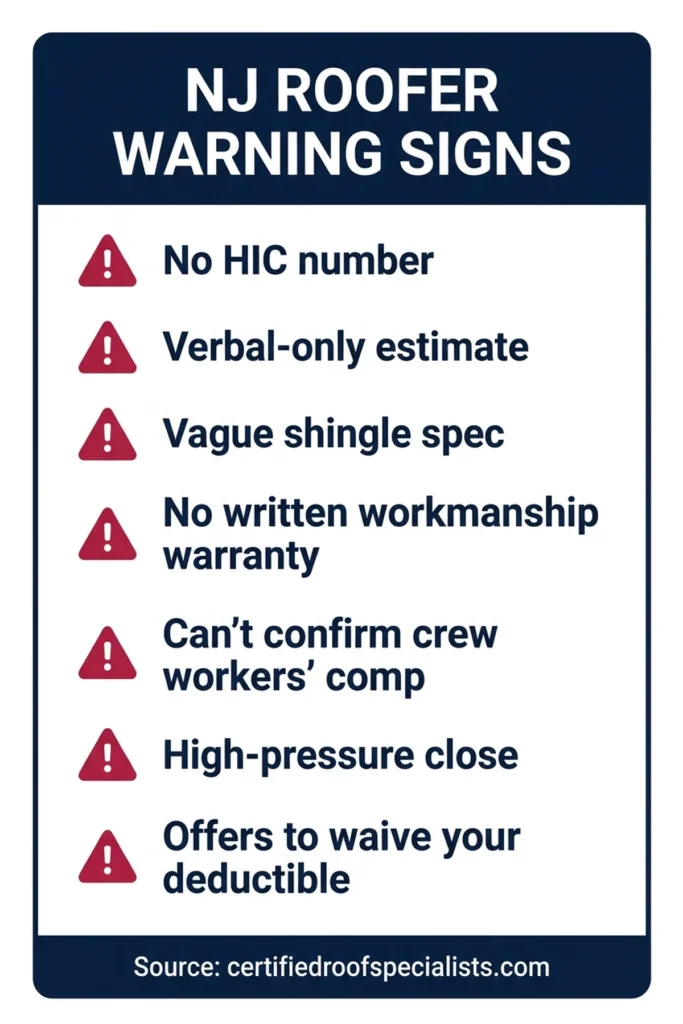
Good answer: provides an NJ HIC number immediately. Red flag: hesitates, says they are “registered” without a number, or says licensing does not apply to them.
2. Will this job need a permit, and who pulls it?
This is a quiet competence test. In New Jersey, a standard re-roof on a one or two-family home is classified as ordinary maintenance and does not require a building permit. A permit is required only for structural work (altering rafters or the roof structure), rooftop solar, or condominium and multi-unit buildings, and the roofing contractor should pull it on those jobs.
Good answer: “A straight re-roof on your house needs no permit; if we find structural work, we pull the permit and budget for the inspection.” Red flag: insists a simple single-family re-roof needs a paid permit (they do not know the code or are padding the bill), or tells you to pull it yourself.
3. What specific shingles are you installing?
You need the brand, product line, and weight class, not a category. The difference between a standard and a premium line is real, and it affects price, appearance, and warranty tier.
Good answer: “GAF Timberline HDZ in Charcoal” or “CertainTeed Landmark PRO in Weathered Wood.” Red flag: “architectural shingles” or “30-year shingles” with no detail. You cannot compare bids without knowing exactly what each installs.
4. What does your workmanship warranty cover, and for how long?
Manufacturer warranties cover the shingles. Workmanship warranties cover how they were installed, and installation errors are the most common cause of early failure. Get the terms in writing before you sign.
Good answer: describes specific coverage and hands you a written warranty. Red flag: verbal only, vague (“we stand behind our work”), or deferred until after the job.
5. Are you enrolled in a manufacturer’s certified contractor program?
GAF Master Elite and CertainTeed SELECT ShingleMaster are the two primary programs in NJ. Enrollment requires training, audits, and insurance standards, and in return those contractors can register enhanced warranties (covering both materials and labor) that standard contractors cannot. GAF states only about 3 percent of US contractors qualify for Master Elite.
Good answer: names the program, can show documentation, and explains what enhanced warranty it unlocks. Red flag: unfamiliar with certified programs or dismisses them as “just marketing.” (Ask what enhanced warranty they can register and verify the credential with the manufacturer.)
6. How do you handle deck damage found after tear-off?
Old decking often has rot or soft spots only visible once shingles come off. How a roofing contractor handles that mid-job moment tells you a lot.
Good answer: “We photograph the damage, write up the cost, and get your approval before doing anything additional.” Red flag: vague, or “we just take care of it and bill you” (no approval, no limit on added cost).
7. Who is actually on my roof, and are they insured?
Some NJ companies use direct crews; others use vetted subcontractor crews. Neither is automatically wrong, but you should know who is on your home and that they are covered.
Good answer: explains clearly whether crews are employees or vetted subcontractors and confirms all workers carry workers’ compensation. Red flag: evasive, or confirms subcontractors but cannot confirm workers’ comp. If an uninsured worker is hurt on your property, you could be liable.
8. How do you measure my roof?
Accurate measurement drives accurate estimates. Aerial measurement software (EagleView is the industry standard) calculates square footage, pitch, and hip-and-ridge lengths with high accuracy.
Good answer: “We use EagleView or equivalent for every estimate.” Red flag: a visual estimate from the ground or “we’ll figure it out up there.” Inaccurate measurements mean inaccurate material orders and shaky pricing.
Get straight answers to all 10 questions, in writing
CRS answers every one of these as part of our standard process, in writing, before you sign anything. Start with a free inspection.
9. What cleanup does your quote include?
Reroofing produces a large volume of debris (old shingles, underlayment, nails), and all of it should be gone when the crew leaves. Three things should be explicit: dumpster placement and removal, full debris haul-off, and a magnetic nail sweep of the driveway, walkways, and yard near the drip edge.
Good answer: all three listed in the written estimate. Red flag: “we clean up after ourselves” with no specifics. Ask for it in writing.
10. What do I need to do before installation day?
A professional contractor prepares you for the day, not just the estimate.
Good answer: clear the driveway for the dumpster and crew vehicles, move or protect plants and patio furniture below the roofline, arrange for pets, and let close neighbors know there will be early noise and activity. Red flag: no pre-installation briefing at all. If they have not thought about what you need to do, they may not be thinking carefully about the job. For the full list, see our NJ pre-construction checklist.
How to choose a roofing contractor · About Certified Roofing Specialists · 2026 NJ cost guide · NJ roofing warranty guide · All FAQs
Last updated September 14, 2026. Written by the Certified Roofing Specialists Inc. team, licensed New Jersey roofing contractors serving Monmouth, Ocean, Middlesex, Somerset, and Union Counties.
Common questions
Frequently Asked Questions
How many roofing quotes should I get in NJ?
Three is a reasonable number. Do not automatically take the middle price; compare what each estimate actually includes. A higher quote that lists ice-and-water shield, drip edge, flashing, and a written warranty is often a better deal than a cheaper one that leaves them out.
Should I pay a large deposit before roofing work in NJ?
A deposit at signing is standard, but full payment before any work begins is a fraud risk. The NJ norm is a deposit plus the balance due after the final walkthrough. Pay by a traceable method, never cash, and get the payment schedule in writing.
Do I need a permit to replace my roof in NJ?
For a standard single-family re-roof, no. New Jersey classifies it as ordinary maintenance, so no building permit is required. Permits apply to structural work (altering rafters or the roof structure), rooftop solar, and condominium or multi-unit buildings. Confirm specifics with your local construction office before work starts.
-

Do You Need a Permit to Replace a Roof in NJ?
Roof replacement permit NJ: a standard one or two-family re-roof needs no permit. Here is when you do…
-
What Separates Great NJ Roofers From the Rest
What separates great NJ roofing contractors from the rest: licensing, real crews, honest inspections, and the details that…
-
Roof Replacement Cost in Middlesex County NJ (2026)
Roof replacement cost Middlesex County NJ: 2026 price ranges by home size for Edison, Woodbridge, and Old Bridge,…