Do You Need a Permit to Replace a Roof in NJ?

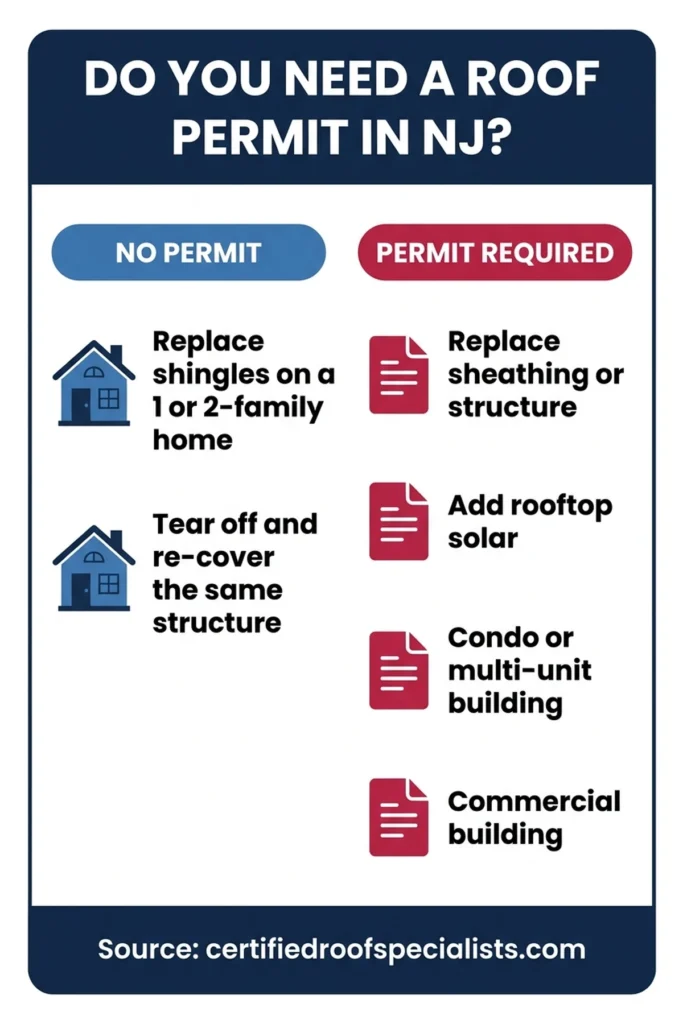
A roof replacement permit NJ homeowners ask about is usually not required. For a standard one- or two-family home, you do not need a permit to replace your roof in NJ. Since March 2018, the state classifies replacing the roof covering as “ordinary maintenance,” which needs no building permit. You do need a roof replacement permit when the job goes beyond the covering: replacing the roof sheathing or structure, adding rooftop solar, or any work on a condo, multi-unit, or commercial building. When a permit is required, your licensed contractor pulls it. Always confirm specifics with your local construction office.
This trips up a lot of NJ homeowners, partly because plenty of websites still say a permit is “required in every municipality.” For a simple re-roof on a house, that has not been true since the rule changed. Here is the accurate breakdown of when a permit applies, who handles it, and what it covers.
When You Need a Roof Replacement Permit NJ
The line is simple: replacing the covering on a one- or two-family home is maintenance, and maintenance needs no permit. The moment the work touches structure, solar, or a multi-unit building, a permit applies.
| The roofing job | Permit in NJ? |
|---|---|
| Replace shingles on a one- or two-family home (a standard re-roof) | No, ordinary maintenance |
| Tear off to the deck and re-cover the same one- or two-family structure | No, if the deck is not replaced |
| Replace roof sheathing/decking or rafters/trusses | Yes, structural work |
| Add rooftop solar panels | Yes |
| Re-roof a condo, townhouse, or other multi-unit building | Yes |
| Re-roof a commercial building | Yes |
Because the deck is hidden until tear-off, a job can start as no-permit maintenance and turn into permit territory if the crew finds rotted sheathing that must be replaced. A good contractor flags that, gets your approval, and pulls the permit if the structural scope requires it. The classification comes from the NJ Division of Codes and Standards.
No Permit Does Not Mean “Not to Code”
This is the part that matters most. A re-roof needing no permit still has to meet NJ code: the correct nailing pattern for the wind zone, balanced attic ventilation, ice-and-water shield at eaves and valleys, proper drip edge, and code-compliant flashing at every penetration. The permit is a municipal inspection step, not the definition of a code-compliant roof.
It also matters for your warranty. Manufacturer warranties require a code-compliant installation, not a permit. A roof can be fully code-compliant with no permit (a standard re-roof), and a roof can be permitted yet still installed wrong. So the question to ask a contractor is not “did you pull a permit?” but “will this meet code, and can you show me the installation specs?” For more, see our questions to ask a roofing contractor.
Who Pulls the Permit, Cost, and Timing
When a permit is required (structural, solar, or multi-unit work), the licensed contractor pulls it, not the homeowner. If a contractor asks you to pull a required permit yourself, treat that as a red flag, and you can verify any contractor’s registration at NJ Consumer Affairs.
Where a permit applies, NJ municipalities typically charge $100 to $400 depending on scope, and issue it within 1 to 5 business days, sometimes 7 to 10 in peak season. The permit triggers a municipal inspection against the installation standards NJ adopts: underlayment and ice-and-water coverage, flashing, fastening, ventilation, and drip edge. You receive a certificate of approval when it passes.
Not sure if your job needs a permit? We will tell you straight
A free CRS inspection gives you a written scope that spells out exactly what your roof needs and whether any permit applies, before you sign anything.
Permits and Selling Your Home
A standard re-roof done with no permit is not a resale problem, because no permit was required. The concern at sale is different work done without a required permit: structural or sheathing replacement, a solar install, or a multi-unit job. If that happened, a buyer’s inspector or attorney may flag it, and you could need a retroactive permit, a penalty, and re-inspection before closing.
If you are preparing to sell and are not sure whether past work needed a permit, a CRS inspection documents the roof’s current condition and scope in writing, so you know where you stand before you list. See our roof replacement service and the Middlesex County cost guide for how scope and price come together.
Questions to ask a roofing contractor · Roof replacement service · Middlesex County roof cost · Find your CRS town
This content is educational; confirm requirements with your local construction office. Last updated September 28, 2026. Written by the Certified Roofing Specialists Inc. team, licensed New Jersey roofing contractors serving Monmouth, Ocean, Middlesex, Somerset, and Union Counties.
Common questions
Frequently Asked Questions
Do you need a permit to replace a roof in NJ?
Not for a standard one- or two-family home. Since March 2018, NJ classifies replacing the roof covering as ordinary maintenance, which needs no building permit. You do need one if the work replaces sheathing or roof structure, adds rooftop solar, or is on a condo, multi-unit, or commercial building. Confirm with your local construction office.
Does no permit mean the work is not up to code?
No. A standard re-roof still must meet NJ code on nailing pattern, ventilation, ice-and-water shield, drip edge, and flashing. A permit is a municipal inspection step, not the definition of code compliance. Manufacturer warranties also require code-compliant installation, whether or not a permit was pulled.
A previous owner re-roofed without a permit. Is that a problem at sale?
Usually not, if it was a standard re-roof, because no permit was required. It only becomes an issue if structural or sheathing work, solar, or a multi-unit job was done without a required permit. In that case you may need a retroactive permit, a penalty, and re-inspection before closing.
-

What Separates Great NJ Roofers From the Rest
What separates great NJ roofing contractors from the rest: licensing, real crews, honest inspections, and the details that…
-
Roof Replacement Cost in Middlesex County NJ (2026)
Roof replacement cost Middlesex County NJ: 2026 price ranges by home size for Edison, Woodbridge, and Old Bridge,…
-
Roof-Over vs Tear-Off in NJ: What the Code Says and What It Costs
Roof over vs tear off NJ: why a second layer is cheaper now but costs more later, what…