Community Association Roofing in NJ: A Property Manager’s Guide
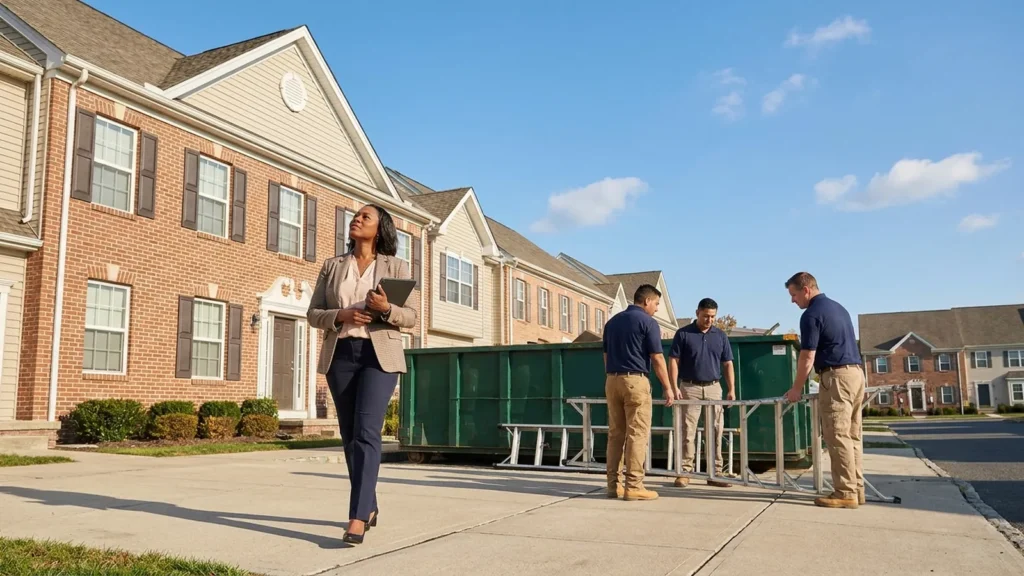
Community association roofing NJ works differently than a single-family reroof. Community association roofing in NJ operates under different constraints than residential work: larger scope, reserve-funding requirements, board approval, mandatory permits and inspections, and documentation standards that single-family projects never touch. This property manager’s guide covers vetting contractors for multi-building work, sequencing phased replacements by condition, and producing documentation your reserve study and insurance carrier can actually use.
It is written for property managers and HOA board members who have managed contracts before and need specific, usable detail. For the budgeting mechanics, pair this with our NJ HOA reserve-study guide; for the broader overview, the NJ community association roofing guide.
Community Association Roofing NJ vs Residential
The gap between a single-family roof and a community association project is not just scale. Several structural differences change how you plan, procure, and manage the work.
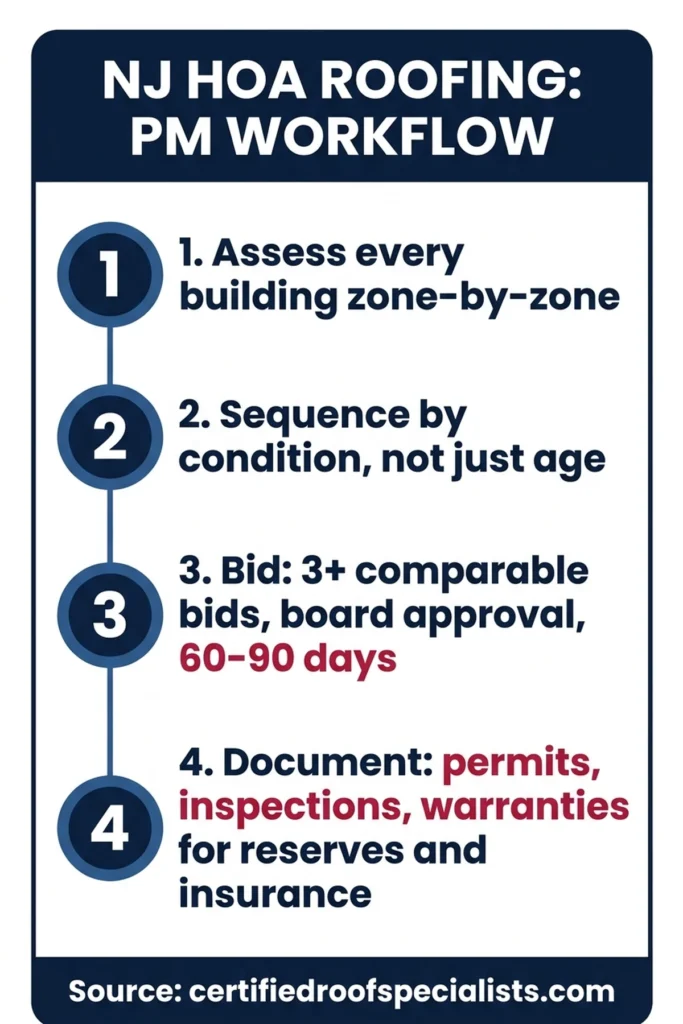
Phased replacement planning. Most NJ associations cannot replace all roofs at once: budget, board approval timelines, and contractor capacity all limit scope in any year. A responsible approach evaluates all buildings at once, then sequences by condition and remaining useful life, not just age. A 1990s townhome with a south-facing exposure may need replacement before a 1985 building with adequate shade and ventilation.
Reserve-study alignment. Under NJ’s reserve-study law, S2760 as amended by S3992, most condos, co-ops, and larger planned developments must maintain a reserve study and a 30-year funding plan, and roofing is typically the largest single line item. Those projections are only as accurate as the underlying condition assessment: “roofs are in fair condition” is not the same as a written report with zone-by-zone ratings and photographs. The mechanics are in our reserve-study guide.
Permits and inspections are mandatory here. Unlike a single-family re-roof (classified as ordinary maintenance, no permit), roofing on condominium, multi-family, and attached-community buildings requires construction permits and municipal inspections under the NJ Uniform Construction Code, administered by the NJ Division of Codes and Standards. Budget the time and keep the records.
Insurance documentation. Association master policies have specific documentation requirements, and after a storm, adjusters ask for pre-loss condition documentation. A community with annual written assessments on file for each building is in a far stronger position than one relying on verbal history.
The bidding process. Most NJ associations require at least three written bids and formal board approval before any major capital expenditure. Plan a 60 to 90 day procurement timeline for bid solicitation, board review, and contract execution.
What a NJ Community Association Board Should Look For
Insurance that matches the scope. Residential general liability is not sufficient for multi-unit work. Require commercial general liability with limits appropriate to the contract value (commonly $2 million per occurrence minimum for larger associations), plus a commercial umbrella and workers’ compensation, with the association named as additional insured. Collect the certificate before contract execution, not after.
Experience with phased, multi-building replacement. Ask for references from comparable NJ associations (similar unit count and building configuration). A contractor whose residential work is excellent may lack the project-management capacity to coordinate 15 buildings over two or three budget cycles.
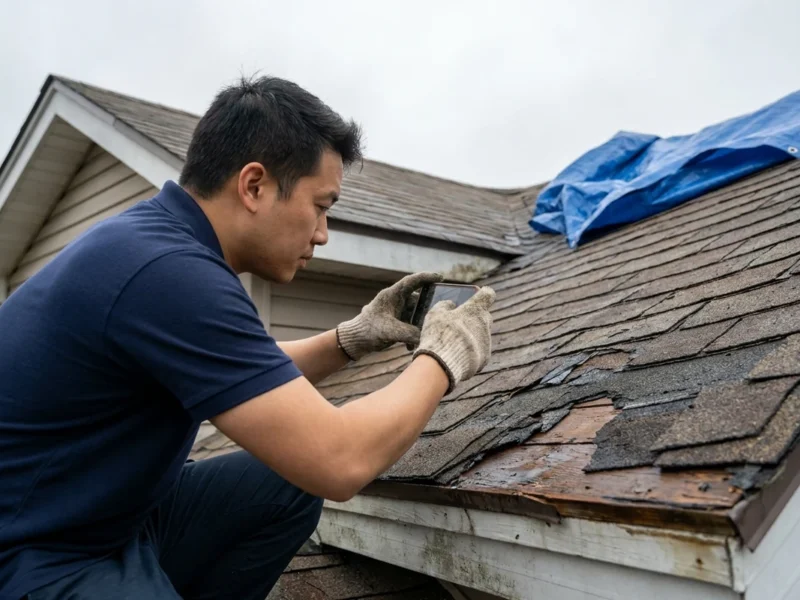
Zone-rated condition reports. The documentation a contractor produces for your reserve specialist, your insurer, and your board must be specific: written reports with photographs, condition ratings by building and roof zone, and recommended replacement sequencing, not a summary email.
A clear change-order process. Across buildings, conditions vary in ways not always predictable before tear-off (rot, deck damage, ventilation deficiencies). The contract should define exactly how additional work is authorized: written change order, board approval required, no additional cost incurred without sign-off. Vague in conversation means vague in execution.
References from comparable NJ communities. Get two or three contacts at associations they have completed phased work for, and call them. Ask specifically about change-order management, communication during active phases, and whether the documentation delivered was usable for reserve and insurance purposes. For the general baseline, see how to choose a roofing contractor in NJ.
The Documentation You Should Demand, and Use
Associations that manage roofing proactively accumulate documentation that pays off at reserve studies, insurance claims, lender requirements for unit sales, and board transitions.
- Written condition assessment per building with an overall rating, zone-by-zone evaluation (field, ridges, valleys, penetrations, drip edges), photographs of every observed condition, and a recommended action (monitor, repair, or replace).
- Phased replacement recommendation with projected costs per phase, feeding directly into your reserve-study update and capital budget.
- Certificate of insurance naming the association as additional insured, collected before each phase begins and updated at renewal.
- Permits pulled and inspection records retained by the association, not just the contractor. These confirm the work was inspected and approved, which matters for insurance and for unit sales where buyers and lenders ask.
- Post-completion package at the close of each phase: a summary by building, manufacturer and workmanship warranty documents, permit closure records, and photographs of the completed installation. This supplements the reserve study and serves as pre-loss documentation for insurance.
Timing and Phasing Strategy for NJ Communities
Assess all buildings before committing to a sequence. Even if budget allows only two buildings this year, you need condition data on all of them, or you are sequencing without the full picture. A building that looks fine outside may have significant deck deterioration that makes it a higher priority than its age suggests.
Sequence by condition, not just age. Age is a starting point. Condition, confirmed by a professional assessment, is the determining factor. Two buildings of the same year and materials can differ meaningfully based on exposure, ventilation, and maintenance history.
Plan 60 to 90 days ahead of your target start. July through September is the peak NJ roofing window and schedules fill quickly. A community that starts the bid process in April for a September start has more options than one starting in June; for multi-building projects requiring board approval, add at least 30 days.
Emergency-response provisions belong in the contract. Storms do not wait for planned cycles. Any ongoing phased-replacement relationship should include emergency provisions: temporary weatherproofing, priority scheduling for storm-affected buildings, and a defined response-time commitment.
Request a multi-building roof assessment
CRS visits your community, assesses every building, and delivers written per-building reports with photos, zone ratings, and a phased replacement proposal your reserve study and insurer can use.
Budget Planning Considerations
Multi-unit roofing is priced differently than residential. Larger scope generally produces better per-square pricing, but several CA factors add complexity and cost:
- Access complexity (townhome configurations, shared walls, limited staging)
- Parapet walls and low-slope transitions requiring different materials and methods
- Units sharing a continuous roof plane, so work must be sequenced to keep every unit weatherproofed throughout
- Disposal logistics on dense sites
- Permit, inspection, and compliance-documentation requirements
Obtain current bids with specific scope documents; ranges from prior years will not reflect current material and labor costs, so this guide does not quote per-square figures. A written condition assessment and phased proposal from CRS is suitable for your reserve-study update: your reserve specialist can use the zone-rated reports, remaining-useful-life estimates, and phased cost projections directly. The Community Associations Institute publishes reserve-study standards your specialist will follow.
Community association roofing service · NJ community association roofing guide · How NJ HOAs budget a roof replacement · Pre-construction checklist · Manchester · Brick · Toms River
This content is educational. Certified Roofing Specialists Inc. is a licensed NJ roofing contractor, not a reserve-study preparer, financial advisor, or attorney. For reserve-study and funding requirements, consult a credentialed reserve specialist and your association attorney. Last updated October 12, 2026. Serving Monmouth, Ocean, Middlesex, Somerset, and Union Counties.
Common questions
Frequently Asked Questions
Does NJ require community associations to keep a reserve study for roofs?
Yes. Under S2760 (as amended by S3992), most New Jersey condominiums, cooperatives, and planned developments with at least $25,000 in common-area capital assets must maintain a reserve study with a 30-year funding plan whose balance never falls below zero. Roofing is usually the single largest line item, so accurate per-building condition data matters. Confirm specifics with your association attorney.
Do community-association roof replacements need a permit in NJ?
Yes. Unlike a single-family re-roof (classified as ordinary maintenance, no permit), roofing on condominium, multi-family, and attached-community buildings requires construction permits and municipal inspections under the NJ Uniform Construction Code. Keep each permit and inspection record in the association file; lenders and buyers’ attorneys ask for them at unit sales.
How far ahead should an HOA plan a roof replacement in NJ?
Plan 60 to 90 days for bid solicitation and board approval ahead of your target construction start, and add time in the peak July-to-September window when contractor schedules fill. Assess every building first, then sequence replacements by condition, not just age.
-

Emergency Roofing in NJ: Storm Damage Response
Emergency roofing NJ: what to do after storm damage, how fast to get a tarp on, what it…
-
Insurance Claim for an Old Roof in NJ: What to Know
Insurance claim for an old roof in NJ: how age cuts your payout, ACV vs RCV explained, what…
-
Roof Protection Plan vs Home Warranty: What NJ Homeowners Need to Know
Roof protection plan vs home warranty NJ: what each actually covers, where home warranties fall short on roofs,…