
Roof Vent Boot Leak in NJ: The Small Part That Fails First
A roof vent boot leak NJ homeowners find in winter starts at the collar sealing a pipe where it passes through the roof, not at the shingles around it. That collar is usually rubber, it is the shortest-lived part on the whole roof, and it splits from years of sun long before anything else fails.
This is one of the smallest components on a New Jersey roof and one of the most common reasons a ceiling gets wet. A pipe boot is a low-cost part. Left alone, it drops water onto the sheathing, down a rafter, and into the drywall of whatever room sits under the bathroom stack.
Be clear about what this is not. It is not a joint where the roof meets a wall or a chimney, which is our post on a chimney flashing leak in NJ. It is not the channel between two slopes, which is a roof valley leak in NJ. And if you have no idea yet where the water is entering, start with our broader roof leak repair guide for NJ.
What Exactly Is a Roof Vent Boot Leak NJ Homeowners Are Dealing With?
Every house has plumbing vent stacks: pipes that carry sewer gas up and out through the roof so the drains can breathe. Each one punches a hole through a waterproof surface, and each one gets a boot, which is a flange that lies under and over the surrounding shingles with a collar that grips the pipe.
Four kinds are common on New Jersey roofs.
| Boot type | What it looks like | How it fails | Relative service life |
|---|---|---|---|
| Rubber collar on a metal flange the common one | A black rubber ring gripping the pipe, on a gray or brown metal base | The rubber hardens in the sun and splits in a ring right at the pipe | Shortest. Fails well before the shingles. |
| Lead boot | A soft dull-gray sleeve folded down inside the top of the pipe | Squirrels and birds chew the soft lip, or the fold gets pushed back open | Long, if nothing chews it |
| All-metal with a storm collar | A metal cone on the pipe with a separate banded ring above it | The sealant bead at the storm collar dries out and shrinks | Long, with the bead maintained |
| Retrofit slip-over collar | A newer rubber ring slipped over an older cracked one | Buys time only. The original flange under the shingles is untouched. | A patch, not a repair |
Notice the pattern in column three. Three of the four failures happen at the top, where the collar meets the pipe, and none of them happen at the shingles. That is why a homeowner looking at a perfectly good roof and a wet ceiling is not looking hard enough at the pipes.
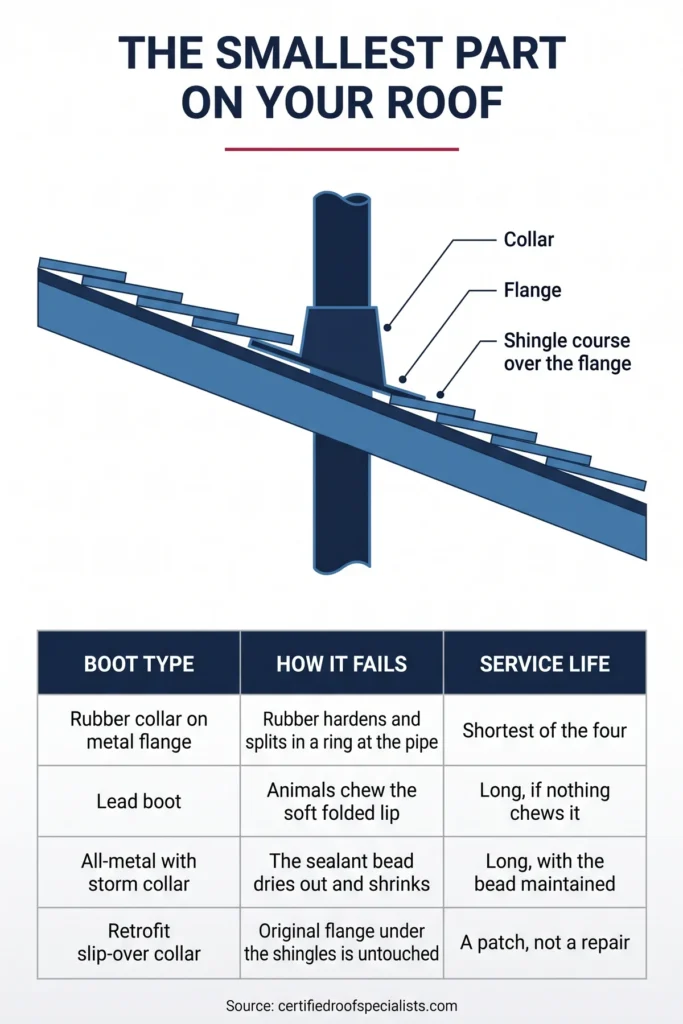
Embed this infographic on your site
Copy the code below to share this infographic with a link back to this guide.
<p><a href="https://certifiedroofspecialists.com/roof-vent-boot-leak-nj/"><img src="https://certifiedroofspecialists.com/wp-content/uploads/2026/10/roof-vent-boot-leak-nj-infographic.webp" alt="roof vent boot leak NJ: four pipe boot types compared by how each one fails and how long it lasts" style="max-width:100%;"></a></p>
<p>Source: <a href="https://certifiedroofspecialists.com">Certified Roofing Specialists</a></p>
What Are the Signs of a Roof Vent Boot Leak NJ Winters Bring Out?
A failing vent boot shows four signs, and the location of the stain is the strongest clue. Look for a ceiling stain in or next to a bathroom, a visible split in the black rubber ring, rust or dark staining on the shingles just below one pipe, and a damp ring on the attic sheathing around a pipe.
- A ceiling stain in or next to a bathroom. Plumbing stacks sit above the bathrooms and the kitchen. A round or ring-shaped stain in that footprint points at a boot before it points at anything else.
- A visible split in the black rubber ring. From a second-floor window or with binoculars, a failed collar shows as a crack running around the pipe, often with the rubber curled back.
- Rust or dark staining on the shingles just below one pipe and nowhere else on the slope.
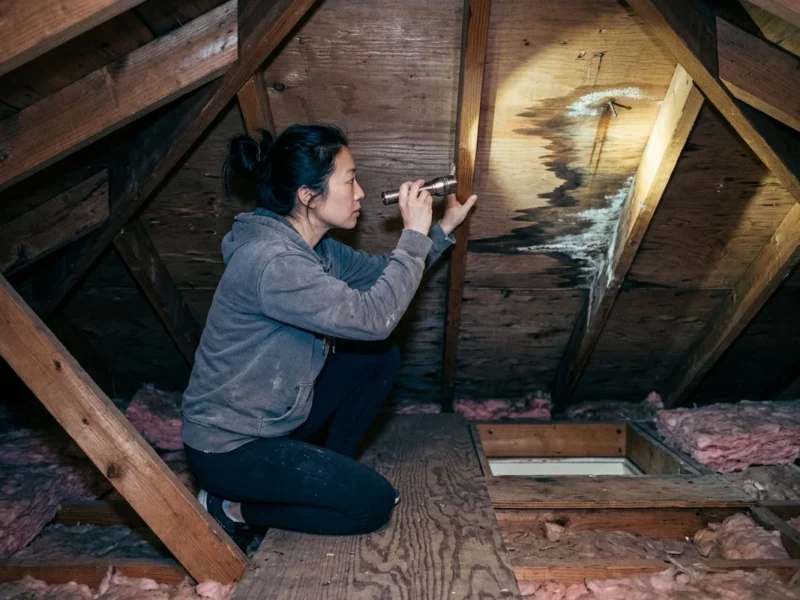
- A damp ring on the attic sheathing around a pipe, visible with a flashlight, sometimes with a rusted nail head at its center.
Because the boots on a house were all installed on the same day, the one that split is rarely the only one near the end. A proper visit checks every penetration rather than the one you pointed at, which is part of what a NJ roof inspection includes. The NRCA publishes the installation standards behind these details.
Frost on the stack, and why a roof vent boot leak NJ winter reveals looks different
Warm moist air from the drains rises up the stack and meets cold air at the top. In a New Jersey January that moisture freezes on the inside of the pipe and on the collar around it. When the sun comes out, it melts, and a collar that is already split takes that meltwater straight down the outside of the pipe and onto the deck.
Two consequences follow. A boot leak in winter often appears on a clear day rather than during rain, which sends people looking in the wrong direction entirely. And the freeze and thaw cycle levers an existing crack wider every night the temperature crosses freezing, so a hairline split in November is an open gap by February.
One thing to rule out while you are up there: frost forming on the underside of the attic sheathing across a wide area is a ventilation problem, not a boot problem, and it is covered in our guide to roof and attic ventilation in NJ. A boot leak is local to one pipe. Condensation is everywhere at once.
Have every pipe on your roof checked, not just the one that leaked
Boots age at the same rate, so the one that split is rarely the only one close to it. A CRS inspector photographs every penetration on the roof and tells you in writing which collars have cracked and which have a season left.
What Does a Real Boot Replacement Include?
The whole boot comes out, not just the collar. That means lifting the shingle courses above the flange, pulling the fasteners, removing the old unit, and setting a new one so the flange sits under the shingles uphill of the pipe and over the shingles downhill of it. Water has to cross the flange on top and never underneath.
- Shingles lifted, not cut, wherever they are still flexible enough to lift.
- The old flange removed rather than covered over.
- The sheathing around the pipe checked and replaced if it is soft.
- A new boot set with fasteners in the flange, sealed under the shingle courses above.
- Every other pipe on the roof looked at and reported on while the crew is up there.
Three things move the price: how many boots are being done, whether the surrounding shingles will lift without cracking, and whether decking has to come out. That middle one is the honest limit on repairing an old roof, because shingles past about fifteen years often break rather than bend, and then the repair grows into the courses around it.
If several boots are gone and the shingles are brittle, the arithmetic changes and the question stops being about boots. Our guide to roof repair against replacement covers that test.
A collar that cracked from age is generally treated by carriers as maintenance rather than sudden accidental damage, so a boot leak is usually not a claim. Wind that tore a boot off is a different case. Certified Roofing Specialists documents roof condition with photographs, measurements and a written report, and does not file, negotiate, or settle insurance claims on your behalf.
On permits, replacing a pipe boot on a one- or two-family New Jersey home is ordinary maintenance and needs no building permit. Replacing sheathing under it is structural work and does, and condominium, multi-family and attached-community buildings require one either way. Confirm the current requirement with your local construction office or the NJ Division of Codes and Standards. No permit never means no code.
Whoever you hire for a job this small, verify the New Jersey Home Improvement Contractor registration first at the NJ Division of Consumer Affairs. A small repair done by someone unregistered is still an unregistered contractor on your roof.
Roof leak repair in NJ · Roof valley leaks · Chimney flashing leaks · Roof ventilation in NJ · Roof repair services
Last updated November 23, 2026. Written by the Certified Roofing Specialists team, registered New Jersey home improvement contractors, NJ HIC registration #13VH14243900, serving Monmouth, Ocean, Middlesex, Somerset, and Union Counties. Call (201) 841-3858.
Common questions
Frequently Asked Questions
Can I just put sealant on a cracked pipe boot?
It buys a few months at most. Sealant on a split collar sits on a surface that flexes with every temperature change, so it opens again. Worse, it hides the crack from the next person who looks. Treat it as a stopgap while a replacement is scheduled, never as the repair.
How many vent pipes does a typical New Jersey house have?
Most homes have two to four plumbing stacks coming through the roof, usually above the bathrooms and the kitchen. Larger or added-onto houses have more. They were almost always installed on the same day, which is why they tend to fail within a season or two of each other.
Is a leak around a pipe the same as an attic ventilation problem?
No, and they get confused constantly. A plumbing stack carries sewer gas out of the drains. A ridge or box vent moves air through the attic. A cracked collar leaks water in; a poorly ventilated attic causes condensation. Different components, different fixes, sometimes both at once.
Does a new roof come with new pipe boots?
It should, and a complete estimate names them as a line item. Reusing old boots under new shingles is one way a low bid gets low, and it means the smallest component on the roof is also the oldest. Read the line items and ask before you sign.
-

Roof Valley Leak in NJ: Why the Channel Fails First
A roof valley leak NJ winters expose is a channel failure, not a joint. Compare open, closed-cut and…
-
Chimney Flashing Leak in NJ: Where the Water Really Gets In
A chimney flashing leak NJ winters expose starts at the joint, not the brick. See the five failure…
-
Emergency Roofing in NJ: Storm Damage Response
Emergency roofing NJ: what to do after storm damage, how fast to get a tarp on, what it…