TPO vs EPDM Flat Roof in NJ: Which Membrane Fits Your Roof?
Comparing TPO vs EPDM flat roof NJ options comes down to three things: seams, sun, and price. TPO is a white membrane with heat-welded seams that hold up well to New Jersey freeze-thaw winters and reflect summer heat. EPDM is a black rubber membrane that costs less up front but relies on glued seams.
If your home has a flat or low-slope section, a porch roof, a dormer, an addition, or a garage tie-in, shingles are the wrong tool for it. Water does not run off a flat surface fast enough for shingles to shed it, so these sections need a membrane. In New Jersey, the two membranes you will be quoted most often are TPO and EPDM, and the right answer depends on what sits under the roof and how long you plan to keep it.
This guide compares both membranes on cost, lifespan, seam strength, and cold-weather performance, using New Jersey conditions rather than national averages. New Jersey roofs take 8 to 12 freeze-thaw cycles in a typical winter, and that number decides more flat-roof arguments than any brochure.
TPO vs EPDM Flat Roof NJ Comparison at a Glance
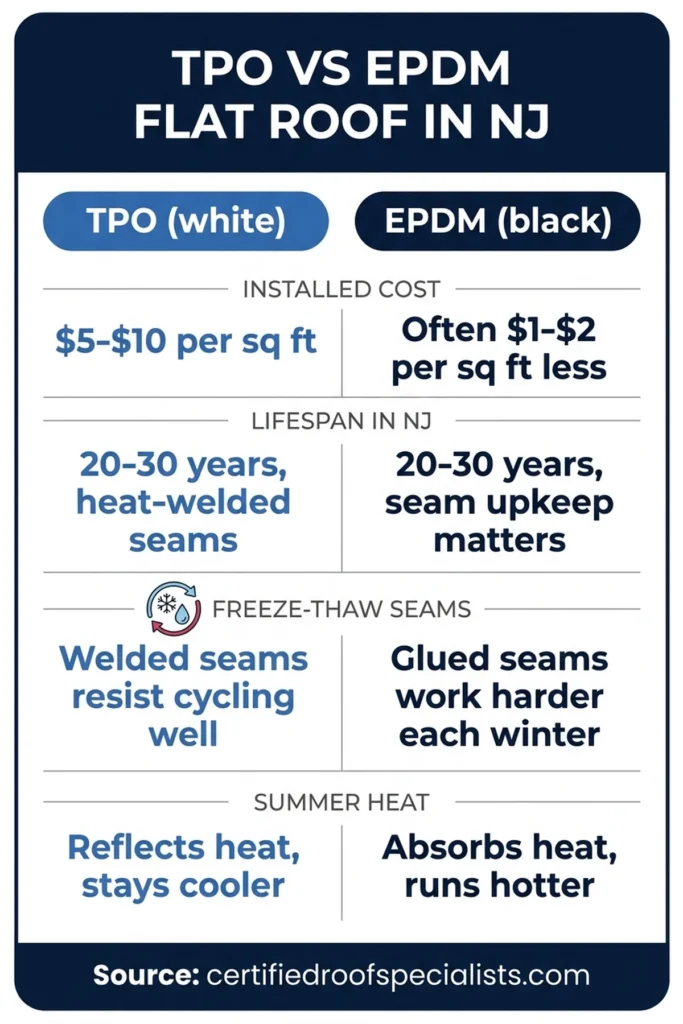
In the TPO vs EPDM flat roof NJ comparison, TPO is a white, heat-welded membrane at roughly $5 to $10+ per square foot installed, while EPDM is black rubber that usually bids $1 to $2 lower. Both last 20 to 30 years when installed well, and the seams decide how close each gets to the long end.
| TPO | EPDM | |
|---|---|---|
| What it is | White single-ply thermoplastic membrane | Black single-ply synthetic rubber membrane |
| Installed cost in NJ | Roughly $5 to $10+ per sq ft | Usually the lower bid of the two, often by $1 to $2 per sq ft |
| Expected lifespan in NJ | 20 to 30 years with heat-welded seams | 20 to 30 years; seam upkeep decides the high end |
| Seams | Heat-welded into one fused sheet, the strongest point of the system | Glued or taped, the most common failure point as adhesives age |
| NJ freeze-thaw (8 to 12 cycles/winter) | Welded seams resist cycling well; avoid cheaper cold-adhesive TPO installs | Membrane stays flexible in cold, but seam adhesives work harder each winter |
| Summer heat | White surface reflects heat and can ease cooling load over living space | Black surface absorbs heat; matters less over garages and porches |
| Ponding water | Needs proper slope (minimum 1/4 inch per foot) or tapered insulation | Tolerates light ponding somewhat better, but ponding still shortens any membrane |
| Repairs | Welded patches by a contractor with a hot-air welder | Simple glue-and-patch repairs; easy for any experienced flat-roof crew |
| Best-fit NJ situation | Flat sections over bedrooms and living space, larger low-slope areas, 55+ community buildings | Porch roofs, garages, small additions, budget-driven projects |
| The honest downside | Costs more, and a cold-adhesive TPO install gives up its main advantage | Glued seams age faster in freeze-thaw, and black rubber runs hot in summer |
The short version is that TPO buys stronger seams and a cooler surface for more money, while EPDM buys a proven, repair-friendly rubber roof for less.
Why Seams Decide Flat Roofs in New Jersey
A flat roof is only as good as the lines where two sheets of membrane meet. On a pitched shingle roof, gravity moves water off before it can find a weakness. On a flat section, water sits, freezes, expands, thaws, and tries again, 8 to 12 times in a normal New Jersey winter.
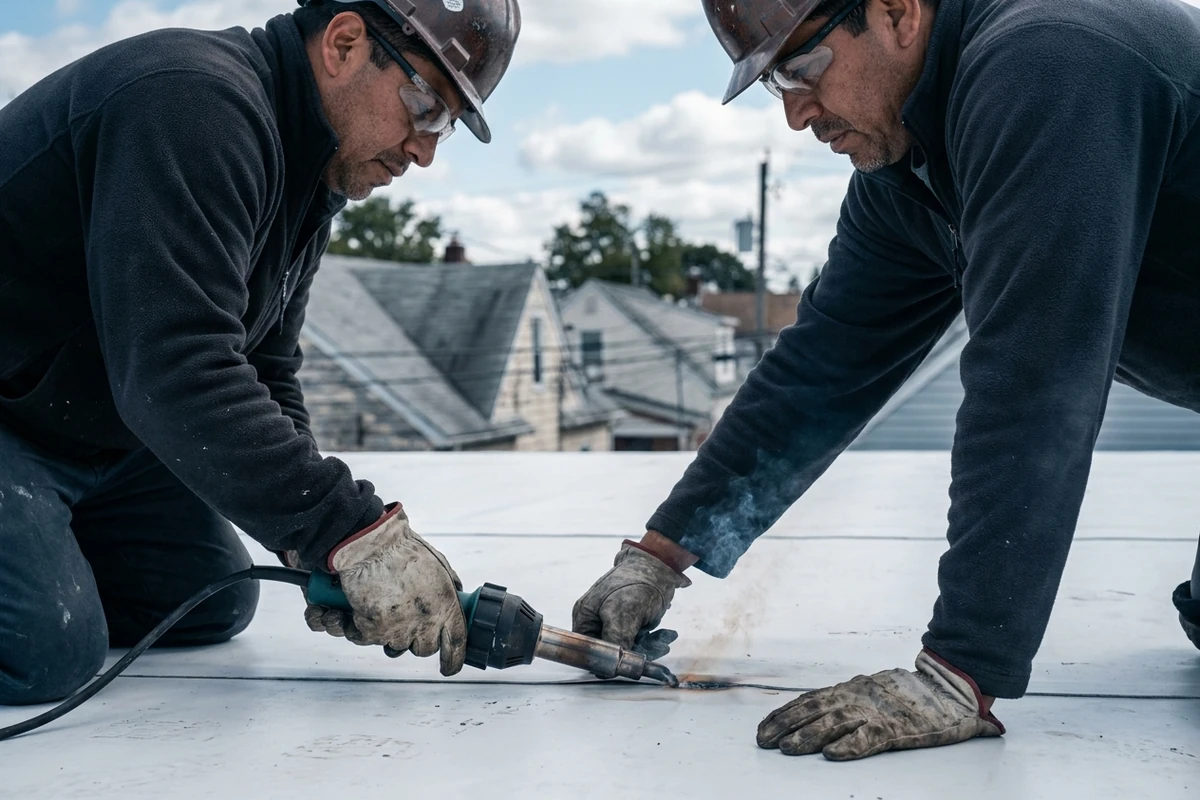
TPO seams are joined with a hot-air welder that fuses the two sheets into one continuous piece of plastic. Done correctly, the seam is stronger than the surrounding membrane. EPDM seams rely on adhesives or seam tape, which do their job well for years but age the way any glue ages, and freeze-thaw cycling accelerates that. This is why seam checks are the heart of any flat roof repair visit on an older EPDM roof.
Ask whether the seams will be heat-welded or cold-adhesive. Cold-adhesive TPO installs cost less, but they trade away the welded seam that makes TPO worth choosing in a freeze-thaw climate. If the answer is cold-adhesive, compare that bid against EPDM instead, because you are no longer buying TPO’s main advantage.
Embed this infographic on your site
Copy the code below to share this infographic with a link back to this guide.
<p><a href="https://certifiedroofspecialists.com/tpo-vs-epdm-flat-roof-nj/"><img src="https://certifiedroofspecialists.com/wp-content/uploads/2026/10/tpo-vs-epdm-flat-roof-nj-infographic.webp" alt="TPO vs EPDM flat roof NJ: installed cost, lifespan, freeze-thaw seams and summer heat compared" style="max-width:100%;"></a></p>
<p>Source: <a href="https://certifiedroofspecialists.com">Certified Roofing Specialists</a></p>
Where Each Membrane Shows Up on NJ Homes
New Jersey homeowners meet flat roofing in three places: the flat or low-slope section on a cape cod, colonial addition, or garage roofline; the porch or sunroom roof; and the large flat sections on attached units in 55-plus communities. Which membrane fits depends on what sits below it and how long you plan to stay.
These sections are where a large share of the flat-roof leaks we inspect begin, usually at a seam or where the membrane meets the shingle field.
The second is the porch or sunroom roof, small areas where EPDM’s lower cost and simple repairs make it a sensible default. The third is the 55+ and active adult communities in towns like Manchester, Berkeley Township, and Barnegat, where attached units often carry large flat sections that belong in the association’s reserve study as a planned budget item.
For community associations, membrane choice is a board decision with a 20-year budget attached. CRS provides paid per-building assessments for associations, with a written report the board can hand to its reserve-study professional. Residential homeowners get a different arrangement: the inspection is free. You can read how we approach association work on our community association roofing page or in our community association roofing guide.
TPO vs EPDM Flat Roof NJ Cost: What the Work Runs
New Jersey flat-roof pricing runs in three tiers, whichever membrane you choose. A seam repair typically runs $300 to $800+. Replacing a damaged section usually runs $1,200 to $2,500+. A full flat-section replacement on a residential home usually runs $5,000 to $10,000+, with TPO toward the top of a given bid range and EPDM toward the bottom.
TPO vs EPDM flat roof NJ cost notes worth knowing before you compare bids
Two cost notes worth knowing before you compare bids. First, tapered insulation to fix ponding adds real money but solves the problem that shortens every membrane’s life, so treat it as part of the roof rather than an upsell. Second, if the plywood deck under the membrane is soft, replacing sheathing is structural work that requires a permit in New Jersey, unlike an ordinary re-roof. The state’s code office publishes the rules at the NJ Division of Codes and Standards.
These are planning ranges, not quotes. Access, deck condition, insulation, and flashing details move real numbers in both directions, which is the same reason our roof lifespan guide gives ranges rather than promises.
TPO or EPDM: When to Choose Which
Choose TPO when the flat section sits over space you cool in summer, you plan to stay 15 years or more, and the bid confirms heat-welded seams. Choose EPDM when the section covers a porch or garage, up-front budget decides, or you want the simplest repairs later. For a small, well-drained area, either works.
| Choose TPO if… | Choose EPDM if… | Either works if… |
|---|---|---|
| The flat section sits over bedrooms or living space you cool in summer | The section covers a porch, garage, or unconditioned space | The area is small and drains well |
| You plan to stay 15+ years and want the strongest seams through NJ winters | Up-front budget is the deciding factor | You will inspect and maintain the seams on a schedule either way |
| The bid confirms heat-welded seams, not cold-adhesive | You want the simplest, most widely understood repairs later | A trusted installer has deep experience with one of the two |
| It is an association building where the board wants the longer maintenance interval | You may sell within a few years and will not recover the TPO premium | Slope and drainage are being corrected as part of the job |
If you remember one sentence, make it this one: installation quality beats membrane choice, because a well-installed EPDM roof outlives a badly welded TPO roof every time.
Whichever way you lean, get the seam type, slope correction, and flashing details in writing on the estimate. The questions that protect you when hiring a roofer apply doubly on flat work, because flat-roof shortcuts hide under the membrane where you cannot see them. Trade groups like the National Roofing Contractors Association publish good baseline standards, and Energy Star covers reflective roofing if the cooling question matters to your home.
Roof replacement · Roof repair · Community association roofing · How long a roof lasts in NJ · Ocean County service area
Last updated November 25, 2026. Certified Roofing Specialists serves homeowners and community associations across Monmouth, Ocean, Middlesex, Somerset, and Union counties in New Jersey. NJ HIC licensed and insured.
Common questions
Frequently Asked Questions
Which lasts longer in New Jersey, TPO or EPDM?
Both membranes can serve 20 to 30 years in New Jersey when installed correctly. The bigger factor is the seams. Heat-welded TPO seams form a single fused sheet, while EPDM relies on glued or taped seams that New Jersey’s 8 to 12 freeze-thaw cycles each winter work harder against.
Is TPO or EPDM cheaper to install on a NJ flat roof?
EPDM usually costs less up front, while TPO typically runs $5 to $10+ per square foot installed in New Jersey. On a small cape or addition flat section, the total difference is often modest, so most homeowners weigh seam strength and summer heat performance more heavily than price alone.
Does a white TPO roof really lower cooling costs in NJ?
It helps most on air-conditioned space directly under the flat section. TPO’s white reflective surface sends summer heat away from the roof, while black EPDM absorbs it. Energy Star tracks reflective roofing for this reason. Over an unconditioned garage, the savings matter far less, so the membrane choice can follow other factors.
-

Asphalt vs Slate Roofing in NJ: An Honest Cost and Lifespan Comparison
Asphalt vs slate roofing NJ compared: installed cost, lifespan, weight, structural needs, and when slate is worth the…
-
Roof Ventilation in NJ: What It Does and What Poor Airflow Costs You
Roof ventilation NJ: why proper attic airflow protects your shingles, warranty, and energy bill, plus the signs your…
-
Impact Resistant Shingles NJ: Are They Worth It?
Impact resistant shingles NJ: are Class 4 shingles worth it for hail and wind? See the cost, possible…