
Insurance Claim for an Old Roof in NJ: What to Know
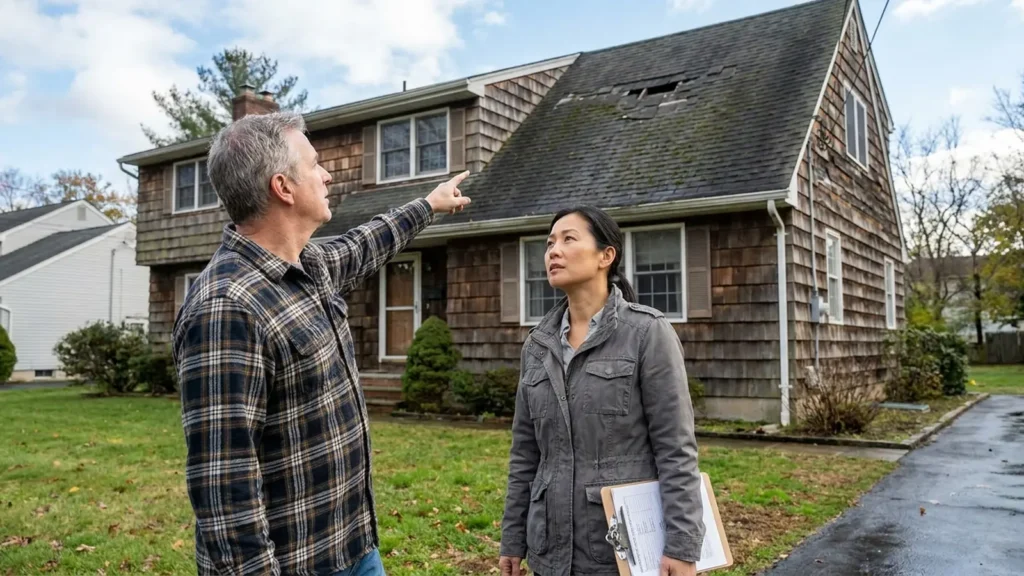
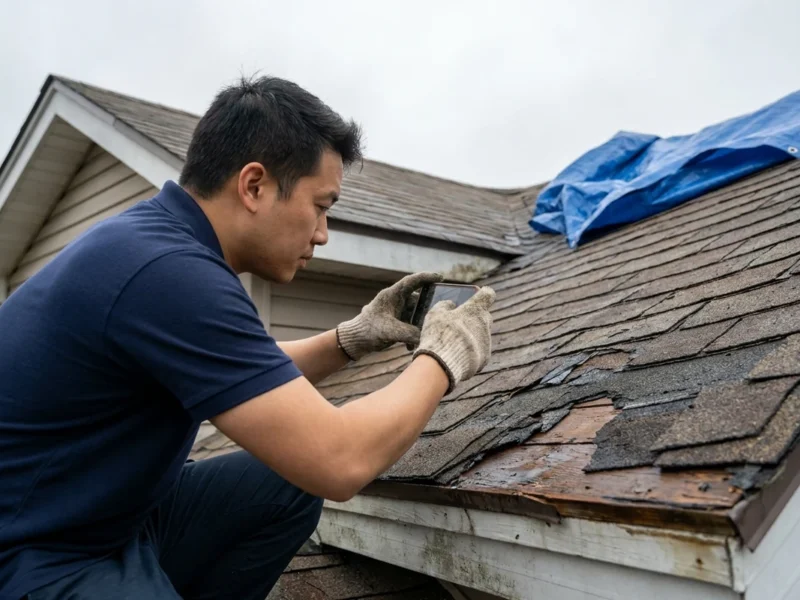
Yes, you can file an insurance claim for an old roof in NJ. Age does not stop you from filing, and storm damage is a covered peril on most policies regardless of roof age. What age changes is the payout. An actual-cash-value (ACV) policy depreciates an older roof and pays a fraction of replacement cost, while a replacement-cost (RCV) policy pays the full amount. The other risk is an adjuster calling storm damage “old wear,” which is where pre-storm documentation protects you.
Older roofs face a specific set of problems on a claim: heavy depreciation, adjusters attributing storm damage to pre-existing wear, and policy language that can be read either way. Here are direct answers, plus the one step that prevents most of it. For the broader coverage question, see does insurance cover a roof in NJ.
ACV vs RCV: How Roof Age Affects an Insurance Claim
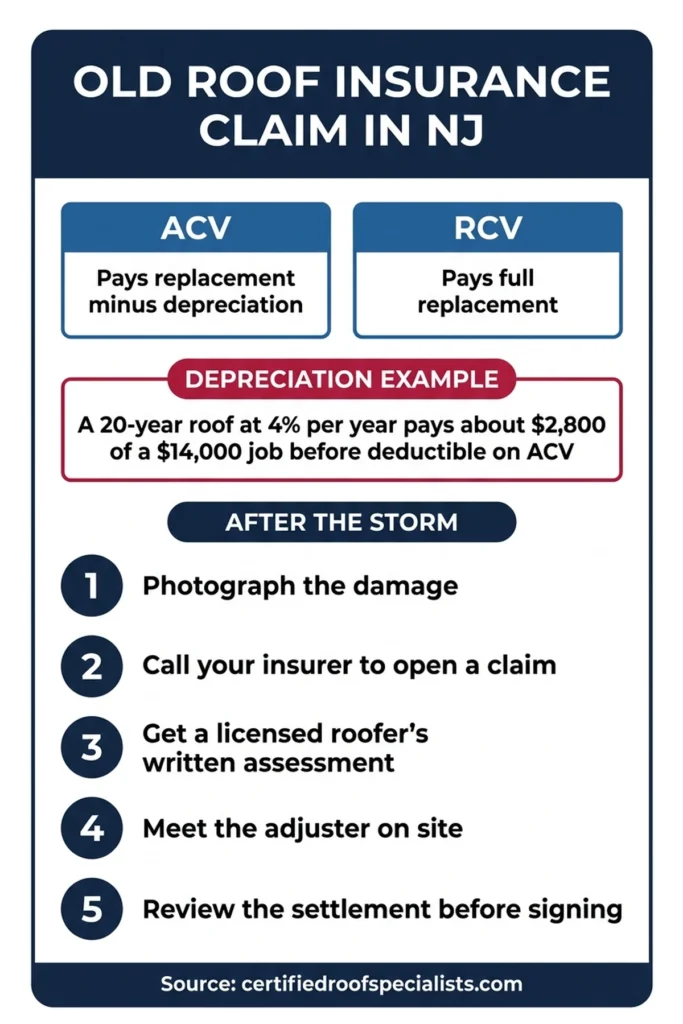
The single biggest factor in an old-roof payout is whether your policy pays actual cash value or replacement cost. NJ insurers typically depreciate roofs older than 10 to 15 years on ACV policies.
| ACV policy (actual cash value) | RCV policy (replacement cost value) | |
|---|---|---|
| What it pays | Replacement cost minus depreciation | Full cost to replace the damaged roof |
| Effect of roof age | Older roof, much smaller check | No age penalty |
| Example: 20-yr roof, $14,000 job | About $2,800 before your deductible | About $14,000 before your deductible |
| Premium | Lower | Higher |
| Best for | A lower premium now, if you can absorb the gap | Older roofs, where the age penalty would sting |
| The catch | A large out-of-pocket gap on an old roof | A higher monthly premium |
That example uses a simple 4 percent-per-year depreciation to illustrate the gap; your insurer’s actual schedule is on your declarations page. Check it before a storm, not after.
Insurance Claim for an Old Roof in NJ: When It Is Denied
Insurers do not deny claims just because a roof is old. They deny when the damage predates the storm (a pre-existing condition) or when wear and tear, rather than a sudden event, caused it. The pivot point is causation: an adjuster who labels the damage “general deterioration” instead of storm-caused can deny or sharply limit the claim.
This is why timing and documentation matter so much on an older roof. The NJ Department of Banking and Insurance publishes consumer guidance on claims and on appraisal rights, and you can confirm a dated storm event through the National Weather Service.
The Documentation Most Homeowners Miss Until It Is Too Late
Most homeowners have no record of their roof’s condition before a storm. When one hits, the adjuster inspects after the fact and has wide discretion to call any finding pre-existing deterioration rather than storm damage.
A written assessment from a licensed NJ contractor, dated before the storm, removes much of that discretion. It establishes your roof’s condition on a specific date and separates storm-caused zones from pre-existing wear, giving you a basis to challenge a determination that mischaracterizes the loss. CRS provides a written assessment with photos and condition ratings by zone as a free residential service, and provides the documentation your insurer can work from, but does not file, negotiate, or settle the claim on your behalf. For storm-day steps, see our hail damage roof FAQ.
Document your roof before the storm, not after
A free CRS inspection gives you a dated written report with photos and condition ratings, the pre-loss baseline that keeps an adjuster from calling storm damage old wear.
What to Do After a Storm Hits an Older NJ Roof
- Photograph the damage from the ground before any repairs, with date stamps.
- Call a licensed NJ roofer for a written assessment before the adjuster visits, so your contractor’s findings are on record first.
- File the claim promptly. Most NJ policies require notice within 30 to 60 days; missing that window can void coverage.
- Request an itemized estimate from your contractor to set alongside the adjuster’s scope.
- If the offer is far below replacement cost, request the depreciation schedule in writing and consult a licensed NJ public adjuster, or invoke your policy’s appraisal clause.
A deductible-waiver offer (“we will pay your deductible”) is illegal in NJ, so treat any contractor who offers it as a warning sign; verify registration at NJ Consumer Affairs. For the repair side after a covered loss, see our roof repair and emergency service.
Does insurance cover a roof in NJ · Hail damage roof FAQ · Roof repair and emergency service · Ocean County roofing
This content is educational. Certified Roofing Specialists Inc. is a licensed NJ roofing contractor and Home Improvement Contractor, not an insurance professional; for coverage and claim questions, speak with your agent or a licensed NJ public adjuster. Last updated October 7, 2026. Serving Monmouth, Ocean, Middlesex, Somerset, and Union Counties.
Common questions
Frequently Asked Questions
Can you file an insurance claim for an old roof in NJ?
Yes. Age does not stop you from filing, and storm damage to a roof of any age is a covered peril on most NJ policies. What changes with age is the payout: an actual-cash-value policy depreciates an older roof heavily, while a replacement-cost policy pays full cost regardless of age.
What is the difference between ACV and RCV for a roof claim?
An ACV (actual cash value) policy pays replacement cost minus depreciation based on the roof’s age, so an older roof gets a much smaller check. An RCV (replacement cost value) policy pays the full replacement cost with no age penalty, at a higher premium. Check your declarations page for which you carry.
My insurer offered far less than the replacement cost. What can I do?
Request an itemized depreciation schedule in writing. If the math or the damage scope is wrong, a licensed NJ public adjuster can run an independent assessment, usually on contingency of about 10 to 15 percent of the additional settlement. You can also invoke your policy’s appraisal clause. CRS documents the damage but does not file the claim.
-

Emergency Roofing in NJ: Storm Damage Response
Emergency roofing NJ: what to do after storm damage, how fast to get a tarp on, what it…
-
Community Association Roofing in NJ: A Property Manager’s Guide
Community association roofing NJ: a property manager guide to multi-building bids, board-ready scopes, reserve-study documentation, and scheduling.
-
Roof Protection Plan vs Home Warranty: What NJ Homeowners Need to Know
Roof protection plan vs home warranty NJ: what each actually covers, where home warranties fall short on roofs,…