Does Homeowners Insurance Cover Roof Replacement in NJ?
Does insurance cover roof replacement in NJ? NJ homeowners insurance covers sudden, accidental damage but not wear and tear. Storm damage from wind, hail, or a falling tree generally qualifies; age and neglect do not. The type of policy you hold (ACV or RCV) determines how much the insurer actually pays, and the difference can be $8,000 or more on a typical NJ roof claim. NJ law also prohibits any contractor from waiving your deductible.
Here is what NJ homeowners insurance actually covers on a roof, and what to know before you call your insurer.
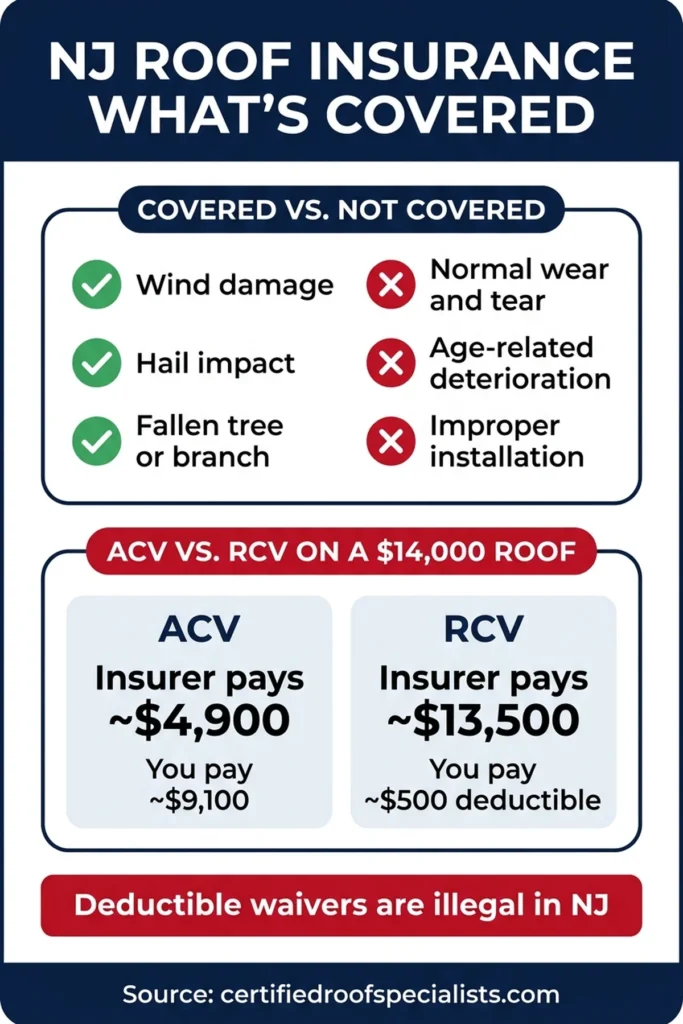
Does Insurance Cover Roof Replacement in NJ? What Is Covered
| Covered | Not covered |
|---|---|
| Wind damage (missing shingles, lifted flashing) | Normal wear and tear |
| Hail impact (cracked or bruised shingles) | Gradual deterioration from age |
| Fallen tree or branch | Mold or rot from deferred maintenance |
| Ice dam damage (sudden and accidental) | Manufacturer defects (covered by the manufacturer warranty) |
| Lightning strike | Improper installation (a contractor workmanship issue) |
| Structural collapse from snow load | Pre-existing damage at the time of policy purchase |
ACV vs RCV: The Homeowners Insurance Gap Most NJ Owners Miss
This is the most consequential line in your homeowners insurance policy, and most people do not notice it until they get a check.
Actual Cash Value (ACV) pays replacement cost minus depreciation, based on the age and expected lifespan of your roof. An 18-year-old architectural roof rated for 25 years has used much of its life, so the homeowners insurance carrier applies steep depreciation.
Replacement Cost Value (RCV) pays the full cost to replace with a comparable new roof, minus your deductible.
| Policy type | Depreciation | Insurer pays | Your out-of-pocket |
|---|---|---|---|
| ACV | 65% (~$9,100) | ~$4,900 | ~$9,100 |
| RCV | None | ~$13,500 | ~$500 (deductible) |
On the same home, same storm, same damage, the difference is about $8,600 (illustrative figures for an 18-year-old roof with a $14,000 replacement cost). Check your policy before a storm hits. If you have ACV coverage and an aging roof, ask your agent whether RCV is available.
The NJ Wind and Hail Deductible
Many NJ policies have a separate wind and hail deductible expressed as 1 to 2 percent of dwelling value rather than a flat dollar amount. On a home insured for $400,000, a 1 percent wind deductible is $4,000. Know this number before deciding whether a smaller repair is worth a claim. The standard “all other perils” deductible (often $1,000 to $2,500) does not apply to wind and hail; the separate deductible does.
Deductible Waiver Is Illegal in NJ
New Jersey law prohibits a contractor from absorbing or rebating an insurance deductible. CRS does not offer “we’ll pay your deductible” promotions. Any contractor offering that is operating outside NJ consumer-protection law, and going along with it creates exposure for you as the homeowner (a potential insurance-fraud allegation). If a contractor offers to waive your deductible, walk away. You can verify any contractor at the NJ Consumer Affairs HIC registry.
Know whether you have a claim before you call your insurer
An independent CRS inspection documents your storm damage in writing, free on residential roofs, so you have a real number before you decide whether to file.
The NJ Storm Documentation Sequence
What you do in the 48 to 72 hours after a storm directly affects your claim. Here is the sequence that protects it:
- Document from the ground first. Photograph visible damage before anything is touched, with the address visible in a frame or two.
- Check the attic. Photograph water stains, wet insulation, or daylight through the deck.
- Call a licensed NJ contractor. Get an independent inspection and written report to establish a baseline.
- Mitigate further damage. Tarping or temporary repair is your responsibility under most policies; failing to prevent more damage can reduce your payout.
- File within the notice window with your documentation in hand.
- Get a second opinion if the adjuster’s number seems low. A licensed contractor may identify damage the adjuster missed; the supplement goes back to your insurer with your contractor’s documentation.
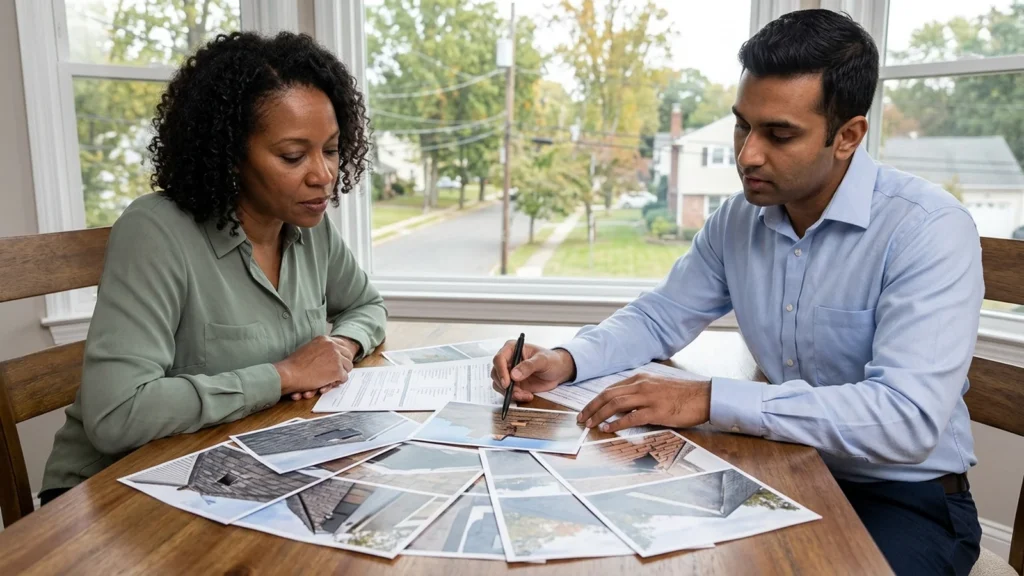
An independent inspection report from a licensed NJ contractor, completed before the adjuster arrives, creates a timestamped record, documents every affected area, and gives you a professional figure to compare. Adjusters are not always wrong, but they work for the insurer; a contractor’s report works for you. CRS does not file, negotiate, or settle claims on your behalf. What CRS provides is the documentation. If you need emergency roofing after a storm, CRS documents the damage as part of that process. The NJ Department of Banking and Insurance publishes consumer guidance on claims.
NJ roofing FAQs · NJ summer storm prep · Storm damage roof inspection · Emergency roofing
This content is educational. Certified Roofing Specialists Inc. is a licensed NJ roofing contractor, not an insurance professional. For coverage questions, speak with your insurance agent or a licensed NJ public adjuster. Last updated July 29, 2026.
Common questions
Frequently Asked Questions
Does age affect my NJ roof insurance claim?
Yes. Insurers assess roof age when processing a claim. An older roof may be heavily depreciated under an ACV policy, sharply reducing your payout. Some NJ insurers also limit coverage or raise deductibles on roofs over 20 years old. Age alone does not disqualify a claim, but on an aging roof the check can be far smaller than expected.
What is the difference between ACV and RCV roof coverage in NJ?
ACV (Actual Cash Value) pays replacement cost minus depreciation. RCV (Replacement Cost Value) pays full replacement cost minus your deductible. On an 18-year-old roof with a $14,000 replacement cost, ACV at 65 percent depreciation pays roughly $4,900, while RCV pays roughly $13,500 after a standard deductible. Your declarations page specifies which you have.
How long do I have to file a roof damage claim in NJ?
Most NJ homeowners policies require timely notice of a loss, commonly within 30 to 60 days of the event, though policy language varies. Filing late gives insurers grounds to deny on a notice violation. Document the damage and contact your insurer within days of a storm, not weeks.
Can an NJ contractor waive my insurance deductible?
No. NJ law prohibits a contractor from absorbing or rebating an insurance deductible. CRS does not offer “we’ll pay your deductible” promotions; any contractor offering that is operating outside NJ consumer-protection law. The deductible is the homeowner’s responsibility on every NJ roofing insurance claim.
-

Emergency Roofing in NJ: Storm Damage Response
Emergency roofing NJ: what to do after storm damage, how fast to get a tarp on, what it…
-
Community Association Roofing in NJ: A Property Manager’s Guide
Community association roofing NJ: a property manager guide to multi-building bids, board-ready scopes, reserve-study documentation, and scheduling.
-
Insurance Claim for an Old Roof in NJ: What to Know
Insurance claim for an old roof in NJ: how age cuts your payout, ACV vs RCV explained, what…