
Local vs National Roofing Company in NJ: An Honest Comparison
The local vs national roofing company NJ decision affects who stands behind the work. In the local vs national roofing decision for NJ homes, local contractors have structural advantages on accountability and warranty execution, while national chains often win on promotional financing and brand polish. The right answer depends on what matters most to you and what you are willing to verify first. Either way, the non-negotiables are the same: a verifiable NJ HIC license, current insurance that names you, and warranty terms in writing.
This is not a case for assuming local is always better. It is a case for verifying claims before you sign. Here are the real differences, the real risks on both sides, and the checks that matter no matter which way you go.
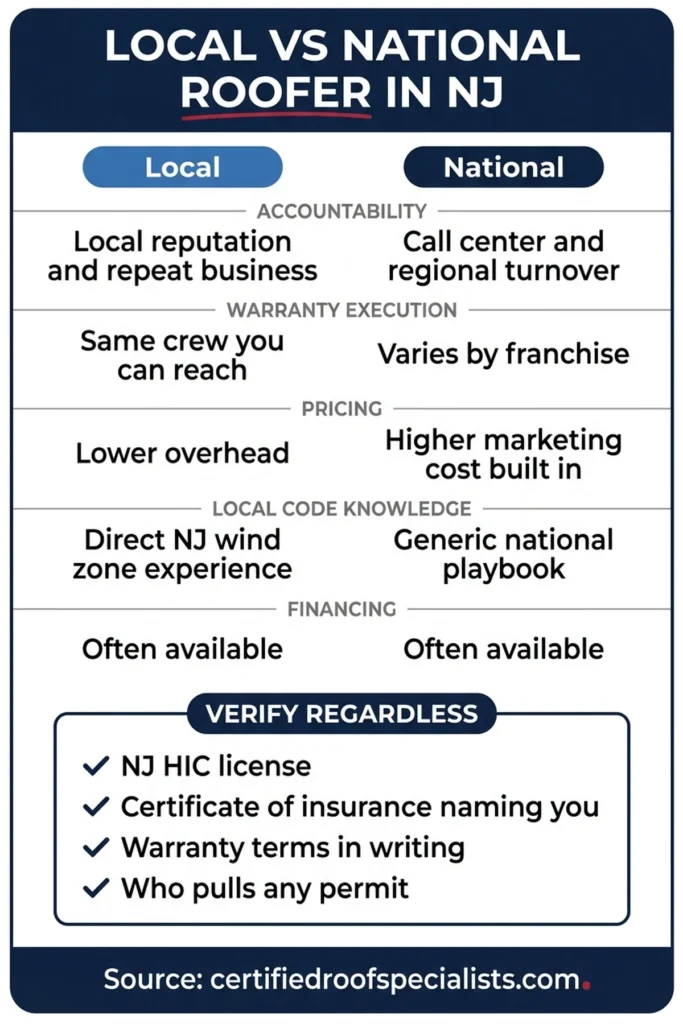
Local vs National Roofing Company NJ: At a Glance
| Factor | Local NJ contractor | National roofing chain |
|---|---|---|
| NJ HIC license | Required, verifiable at NJ Consumer Affairs | Verify each local franchise or crew independently |
| Crews | Varies; ask directly (employees or vetted subs) | Often rotating, frequently subcontracted |
| Warranty execution | The contractor is directly responsible | Corporate claims process; varies by location |
| Pricing | Market rate, often negotiable | Often higher (franchise margin), less flexible |
| Financing | Usually third-party lenders | Often in-house promo rates (such as 0% for 12 to 18 months) |
| Local NJ code knowledge | Direct and current | Depends on the local crew or sub |
| Post-job recourse | Reach the business owner directly | Corporate customer-service process |
| Reviews | Smaller, geographically specific sample | Large aggregate, may span many states |
| Best for | Homeowners who want direct accountability and local code knowledge | Homeowners who prioritize promo financing or a national brand name |
| The honest downside | Smaller review sample; financing is usually third-party | Recourse routes through corporate; the install crew may not be reachable later |
The bottom line: the label “local” or “national” matters less than whether the company will stand behind the work and can prove it on paper.
What National Chains Do Well
National roofing chains have real advantages worth acknowledging. Financing is the clearest: many carry in-house or preferred-lender programs with promotional rates, sometimes 0 percent for 12 to 18 months, which local contractors usually match only through third-party lenders. Marketing polish is another, with standardized proposals and digital tools that can feel like reliability. Volume purchasing across many markets can occasionally trim material cost, though competitive NJ pricing compresses that edge. And some homeowners simply prefer a recognized brand name, which is a legitimate preference even though it is not the same as installation quality.
Where Local NJ Contractors Have the Edge
Accountability is not abstract. A local owner’s NJ HIC number is on your contract, and their livelihood depends on the work holding up and on their local reputation. When something goes wrong six months later, you call the same person who sold you the job. With a national chain, post-job issues usually route through customer service, and the crew that installed your roof may not be reachable, or may have been subcontracted.
Local code knowledge is real. NJ routes building permits through individual municipalities, each with its own building department. Most standard re-roofs need no permit at all, but for the jobs that do (structural or sheathing replacement, solar, multi-unit), and for code interpretation generally, a contractor who works these towns daily knows the differences across Monmouth, Ocean, and Middlesex County. See our roof permit FAQ for when a permit applies.
Warranty execution is not the same as warranty existence. Both local and national contractors offer workmanship warranties, and the enhanced manufacturer warranties require a credentialed installer either way. The difference is in execution: a local contractor making a warranty repair is protecting their own reputation and license, while a national chain is running a corporate claims process. Ask any contractor what enhanced warranty they can register and verify the credential directly with the manufacturer.
The Subcontractor Question
Many companies use subcontracted crews, local and national alike. That is not automatically a problem, but get written answers to three questions before work begins:
- Are the installers employees of the company, or subcontractors?
- If subcontractors, do they hold their own NJ licenses?
- Do they carry their own workers’ compensation, or does an on-site injury fall to the general contractor’s policy?
If a crew member is injured on your property and the coverage structure is unclear, you can face exposure. The NJ Department of Banking and Insurance publishes guidance on what homeowners insurance does and does not cover.
Start with a written assessment you can take to any bid
A free CRS inspection gives you a documented condition report and scope, so you can hold local or national contractors to the same standard before you sign.
What to Verify, Local or National
These checks are non-negotiable for any NJ roofing contractor:
- NJ HIC license. Verify the number at NJ Consumer Affairs. An active license is required for any home improvement contract over $200. No number, no deal.
- Certificate of insurance. Get one that names you as additional insured, with current general liability and workers’ compensation. Call the insurer to confirm it is active.
- Warranty terms in writing. “Lifetime warranty” means nothing without a document defining what is covered, what is excluded, how to file, and how long the workmanship period runs.
- Who pulls any permit. For jobs that need one, the contractor pulls it and gives you a copy. The NRCA publishes the installation standards the inspection checks against.
CRS is a local NJ contractor with an active HIC license, working across Monmouth, Ocean, Middlesex, Somerset, and Union Counties with vetted crews held to written CRS standards. The argument here is not that local always wins; it is that any contractor’s claims should be verifiable, and the license and insurance checks are non-negotiable. For more, see our questions to ask a roofing contractor.
Questions to ask a roofing contractor · Roof permit FAQ · Roof replacement service · Freehold roofing
Last updated September 30, 2026. Written by the Certified Roofing Specialists Inc. team, licensed New Jersey roofing contractors serving Monmouth, Ocean, Middlesex, Somerset, and Union Counties.
Common questions
Frequently Asked Questions
Is a local or national roofing company better in NJ?
Neither is automatically better. Local contractors have structural advantages on direct accountability and warranty execution; national chains often win on promotional financing and brand polish. The real test is verifiable license, insurance, and written warranty terms. A national chain that produces all three is a fine choice; a local one that cannot is not.
How do I verify a NJ roofing contractor is legitimate?
Check the NJ HIC license number at the Division of Consumer Affairs, request a current certificate of insurance that names you as additional insured for both liability and workers’ compensation, and get the warranty terms in writing. An active HIC license is required for any NJ home improvement contract over $200.
Do roofing companies use subcontractors in NJ?
Many do, both local and national. Subcontracting is not automatically a problem, but ask three things in writing: are the crew employees or subcontractors, do subs hold their own NJ licenses, and do they carry their own workers’ compensation. Unclear coverage can leave you exposed if someone is injured on your property.
-

Emergency Roofing in NJ: Storm Damage Response
Emergency roofing NJ: what to do after storm damage, how fast to get a tarp on, what it…
-
Community Association Roofing in NJ: A Property Manager’s Guide
Community association roofing NJ: a property manager guide to multi-building bids, board-ready scopes, reserve-study documentation, and scheduling.
-
Insurance Claim for an Old Roof in NJ: What to Know
Insurance claim for an old roof in NJ: how age cuts your payout, ACV vs RCV explained, what…