
NJ Roofing Warranties Explained: 2026 Guide

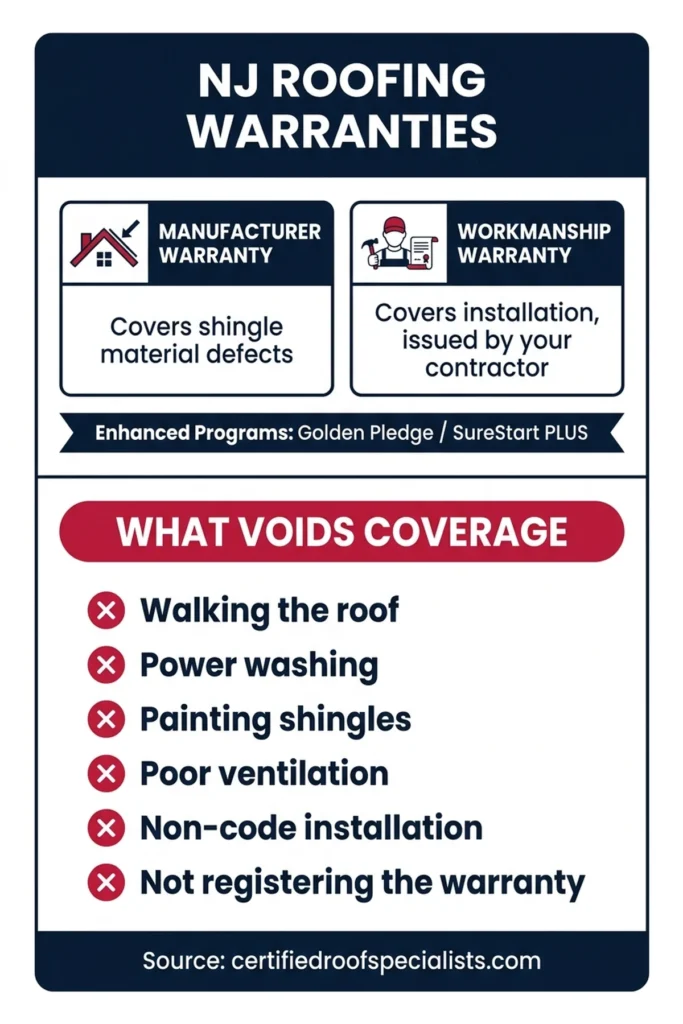
NJ roofing warranties come in two separate parts, and most homeowners only know one. Every roofing warranty in NJ comes in two parts. The manufacturer warranty covers material defects in the shingle itself (GAF, CertainTeed, Owens Corning). The workmanship warranty covers installation defects (flashing, nailing, underlayment) and is issued by your contractor. You need both. Standard NJ contractor workmanship runs 5 to 10 years; the enhanced manufacturer programs (GAF Golden Pledge, CertainTeed SureStart PLUS) extend to 25 years with a credentialed contractor.
Most NJ homeowners sign a roofing contract without understanding what warranty they are actually receiving. The contractor says “lifetime warranty.” The homeowner hears “covered forever.” The paperwork says something more specific. This guide explains what each warranty covers, what the certified-contractor programs unlock, what quietly voids coverage, and the exact questions to ask before you sign.
NJ Roofing Warranties: The Two Types of Coverage
1. The manufacturer warranty
Issued by the shingle maker (GAF, CertainTeed, Owens Corning), it covers the shingle material. On architectural products it is usually stated as “Limited Lifetime,” meaning the life of the original owner in the original structure, subject to the document’s terms.
What it covers: manufacturing defects in the shingle. What it does not cover: installation errors, leaks from improper flashing, storm damage, or normal wear. If a shingle blows off because a roofer used four nails instead of six, that is an installation error, and the manufacturer’s warranty does not touch it. The manufacturer warranty also does not activate automatically: the shingles must be registered after installation. Some contractors do this; others do not. Ask.
2. The workmanship warranty
Issued by your contractor, it covers the installation: labor, flashing, underlayment, the whole execution. If a leak develops because of how the roof was installed, this is what you call on. NJ contractor workmanship warranties most commonly run 5 to 10 years (the market ranges from 1 year to lifetime). This is the roofing warranty that matters for the first decade, because roofs that leak early leak from installation problems, not manufacturing defects.
The Certified-Contractor Difference
Both GAF and CertainTeed run programs that require contractors to pass training and insurance standards and, in return, unlock enhanced warranties covering both materials and labor at a level uncertified contractors cannot offer.
GAF Master Elite. GAF states only about 3 percent of US roofing contractors qualify. Master Elite contractors can offer the GAF Golden Pledge: 25-year non-prorated labor plus 50-year material, transferable at reduced terms within 10 years.
CertainTeed SELECT ShingleMaster. CertainTeed’s equivalent program. SELECT ShingleMaster contractors can offer SureStart PLUS: up to 25-year workmanship plus up to 50-year material, transferable.
Before hiring any NJ contractor, ask which certified program they are in and verify the credential directly with the manufacturer. If neither, you cannot receive the enhanced warranty regardless of which brand they install. For how these programs affect shingle choice, see GAF vs CertainTeed shingles in NJ.
What Voids an NJ Roofing Warranty
Several common actions void manufacturer warranties, often without the homeowner realizing it:
- Walking on the roof. Foot traffic cracks shingles and displaces granules; warranties typically prohibit unnecessary traffic. Solar, HVAC, and satellite installers walking your roof without protection can create issues.
- Power washing shingles. Pressure strips the granules that protect the asphalt mat from UV. A soft wash by a licensed roofer is the appropriate alternative.
- Painting shingles. Paint traps moisture and degrades the asphalt; it typically voids coverage.
- Adding penetrations without proper flashing. New solar, vents, or HVAC cut into the roof without correct flashing creates leak pathways and can void coverage for that area.
- Improper ventilation that traps heat. Blocked soffits, insufficient ridge venting, or attic-exhausting equipment raise deck temperatures and accelerate shingle aging.
- Not registering the shingles. Many warranties require post-installation registration to be valid.
Code Compliance and Warranties: The Connection Most Homeowners Miss
Manufacturer warranties require that the installation comply with local building code. That is about how the roof is built (correct nailing pattern, proper ventilation, code-required ice and water shield and flashing), not about paperwork. If a claim arises and the manufacturer finds the work did not meet code, it can be denied on that basis.
Here is where homeowners get confused about permits. A standard re-roof on a one or two-family NJ home is classified as ordinary maintenance and does not require a building permit, so there is usually no permit to pull. What still matters is that the work meets code. Structural work, rooftop solar, and condominium or multi-family buildings do require permits, and a passed municipal inspection then documents code compliance for warranty, insurance, and resale purposes. The framework is published by the NJ Division of Codes and Standards.
The takeaway: do not equate “no permit” with “not to code.” Insist on a contractor who installs to code and manufacturer specification, and get the workmanship and manufacturer warranty terms in writing.
Get the warranty terms in writing, before you commit
Every CRS estimate states which manufacturer warranty the installation qualifies for and the workmanship terms, in writing. We register your shingles and pull permits when a job requires one.
What to Ask About NJ Roofing Warranties Before You Sign
- Which manufacturer warranty does this installation qualify for? Get the specific product name (e.g., GAF System Plus, Golden Pledge, CertainTeed SureStart PLUS) and what it covers.
- What is your workmanship warranty, and what does it cover? Duration plus a plain-language statement, not just “our work.”
- Are you in a manufacturer’s certified program? Ask the designation name and confirm they can document it.
- Do you pull a permit if my job requires one? A standard single-family re-roof in NJ needs none; structural work, solar, and multi-unit buildings do.
- Will you register the shingles after installation? Know who is responsible.
- Does the roofing warranty transfer if I sell? Both GAF and CertainTeed offer partial transfer; terms vary.
- What is not covered? The exclusions matter as much as the coverage.
GAF vs CertainTeed shingles in NJ · Best roofing shingles in NJ · Roof replacement service · All FAQs · Find your CRS town
Last updated August 10, 2026. Written by the Certified Roofing Specialists Inc. team, licensed New Jersey roofing contractors serving Monmouth, Ocean, Middlesex, Somerset, and Union Counties. Warranty programs and terms are the manufacturers’; confirm current terms with GAF or CertainTeed.
Common questions
Frequently Asked Questions
What voids an NJ roofing warranty?
Common ones: walking on the roof, power washing shingles, painting shingles, adding penetrations without proper flashing, attic ventilation that traps heat, installation that does not meet local building code, and failing to register the shingles with the manufacturer after installation. Storm damage, owner neglect, and unauthorized modifications are standard exclusions.
What is the difference between GAF Golden Pledge and CertainTeed SureStart PLUS?
Both extend coverage to roughly 25-year non-prorated workmanship plus a 50-year material warranty, both require a credentialed contractor (GAF Master Elite or CertainTeed SELECT ShingleMaster), and both are transferable within 10 years. Ask any contractor which program they can register and verify the credential with the manufacturer.
Do I have to register my shingles for the warranty to be valid?
Usually yes. Manufacturer warranties generally require the shingles to be registered after installation, and the enhanced terms depend on it. Some contractors register on your behalf; others leave it to you. Confirm in writing who is responsible before the job starts.
-

Emergency Roofing in NJ: Storm Damage Response
Emergency roofing NJ: what to do after storm damage, how fast to get a tarp on, what it…
-
Community Association Roofing in NJ: A Property Manager’s Guide
Community association roofing NJ: a property manager guide to multi-building bids, board-ready scopes, reserve-study documentation, and scheduling.
-
Insurance Claim for an Old Roof in NJ: What to Know
Insurance claim for an old roof in NJ: how age cuts your payout, ACV vs RCV explained, what…