NJ Wind Zone Shingle Requirements: What Code Requires by County in 2026
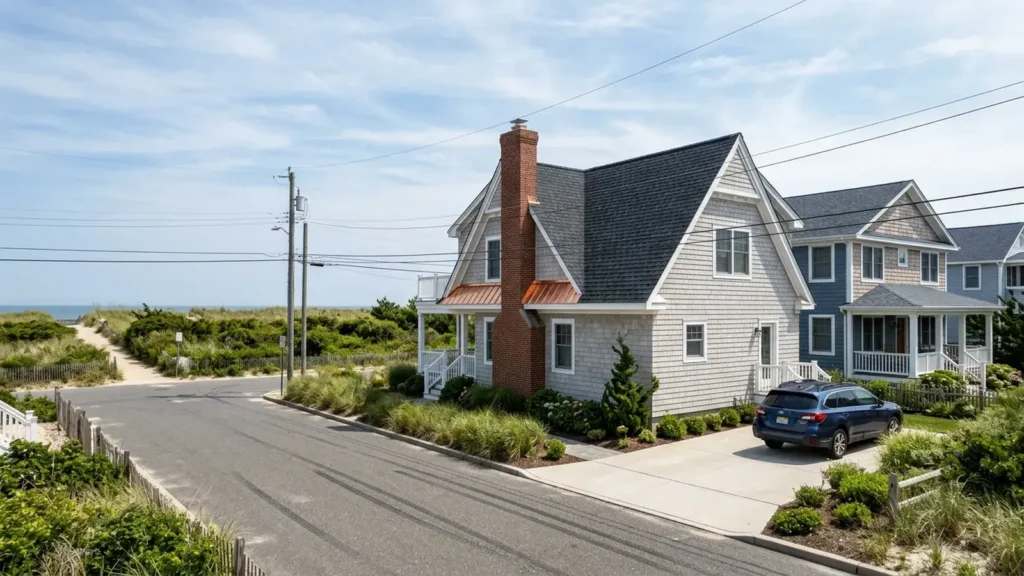
For NJ wind zone shingle requirements, the home’s exposure to wind drives the answer. New Jersey follows the International Residential Code wind-exposure framework. Coastal Ocean County barrier islands and shore-adjacent Monmouth County (within roughly two miles of the Atlantic) call for 110 mph minimum shingle wind ratings, with 130 mph the practical standard. Inland Middlesex and central Monmouth typically use 90 to 110 mph products. The contractor is responsible for matching the shingle and fastening to your home’s wind exposure; confirm specifics with your local construction office.
Wind rating is the one shingle spec most homeowners never ask about, and it is the one that matters most along the Jersey Shore. For the full type-by-type comparison of shingle grades, see our guide to the best roofing shingles in NJ. This article focuses on what your NJ wind zone actually calls for.
NJ Wind Exposure Categories
New Jersey adopts the IRC wind-exposure framework. Your category depends on the terrain around your home.
| Exposure | Definition | Where it applies in NJ |
|---|---|---|
| Exposure B | Suburban, urban, or wooded areas | Inland Middlesex, central Monmouth, inland Ocean |
| Exposure C | Open terrain, scattered obstructions | Suburban-rural fringe, large-lot inland sections |
| Exposure D | Flat, unobstructed, water exposure within 1 mile | Barrier islands, coastal Ocean County, shore-adjacent Monmouth |
Exposure D is the relevant category for any home with line-of-sight to the Atlantic or large open-water bay exposure: Ortley Beach, Lavallette, Long Branch, Asbury Park, Point Pleasant, and Sea Girt. Brick Shore Acres and Toms River bayfront sit in mixed C/D zones. Inland towns (Edison, Woodbridge, Freehold, Marlboro, Hazlet, most of Howell) sit in Exposure B. The framework is published by the NJ Division of Codes and Standards.
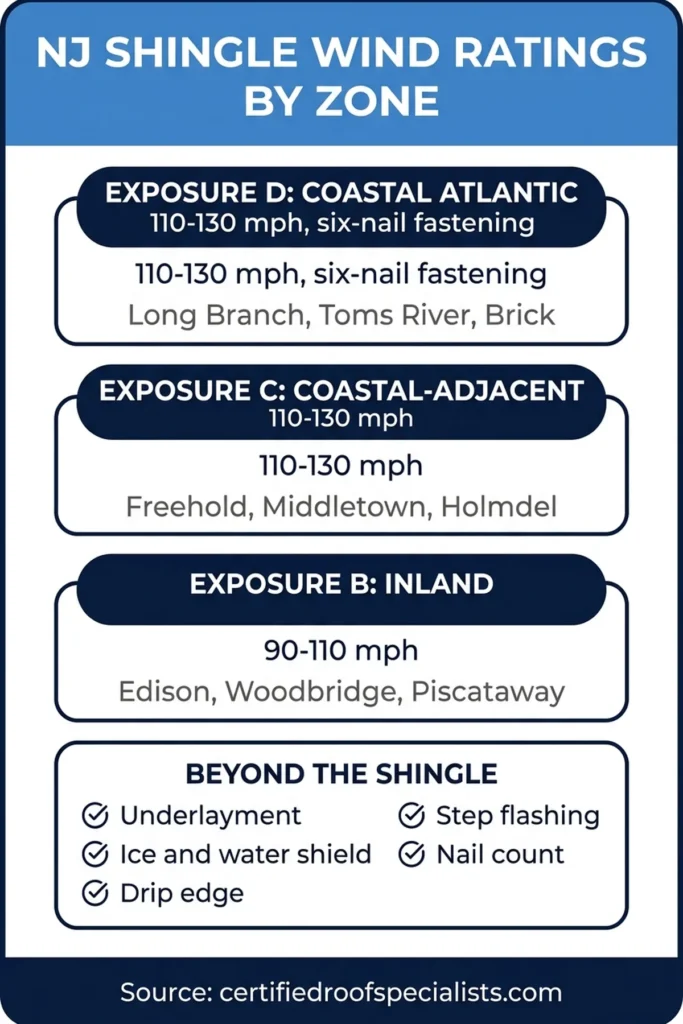
NJ Wind Zone Shingle Requirements by Zone
| Zone | Minimum | Recommended | Examples |
|---|---|---|---|
| Exposure D (coastal Atlantic) | 110 mph | 130 mph, six-nail | Long Branch, Point Pleasant, Asbury Park, Sea Girt |
| Exposure C (coastal-adjacent) | 110 mph | 130 mph | Brick Shore Acres, Toms River bayfront, Cliffwood Beach |
| Exposure B (inland) | 90 mph | 110 mph architectural | Edison, Woodbridge, Freehold, Marlboro, Hazlet, Howell |
Standard 3-tab shingles rated at 60 to 70 mph do not meet Exposure C or D needs. They clear Exposure B but are phasing out of the NJ residential market anyway as manufacturers narrow their product lines.
Products That Meet Each NJ Wind Zone
Exposure D (Coastal Atlantic)
- GAF Timberline HDZ with LayerLock: 130 mph wind warranty when installed to spec. The most-installed coastal-NJ shingle.
- CertainTeed Landmark PRO: 130 mph with SureStart PLUS when installed by a credentialed contractor.
- Owens Corning Duration with SureNail: 130 mph; the SureNail strip widens the nail zone and improves uplift performance.
- GAF Timberline AS II (Class 4 impact-rated): 130-plus mph. Recommended for the barrier-island cohort where wind, hail, and salt air coexist.
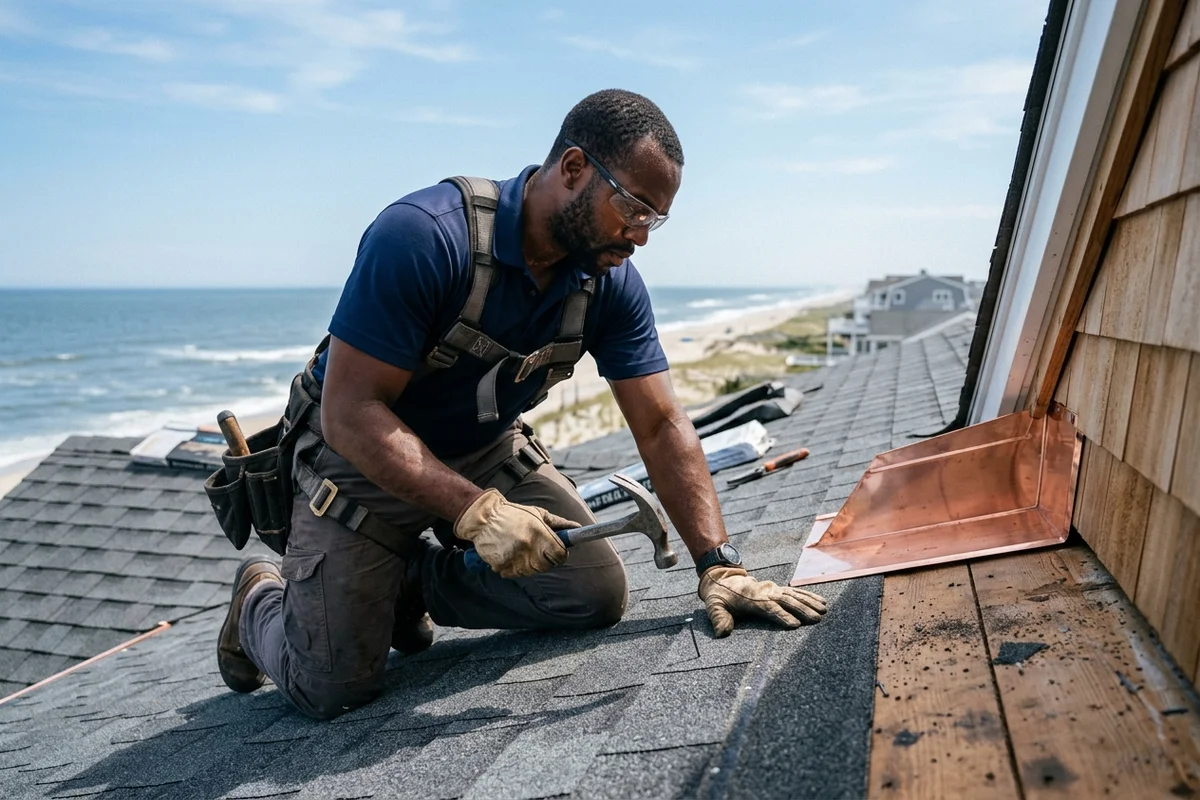
All coastal Exposure D installations call for six-nail fastening (not four), copper flashing as the default (not galvanized), and salt-rated drip edge (stainless or aluminum).
Exposure C (Coastal-Adjacent)
The same product list applies. Many homes here install the same 130 mph products as the direct-coastal cohort. Six-nail fastening is recommended, and copper flashing is recommended for any home within one mile of bay or open water.
Exposure B (Inland)
- GAF Timberline HDZ: 130 mph rating works fine in Exposure B; the most-installed inland product.
- CertainTeed Landmark: 110 mph standard with a transferable SureStart warranty.
- Owens Corning Duration: 130 mph with SureNail. A strong inland performer.
- 3-tab (60 to 70 mph): clears the Exposure B minimum but does not justify its lifetime cost over architectural, and is phasing out. Avoid for any home you plan to keep more than seven years.
For inland hail-corridor towns (Freehold, western Howell, parts of Marlboro), Class 4 impact-rated is worth the upgrade even though wind exposure alone does not require it. The summer hail line drives the decision.
What Code Requires Beyond the Shingle
A wind rating on the shingle is necessary but not sufficient. NJ residential code also calls for:
- Synthetic underlayment on new installations (felt is largely phased out)
- Ice and water shield at eaves (extending inside the warm wall line), valleys, and penetrations
- Drip edge at all eaves and rakes
- Step flashing at every sidewall-to-roof transition
- Counter-flashing at masonry chimneys, cut into the mortar joint (not face-nailed)
- Manufacturer-specified nail count: four nails minimum for Exposure B; six nails for Exposure C and D
A 130 mph shingle installed with four nails in an Exposure D zone does not meet the manufacturer’s warranty requirements. The contractor is responsible for matching the fastening pattern to the wind exposure, and the standard is published in the manufacturer’s installation instructions and the International Residential Code NJ adopts.
Get the right wind-rated roof spec for your home
A free CRS inspection identifies your wind exposure and gives you the right shingle, nail count, and flashing spec in writing before any estimate.
How NJ Wind Zone Affects Cost
A 110 mph architectural shingle costs roughly the same as a 130 mph architectural shingle ($500 to $700 per square installed). The gap between standard architectural and Class 4 impact-rated is 20 to 40 percent ($625 to $875 per square installed).
In coastal Exposure D zones, the bigger cost driver is not the shingle. It is the rest of the system: copper flashing ($600 to $2,500 above galvanized), six-nail fastening, salt-rated drip edge, and full ice and water shield at every eave, valley, and penetration. The coastal premium runs 10 to 20 percent of total job cost. See the full 2026 NJ cost ranges by county and town.
Ask before you sign: What specific shingle product are you quoting, and its wind rating? What NJ exposure category is my home? What nail count and pattern will you use? What flashing material (copper coastal, G-90 galvanized inland minimum)? Are you a credentialed installer for that manufacturer’s enhanced warranty?
Best roofing shingles in NJ · How much a new roof costs in NJ · Roof replacement service · Long Branch · Point Pleasant
Last updated August 5, 2026. Written by the Certified Roofing Specialists Inc. team, licensed New Jersey roofing contractors serving Monmouth, Ocean, Middlesex, Somerset, and Union Counties. Always confirm code requirements with your local construction office.
Common questions
Frequently Asked Questions
Are 3-tab shingles still legal to install in NJ?
Yes in most inland zones, but they are phasing out of the market. Standard 3-tab shingles rated at 60 to 70 mph clear minimum NJ code in low-wind inland exposure zones but do not meet coastal-zone needs. Major manufacturers (GAF, CertainTeed, Owens Corning) are narrowing their 3-tab lines as architectural becomes the residential default.
Which shingle products meet NJ coastal wind needs?
GAF Timberline HDZ with LayerLock (130 mph), CertainTeed Landmark PRO (130 mph), Owens Corning Duration with SureNail (130 mph), and Class 4 impact-rated lines (GAF Timberline AS II, Landmark Solaris) all meet coastal NJ wind ratings. Coastal installations also call for six-nail fastening and copper flashing within two miles of the Atlantic.
Can I install a 110 mph shingle in Long Branch?
You can, but it is the minimum that clears the coastal exposure. Most CRS Long Branch installations specify 130 mph products with six-nail fastening, copper flashing, and salt-rated drip edge as the default specification, not an upgrade. The premium pays back in measurably longer service life in salt air and nor’easter exposure.
-

Emergency Roofing in NJ: Storm Damage Response
Emergency roofing NJ: what to do after storm damage, how fast to get a tarp on, what it…
-
Community Association Roofing in NJ: A Property Manager’s Guide
Community association roofing NJ: a property manager guide to multi-building bids, board-ready scopes, reserve-study documentation, and scheduling.
-
Insurance Claim for an Old Roof in NJ: What to Know
Insurance claim for an old roof in NJ: how age cuts your payout, ACV vs RCV explained, what…