
NJ Summer Storm Roof Prep 2026: What to Do Before the Next One Hits
NJ summer storm roof prep is about getting ahead of the damage, not reacting to it. When you plan for storm damage to a roof in NJ, timing is everything. Hail and severe-thunderstorm season runs April through September, peaking in June and July. Nor’easter season runs October through March, with the most destructive storms often in January and February. Parts of NJ can see multiple hail events in an active summer, and the shore sees several significant nor’easters a year. Most storm damage exploits a pre-existing vulnerability rather than creating a new one, which is why prep matters.
New Jersey averages more than 47 inches of rain a year. A 90 mph gust can lift a shingle with a failed adhesion strip. A three-inch rain event can push water under a pipe boot that has been leaking slightly for two years. The storm gets the blame, but the real problem usually started well before the storm arrived.
A little prep before a summer storm keeps small problems small. This guide covers what to check before summer storm season peaks, what to do immediately after a significant event, and how to handle the insurance documentation that protects a claim. If a summer storm has already hit, jump to our storm damage roof inspection playbook for the first-48-hours sequence.
NJ Summer Storm Roof Prep: What Storms Do to Roofs
Wind uplift. A summer storm drives the wind that tests every roof. Shingles are held down by a factory adhesion strip that bonds when warmed. North-facing slopes sometimes do not seal as strongly. Older 3-tab shingles have smaller tabs and lower wind ratings than modern architectural shingles. When wind hits the edge of an unsealed tab at 60 or 70 mph, the tab lifts, and once lifted it catches more force on the next gust.
Hail granule loss. NJ summer storms can bring hail, commonly 0.75 to 1.25 inch, occasionally larger. Hail around an inch causes cosmetic damage; 1.5 inch or larger breaks the granule bond. The central NJ summer storm hail corridor crosses Freehold, western Howell, and parts of Marlboro. Hail does not always punch through visibly; more often it knocks granules loose, leaving exposed asphalt that UV then attacks.
Flashing failures at penetrations. The most common source of active roof leaks is not missing shingles. It is failed flashing. Most NJ roof leaks start at flashing points (chimney, valley, pipe boot, skylight curb), not the open shingle field. That metal and sealant is a smaller system with less redundancy than the field of the roof.
Coastal salt-air corrosion. Within two miles of the Atlantic, salt corrodes galvanized flashing noticeably faster than inland. Long Branch, Point Pleasant, and Asbury Park homes see rust streaks running down shingle faces as a leading sign of flashing failure. Copper flashing is the CRS default on every coastal replacement for this reason.
Late-season storms and ice damming. Nor’easters in October and November can deposit wet, heavy snow. Ice dams form when heat escapes the roof deck, melts the snow above, and the meltwater refreezes at the cold eaves, backing up under the shingles. Without properly installed ice and water shield at the eaves and adequate attic insulation, ice dams translate into interior water damage, commonly $1,500 to $4,000 per event and more in severe cases.
Town-Specific Storm Exposure (NJ 2026)
| Zone | Towns | Dominant storm risk |
|---|---|---|
| Direct coastal Atlantic | Long Branch, Point Pleasant, Asbury Park, Sea Girt | Nor’easter wind, salt-air flashing corrosion, six-nail fastening |
| Barrier-island / bayfront Ocean | Toms River Ortley/Silverton, Brick Shore Acres, Barnegat bayfront | Wind plus salt; Sandy-era 2012-2014 repairs now overdue |
| Central NJ hail corridor | Freehold, western Howell, parts of Marlboro | Summer hail; Class 4 impact-rated shingles recommended |
| Inland suburban | Edison, Woodbridge, Old Bridge, Manchester | Nor’easter wind, freeze-thaw, occasional hail |
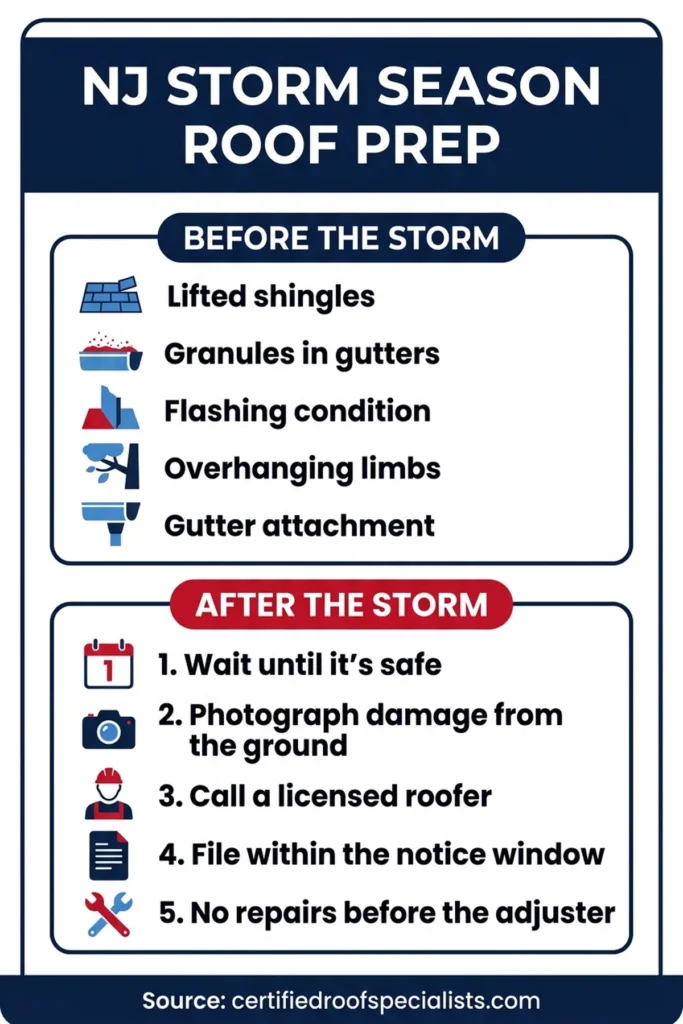
Pre-Storm Checklist: What You Can See Without Getting on the Roof
You do not need a ladder for a useful assessment before summer storm season. Walk the perimeter and look from the ground and gutter line for:
- Missing or lifted shingles visible from ground level (color breaks or gaps in the pattern).
- Granules in gutters after rain. A cup or two is normal wear; significant accumulation after a modest rain means accelerated degradation.
- Flashing condition around the chimney and skylights. You can often see from the ground whether flashing sits flat or is lifting away.
- Rust streaks on shingle faces (coastal). The leading sign of galvanized flashing failure in salt air; copper is the appropriate replacement.
- Overhanging limbs within 10 feet of the roof. In a 60-plus mph wind, a four-inch limb becomes a roof penetration waiting to happen. The easiest pre-storm item to fix.
- Gutter attachment and drainage. Gutters pulling from the fascia can mean the fascia itself is rotting.
This gives you a picture of the obvious vulnerabilities. It will not tell you whether your pipe boots are cracked or your ridge cap is separating; that requires getting on the roof.
After a Storm: The Documentation Protocol
- Wait until it is safe. Do not go on or near the roof during active weather.
- Do a ground-level assessment first. Walk the perimeter; note displaced shingles, debris impact, granule piles below downspouts.
- Photograph everything, dated, with the address visible. Wide shots of each slope and close-ups of any damage. The timestamp and address establish chain of custody for claims.
- Do not make permanent repairs before the adjuster sees the damage. Temporary tarping to stop active intrusion is appropriate; replacing shingles first removes the evidence.
- Call a roofer for a written assessment before the adjuster. A licensed contractor’s report with photos gives you specificity in the claims process.
Keep every photo date-stamped and the contractor’s written assessment on file for the claim. If there is an active breach, CRS provides same-day emergency tarping for qualifying situations across all three counties. Phone calls route faster than forms for active leaks. Emergency roofing service.
Find the weak spot before the next storm does
A failing pipe boot caught in May costs about $200 to fix; the ceiling and mold repair after a storm drives water through it costs thousands. A free CRS inspection finds it first.
Working With Your Insurance Company
NJ homeowners insurance typically covers storm damage under dwelling coverage, subject to the deductible. Wind and hail events are generally covered; wear and maintenance-related deterioration is not.
Get a roofer on the roof before you call your adjuster. A written inspection report documents the specific damage and its cause, giving you an independent data point.
Know your deductible. Many NJ policies have a separate wind/hail deductible, often 1 to 2 percent of dwelling value rather than a flat dollar amount. On a home insured for $400,000, a 1 percent wind deductible is $4,000. Know this before deciding whether a smaller job is worth a claim. The NJ Department of Banking and Insurance publishes consumer guidance on claims.
Document the storm event. The National Weather Service maintains storm data by date and location to confirm a qualifying event occurred.
Deductible waiver is illegal. New Jersey law prohibits a contractor from absorbing or rebating an insurance deductible. CRS does not offer “we’ll pay your deductible” promotions; any contractor offering that is operating outside NJ consumer-protection law. You can verify any contractor at NJ Consumer Affairs. For roof repair estimates after a storm, CRS provides written documentation suitable for insurance purposes but does not file or negotiate claims on your behalf.
Storm damage roof inspection · NJ roofing FAQs · Emergency roofing · Protection plan
Last updated July 15, 2026. Written by the Certified Roofing Specialists Inc. team, licensed New Jersey roofing contractors serving Monmouth, Ocean, Middlesex, Somerset, and Union Counties.
Common questions
Frequently Asked Questions
What should I do after an NJ storm damages my roof?
Wait until the weather passes, photograph from the ground (date-stamped, address visible), call a licensed NJ contractor for a written assessment, file the insurance claim within your policy’s notice window (commonly 30 to 60 days), and meet the adjuster with the contractor’s written report in hand. Do not make permanent repairs before the adjuster sees the damage.
Does NJ homeowners insurance cover roof storm damage?
Generally yes for sudden storm damage (wind, hail, fallen limbs) and no for age-related wear or maintenance issues. Many NJ policies have a separate wind/hail deductible expressed as 1 to 2 percent of dwelling value. On a $400,000 home, a 1 percent wind deductible is $4,000, so know your deductible before deciding whether a small repair is worth a claim.
Is a roofing deductible waiver legal in NJ?
No. New Jersey law prohibits a contractor from absorbing, rebating, or waiving your insurance deductible. Any “we’ll pay your deductible” offer is operating outside NJ consumer-protection law and can expose you to an insurance-fraud problem. A legitimate NJ roofer documents the damage for your claim but never waives the deductible.
-

Emergency Roofing in NJ: Storm Damage Response
Emergency roofing NJ: what to do after storm damage, how fast to get a tarp on, what it…
-
Community Association Roofing in NJ: A Property Manager’s Guide
Community association roofing NJ: a property manager guide to multi-building bids, board-ready scopes, reserve-study documentation, and scheduling.
-
Insurance Claim for an Old Roof in NJ: What to Know
Insurance claim for an old roof in NJ: how age cuts your payout, ACV vs RCV explained, what…