
What Voids a Roof Warranty in NJ? 6 Common Mistakes

Six things commonly void a roof warranty in NJ: repairs by an unlicensed or DIY installer, incorrect installation, mixing brands or product lines, unapproved solar penetrations, layering new shingles over old when the maker prohibits it, and inadequate attic ventilation. A new roof carries two separate warranties, the manufacturer’s product warranty and the contractor’s workmanship warranty, and they void for different reasons. Storms and normal wear do not void coverage; they are simply excluded from it.
Knowing the difference matters before you make a claim, and before you let anyone touch a roof that is still under coverage. This page walks through what voids each warranty and what is merely excluded, so a denied claim does not catch you off guard. For the full picture, see the complete NJ roofing warranty guide.
The Two Roof Warranties, Side by Side
Your roof warranty is really two documents covering different things. Confusing them is the most common reason a homeowner is surprised by a denial.
| Manufacturer warranty | Workmanship warranty | |
|---|---|---|
| Who issues it | The shingle maker (GAF, CertainTeed, etc.) | Your installing contractor |
| What it covers | Material defects in the shingle | Installation quality and labor |
| Typical length | 25 years to limited lifetime | 1 to 25 years, by contractor and tier |
| Voided by | Wrong installation, unlicensed or DIY repair, mixing brands, bad ventilation, unapproved penetrations | Work by another contractor afterward, late leak reporting outside the notice window |
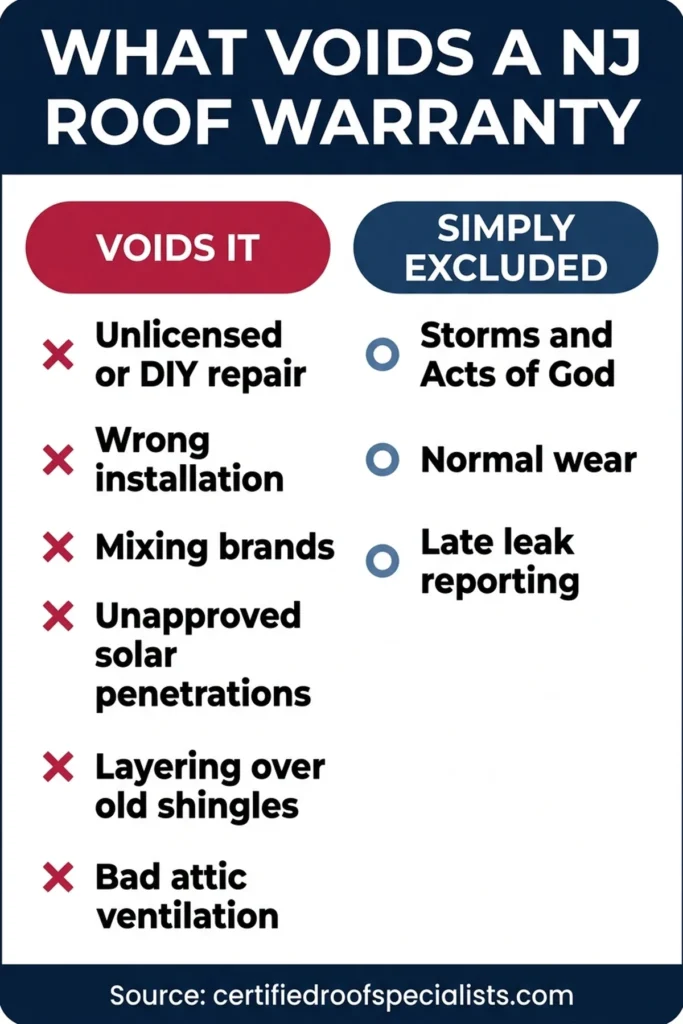
What Voids a Roof Warranty in NJ vs What Is Excluded
This distinction trips up most homeowners. “Voided” means an action you or another party took cancels coverage. “Excluded” means the warranty never covered that event in the first place. A storm does not void your warranty; it was never a covered cause.
| Actions that VOID coverage | Events that are EXCLUDED (never covered) |
|---|---|
| Repairs by an unlicensed contractor or DIY work | Storm, wind, hail, and other Acts of God (these go to homeowners insurance) |
| Wrong fastening pattern, overlap, or nailing depth | Normal wear and age-related deterioration |
| Mixing brands or product lines on one roof | Damage from foot traffic or equipment placed by others |
| Solar or other penetrations outside maker specs | Leaks reported after the warranty’s notice window |
| Layering new shingles over old when prohibited | Pre-existing structural or deck problems |
| Attic ventilation below the manufacturer’s requirement | Modifications to the structure after installation |
One important detail on the workmanship side: many NJ contractor warranties require written notice of a leak or defect within 30 to 90 days of discovery. Miss that window and a covered defect can still be denied, so report problems in writing as soon as you see them.
Ventilation, Solar, and the Claim Process
Ventilation. Most manufacturers require adequate attic ventilation for full coverage. NJ practice calls for roughly one square foot of net free vent area per 300 square feet of attic floor with balanced intake and exhaust. If a claim inspector finds ventilation below that, the maker can deny the claim. The standard is published by the NJ Division of Codes and Standards.
Solar. Panels attached outside the manufacturer’s flashing and penetration specs put coverage at risk on the affected sections. Require the solar installer to use approved methods and have your roofer review the plan first.
Before you file. Check two things: your warranty’s notice requirement, and whether any post-installation work has been done on the roof. Both directly affect eligibility. Manufacturer requirements like fastener count and placement are product-specific, and the specs are published by makers such as GAF; the National Roofing Contractors Association publishes installation best practices that back them.
Find out if your roof warranty is still intact
A free CRS inspection documents your roof's condition, flags any modifications, and notes ventilation and warranty-relevant issues in writing, before you ever need to file a claim.
How Long NJ Roof Warranties Last
Manufacturer warranties on architectural shingles run from 25 years to limited lifetime, depending on the product tier and whether a credentialed contractor installed them. Contractor workmanship warranties run from about 1 to 25 years.
The enhanced manufacturer warranties are tied to the installer’s credential. A standard licensed NJ contractor installing GAF shingles may register a mid-tier warranty, while the top-tier Golden Pledge requires the GAF Master Elite designation, which GAF states it limits to roughly 3 percent of contractors. The practical takeaway is not to chase a specific credential, but to ask any contractor what enhanced warranty they can register for your roof and to verify that credential directly with the manufacturer before you sign.
If you are not sure of your current roof’s warranty status, a free CRS inspection documents the condition, flags any modifications, and notes warranty-relevant issues in writing. See our roof replacement service and the NJ roofing warranty guide for the full breakdown.
NJ roofing warranty guide · Roof replacement service · Protection plans · Edison roofing
Last updated August 24, 2026. Written by the Certified Roofing Specialists Inc. team, licensed New Jersey roofing contractors serving Monmouth, Ocean, Middlesex, Somerset, and Union Counties. Warranty terms vary by manufacturer and contractor; confirm your specific coverage in writing.
Common questions
Frequently Asked Questions
Does DIY roof repair void a warranty in NJ?
Usually yes. Major manufacturers like GAF and CertainTeed require warranty work to be done by a licensed contractor following their installation specs. A DIY repair, even a simple shingle swap, can void coverage across the whole system if it deviates from those standards, regardless of whether the repair caused the problem.
Does bad attic ventilation void a roof warranty?
It can. Most major manufacturers require adequate attic ventilation as a condition of full coverage, because trapped heat accelerates shingle aging. If a claim is filed and the inspector finds ventilation below code, the manufacturer can deny it. NJ code calls for balanced intake and exhaust sized to the attic area.
Can adding solar panels void my NJ roof warranty?
Yes, if the panels penetrate the roof outside manufacturer specifications. To protect coverage, require the solar installer to use manufacturer-approved attachment and flashing methods, and have your roofer review the plan before work begins. Get that review done before installation, not after the holes are drilled.
-

Emergency Roofing in NJ: Storm Damage Response
Emergency roofing NJ: what to do after storm damage, how fast to get a tarp on, what it…
-
Community Association Roofing in NJ: A Property Manager’s Guide
Community association roofing NJ: a property manager guide to multi-building bids, board-ready scopes, reserve-study documentation, and scheduling.
-
Insurance Claim for an Old Roof in NJ: What to Know
Insurance claim for an old roof in NJ: how age cuts your payout, ACV vs RCV explained, what…